From design to toy · 1990s
GigaRhinos: The Parts That Became a Cannon
Five vehicles become a robot, but their equipment has somewhere else to go. A toy-size problem gave GigaRhinos its great combined cannon.
- From the world of
- Seijuu Sentai Gingaman
- Toy maker
- Bandai
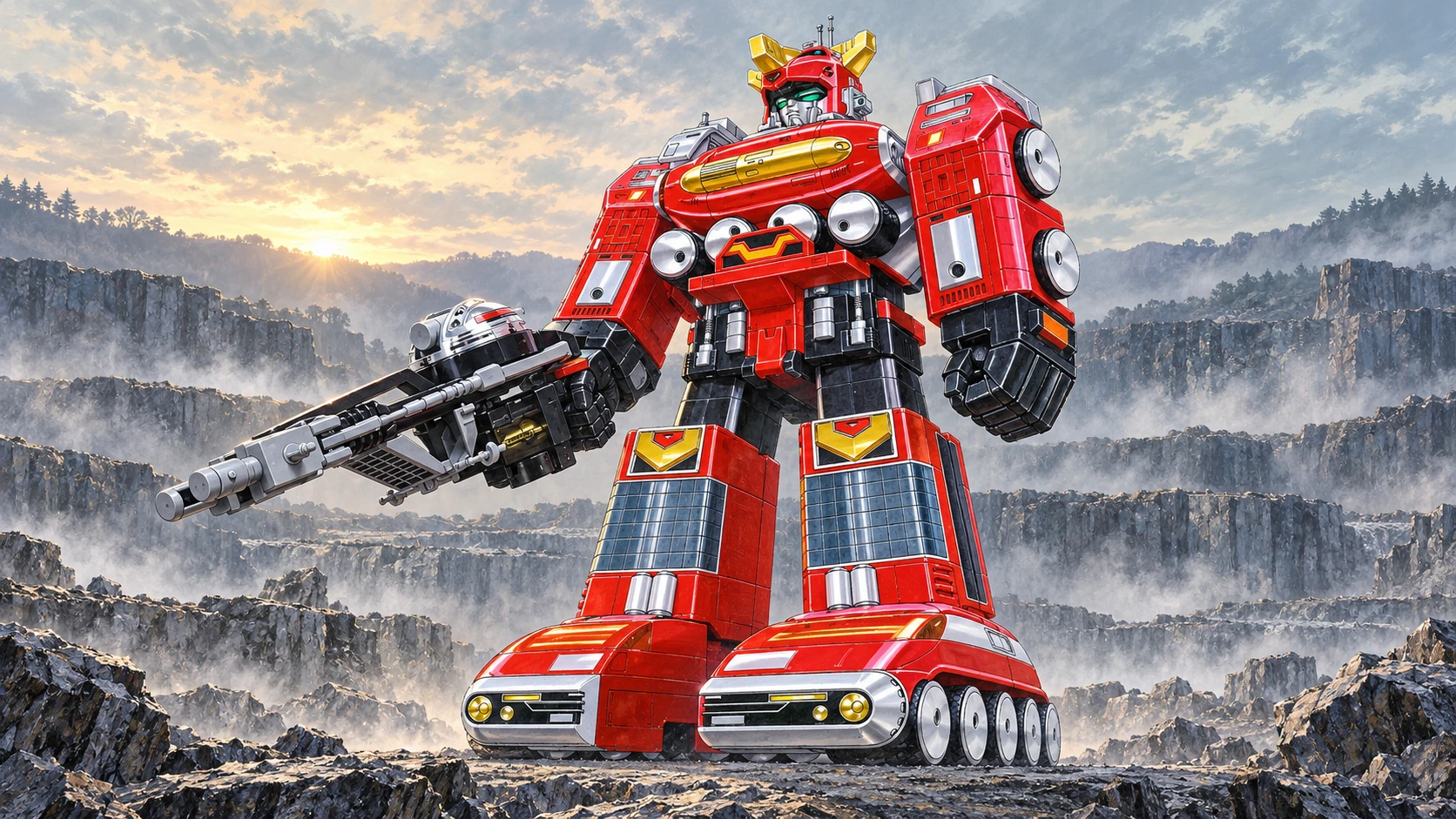
GigaRhinos in an imagined quarry. A new illustration based on the finished design and original toy; documentary images follow.
AI cover illustration · Rewind: Northwest RetroDesign reference ↗01 / The design
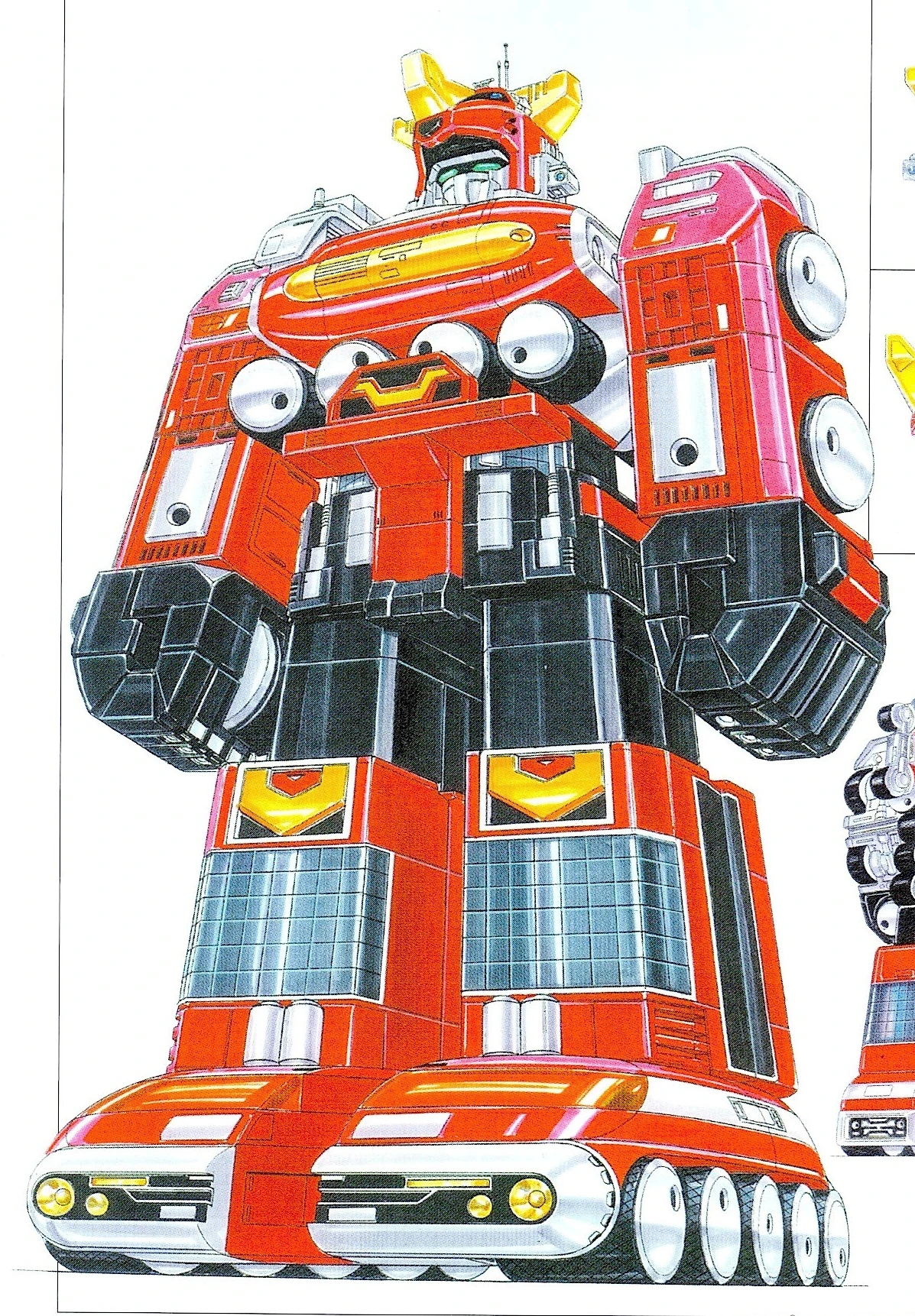
Follow the visible wheels: the five vehicles remain legible inside the finished robot.
Super Sentai Art Collection · MediaWorks, 2002 · printed p. 044 · PDF p. 52
02 / The toy
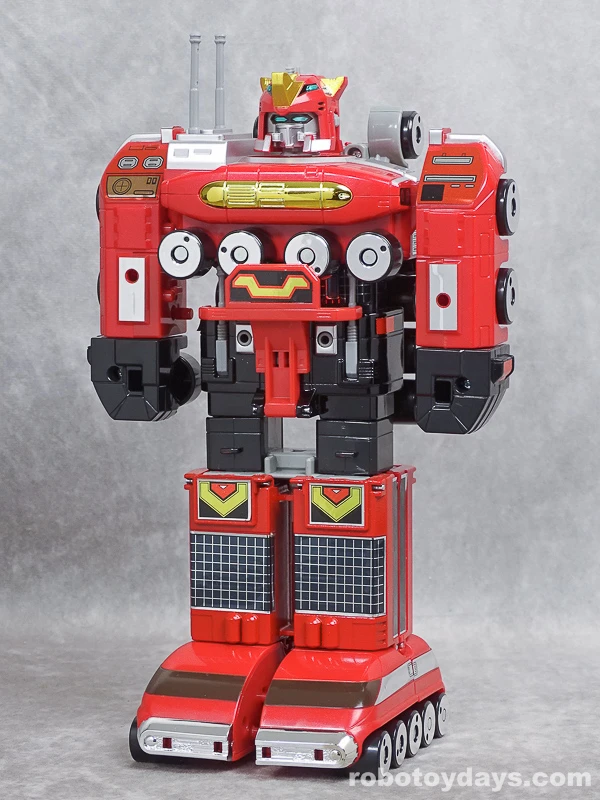
The original Japanese DX Chogokin toy, assembled from five GigaWheels.
A cannon from the parts left over
Five vehicles have become one robot. Now there is another assembly to do: the equipment taken off their roofs becomes Gigantis Buster, GigaRhinos’s enormous cannon.
That second build grew out of a practical problem. The artbook says these parts were originally meant to stow inside the body. Product-size constraints and related issues led to removing them during combination instead—and the cannon was born. Look at the silver dome and the pair of long working arms: details that give the vehicles character become the weapon’s most recognizable features. Artbook, p. 044.
The photographs show Bandai’s original Japanese GD-13 DX Chogokin Ju-Riku Gattai GigaRhinos. Its box promises five combining GigaWheels. This is the full combining set, distinct from the miniature vehicles supplied with GigaBitus. Original package and toy.
Look closer
One more thing to build
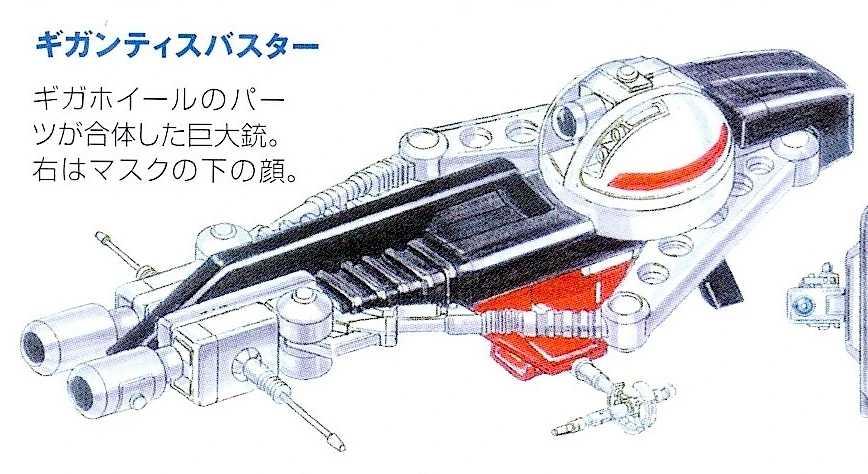
Gigantis Buster: the vehicle fittings become one long weapon.
Super Sentai Art Collection · MediaWorks, 2002 · printed p. 044 · PDF p. 52
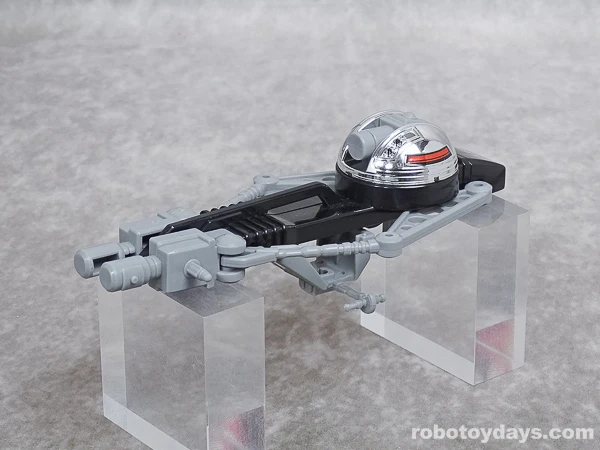
Equipment off, weapon on
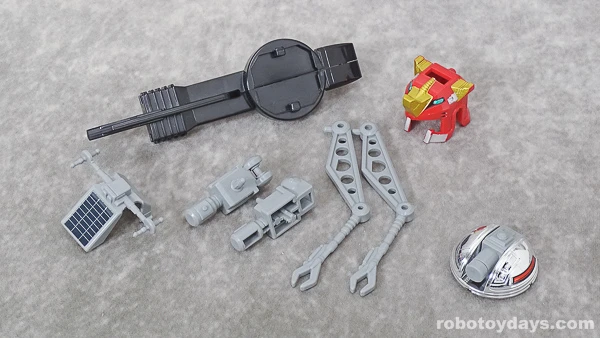
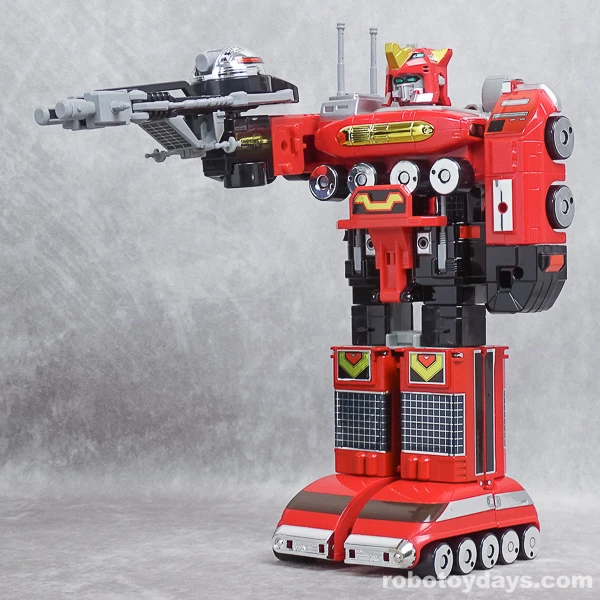
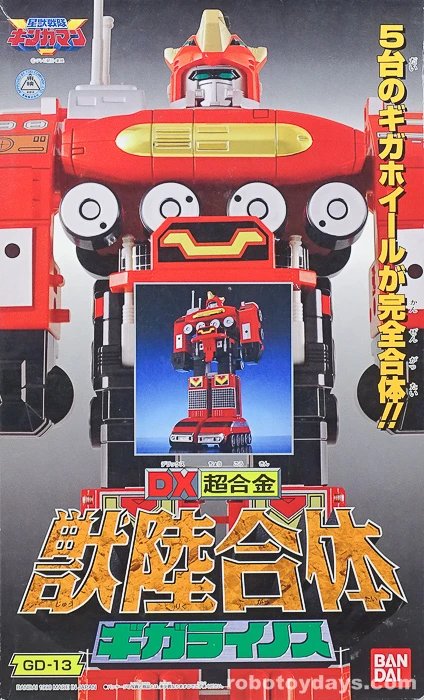
Three vehicles through the middle
In Seijuu Sentai Gingaman, the five GigaWheels unite as the Steel Starbeast GigaRhinos, which joins the heroes in chapter 30. Its cannon fires plasma rounds in the story. Artbook, p. 044.
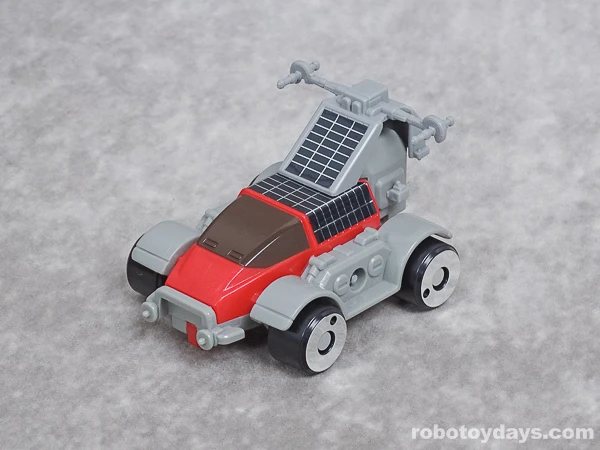
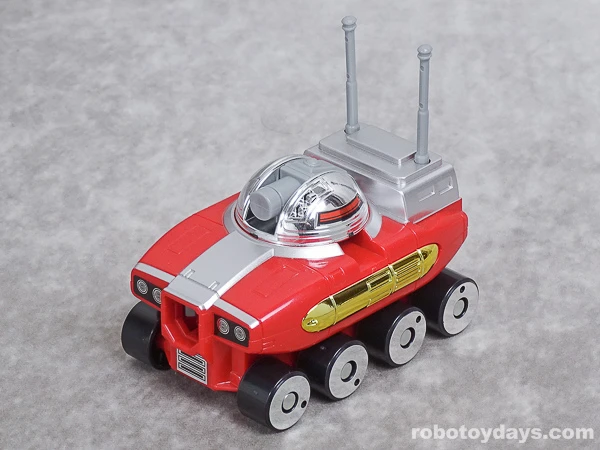
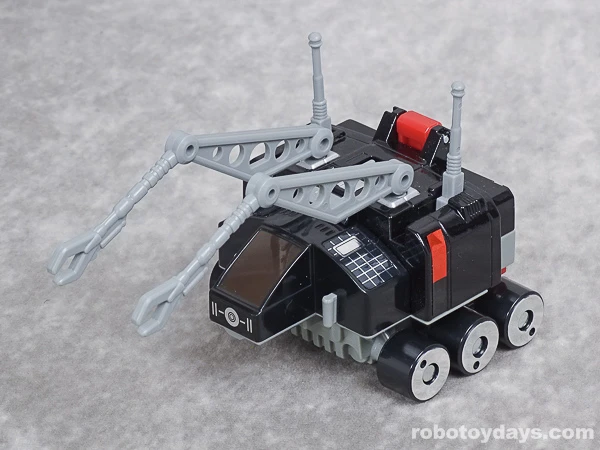
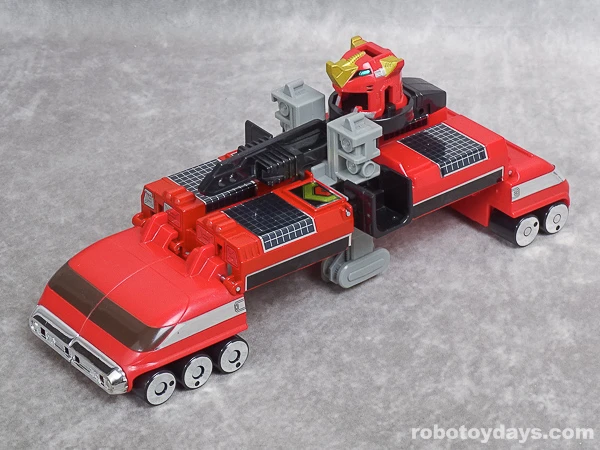
Start with the three central machines. GigaWheel 1 supplies the head and back, 2 the chest, and 3 the waist. The gold oval makes the chest vehicle especially easy to track. Below it, the black body remains visible between the red arms and legs. Each pair of pictures lets you follow a vehicle from drawing to manufactured component. Original toy and combination photographs.
Look closer
1 / Head and back
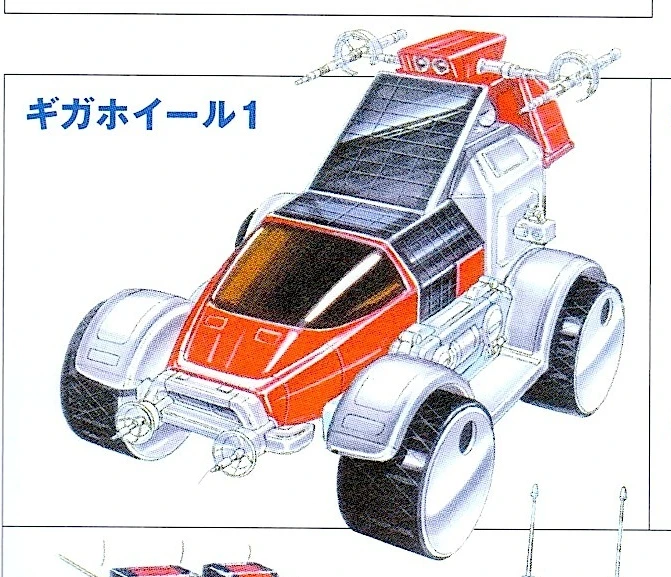
GigaWheel 1 design. The sloping dark panel belongs to the small buggy. Its rear conceals the robot head.
Super Sentai Art Collection · MediaWorks, 2002 · printed p. 044 · PDF p. 52
2 / Chest
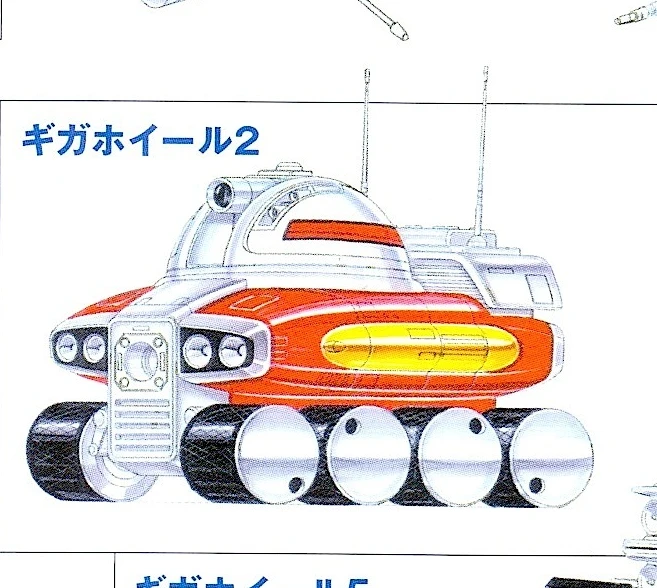
GigaWheel 2 design. The gold oval stays at the center of the chest; the wheels remain visible beneath it.
Super Sentai Art Collection · MediaWorks, 2002 · printed p. 044 · PDF p. 52
3 / Waist
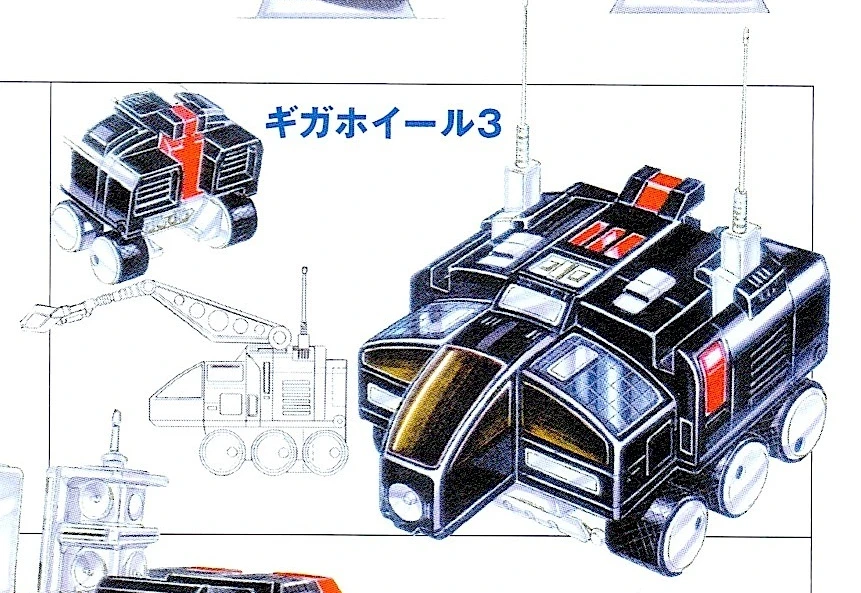
GigaWheel 3 design. The black vehicle forms the middle of the robot. Its long working arms detach.
Super Sentai Art Collection · MediaWorks, 2002 · printed p. 044 · PDF p. 52
One vehicle for both arms, one for both legs
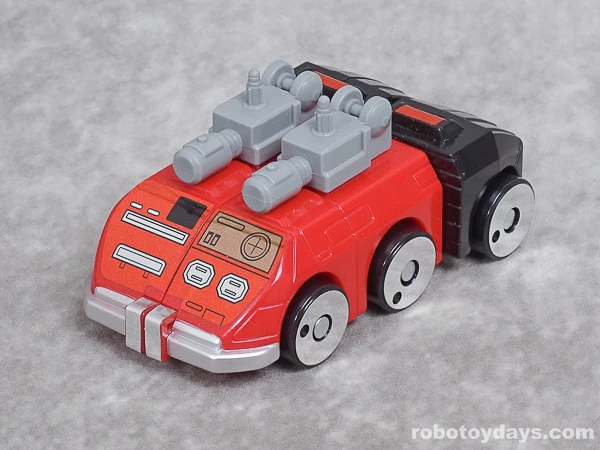
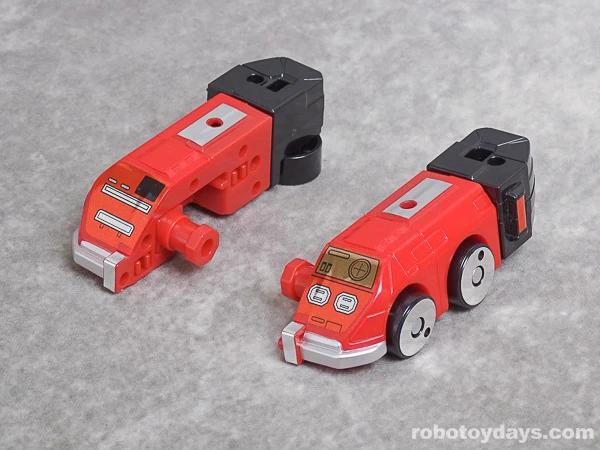
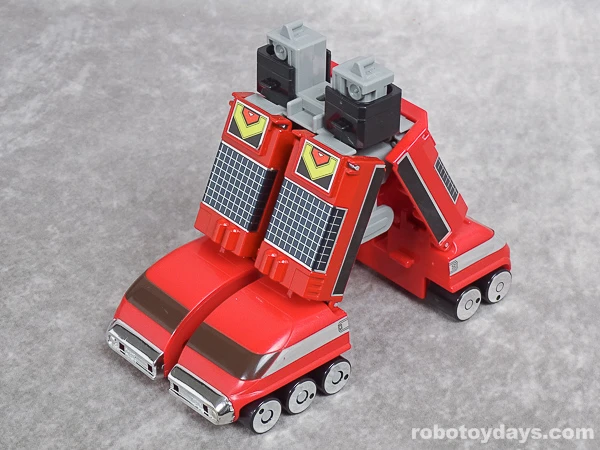
The last two machines divide the work differently. GigaWheel 4 splits lengthwise to make both arms. Its black rear sections become the fists. GigaWheel 5 supplies the entire lower body: the broad front separates into two feet, and the trailer folds upward into legs. The intermediate toy views catch both changes. Original combination photographs.
The wheels do not disappear into the robot. They become a repeated circular pattern across its chest, arms and feet. The artbook singles out the DX toy’s 34 tires, all made as separate parts. Even standing still, GigaRhinos looks like a fleet that has just pulled together. Artbook, p. 044.
Look closer
4 / Both arms
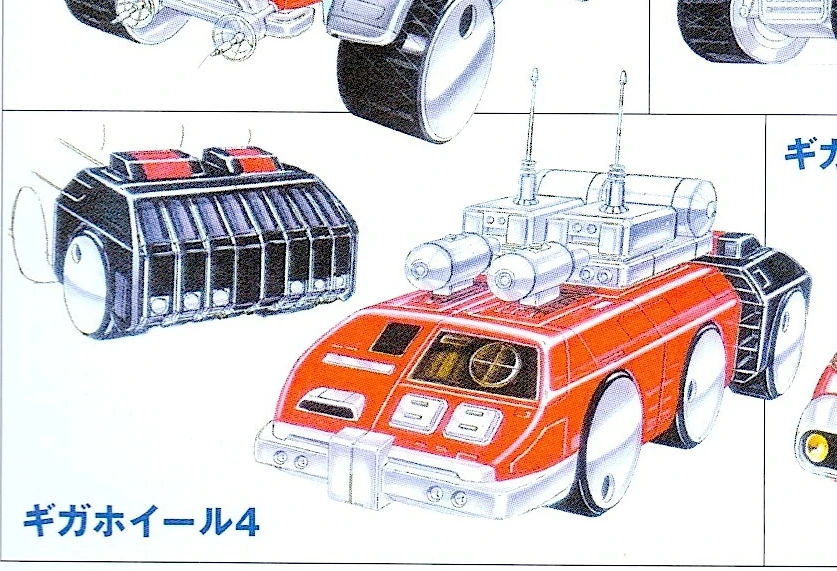
GigaWheel 4. Its broad black rear divides into two fists.
Super Sentai Art Collection · MediaWorks, 2002 · printed p. 044 · PDF p. 52
5 / Both legs
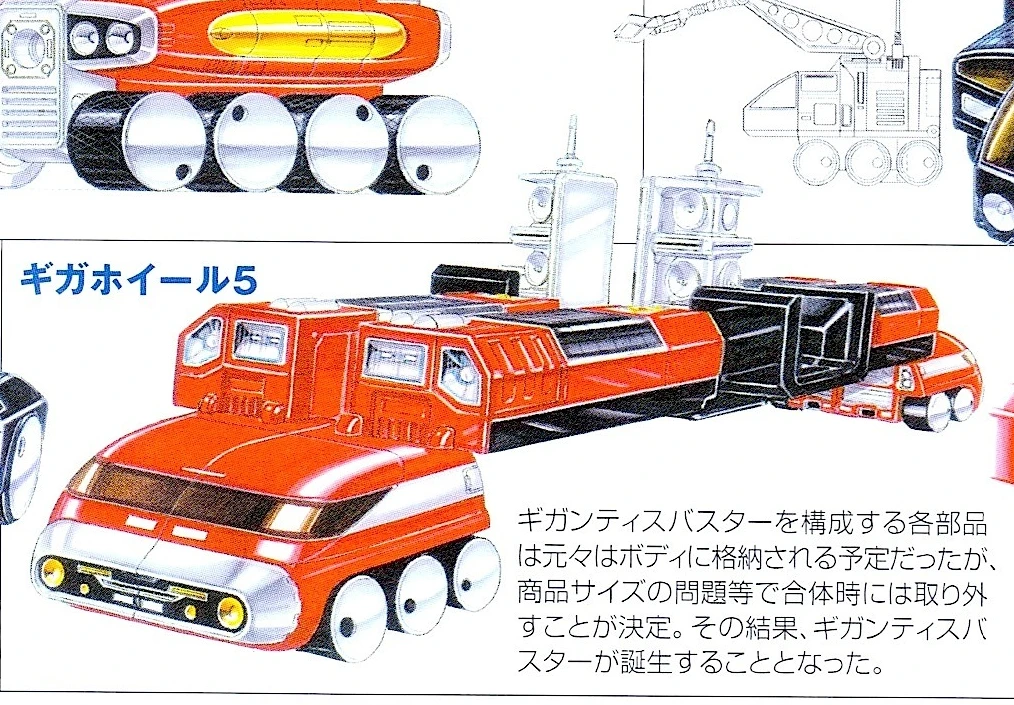
GigaWheel 5. The wide vehicle nose will become the two feet.
Super Sentai Art Collection · MediaWorks, 2002 · printed p. 044 · PDF p. 52
Explorers with a rhino’s name
The early vehicles look equipped to investigate somewhere. Drawings 34–41 explore domes, working arms, opening bodies and a long trailer. The book’s caption points to solar panels and working arms and suggests a planetary-exploration image. That is a reading of the designs, rather than a list of fictional missions.
Below them, drawings 42–43 show GigaRhinos’s Starbeast form: a muscular, two-legged rhino. Set beside the vehicles, it makes the finished helmet’s animal identity easier to see. These are creature drawings, not an additional transformation of the photographed toy. The eventual design combines a rhino’s face with a body whose vehicle parts stay conspicuous. Early Sketches, p. 145.
Look closer
The equipment was part of the idea
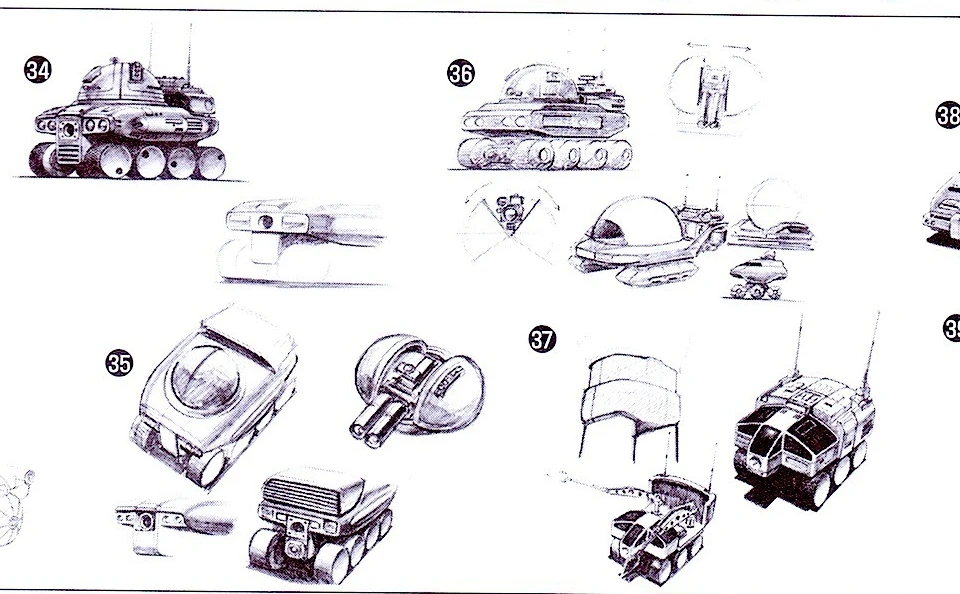
Studies 34–37 explore the chest vehicle, dome and opening body shapes.
Super Sentai Art Collection · MediaWorks, 2002 · printed p. 145 · PDF p. 153
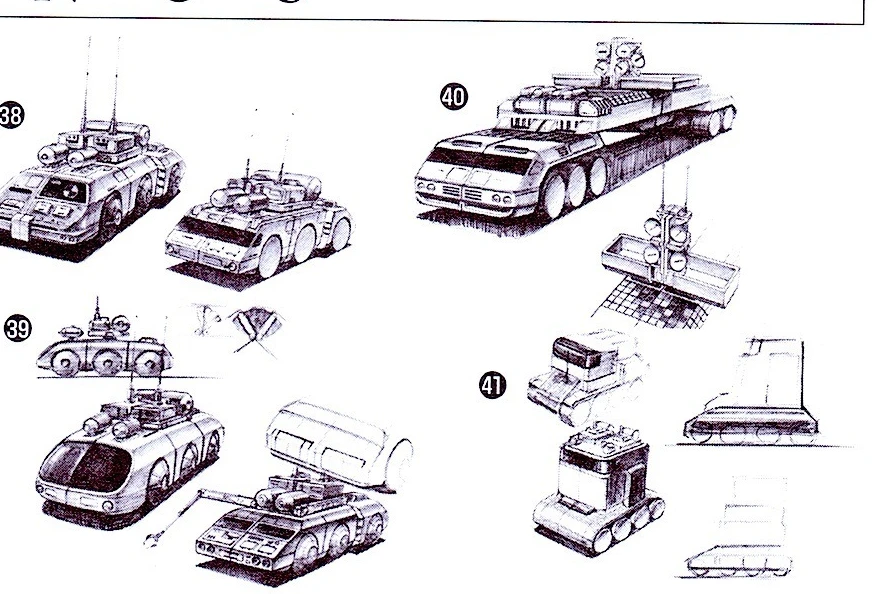
Studies 38–41 try vehicle bodies, a long trailer and equipment arrangements.
Super Sentai Art Collection · MediaWorks, 2002 · printed p. 145 · PDF p. 153
The rhino beneath the machines
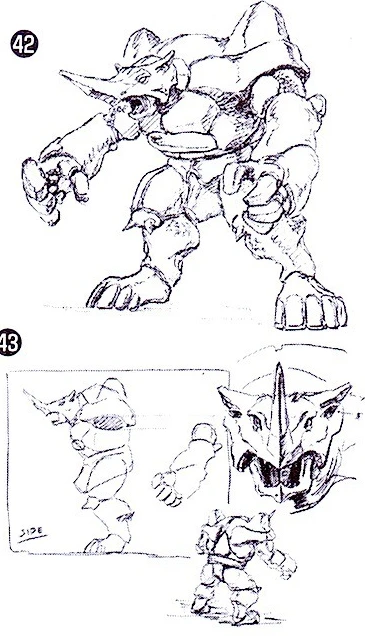
Drawings 42–43: GigaRhinos’s Starbeast form, a creature design rather than a demonstrated toy mode.
Super Sentai Art Collection · MediaWorks, 2002 · printed p. 145 · PDF p. 153
The last part is a face
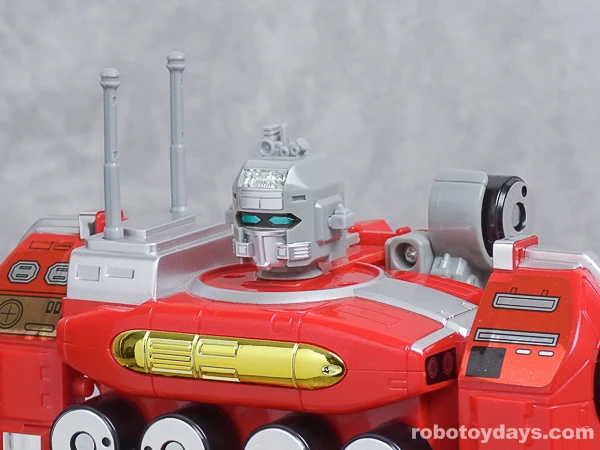
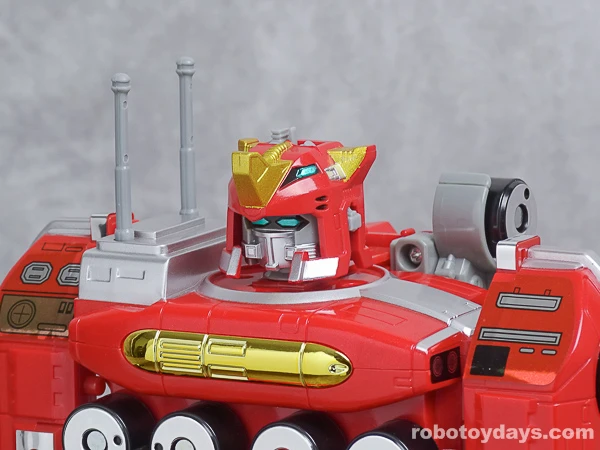
The red rhino helmet is removable too, but it has a different destination from the cannon fittings. Beneath it is a silver mechanical head, complete with green eyes and instruments above the brow. The finished drawing shows that inner face, and the original DX reproduces it. Artbook, p. 044.
The helmet gives the machine its animal expression. The cannon gathers up the equipment. What looked like a collection of parts to put aside becomes the final two steps of the transformation: arm the robot, then give it its face.
Look closer
Lift the helmet
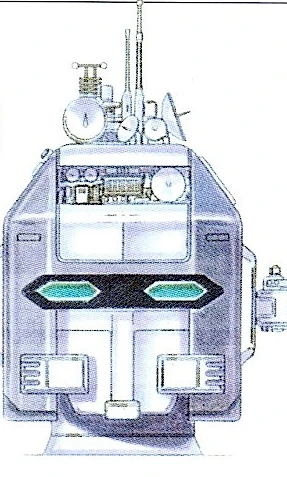
Under the red helmet: a silver face with instruments above the eyes.
Super Sentai Art Collection · MediaWorks, 2002 · printed p. 044 · PDF p. 52
Sources
- Super Sentai Art Collection — GigaRhinos · MediaWorks · 2002 · page 044 · scan page 52
- Super Sentai Art Collection — GigaRhinos early sketches · MediaWorks · 2002 · page 145 · scan page 153
- RoboToyDays — original Japanese Bandai GD-13 DX Chogokin GigaRhinos · RoboToyDays
Artwork and toy photographs are credited reproductions from published sources. This is a virtual exhibit.