From design to toy · 1994
Muteki Shogun
Five ninja guardians become a towering armored warrior. Follow Muteki Shogun from castle-shaped sketches to Bandai’s five-part combining toy.
- From the world of
- Ninja Sentai Kakuranger
- Toy maker
- Bandai
- Release year
- 1994
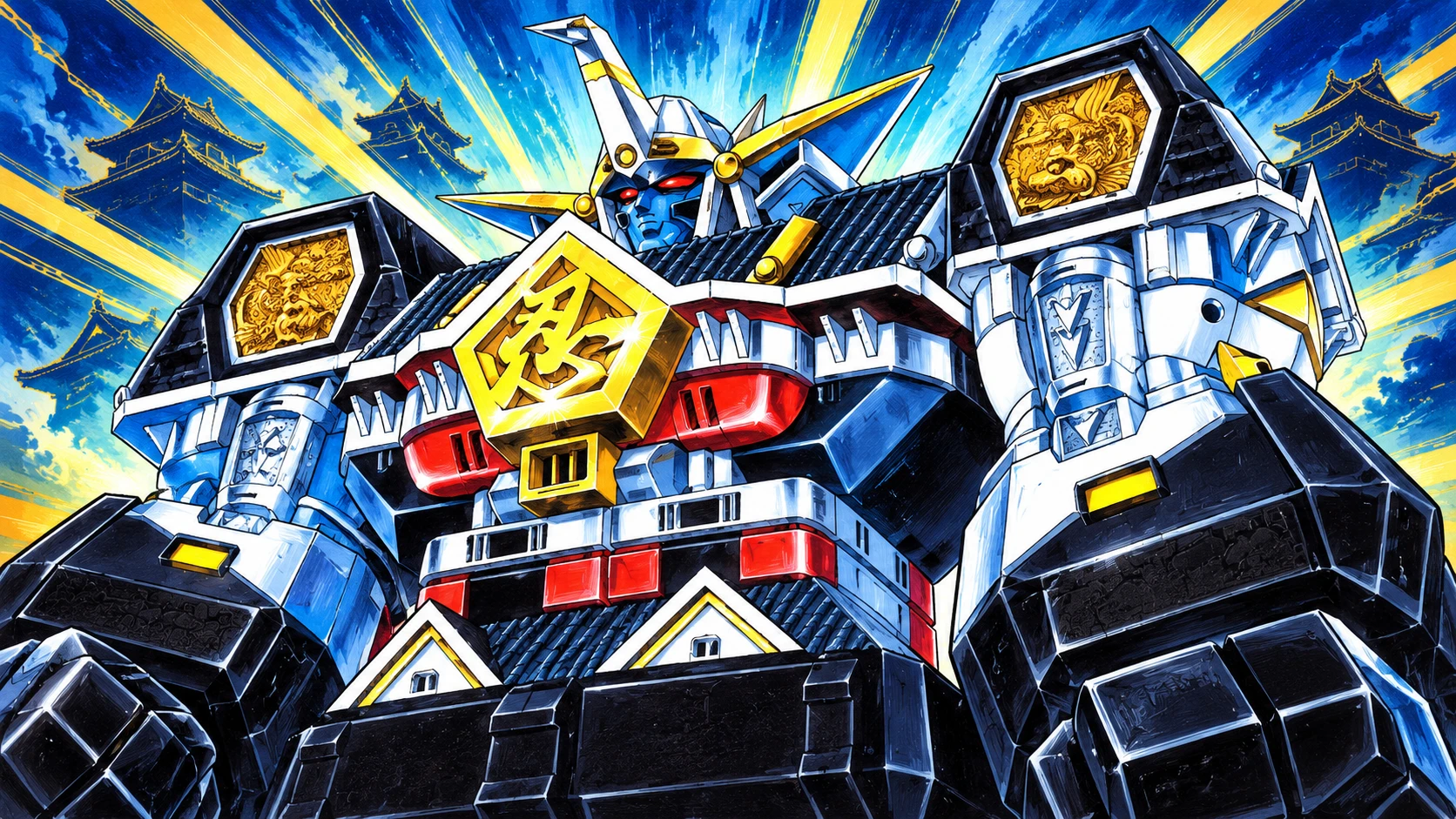
Original AI cover illustration inspired by the character design; historical artwork and toy photographs appear inside the article.
AI cover illustration · Rewind: Northwest RetroDesign reference ↗01 / The design
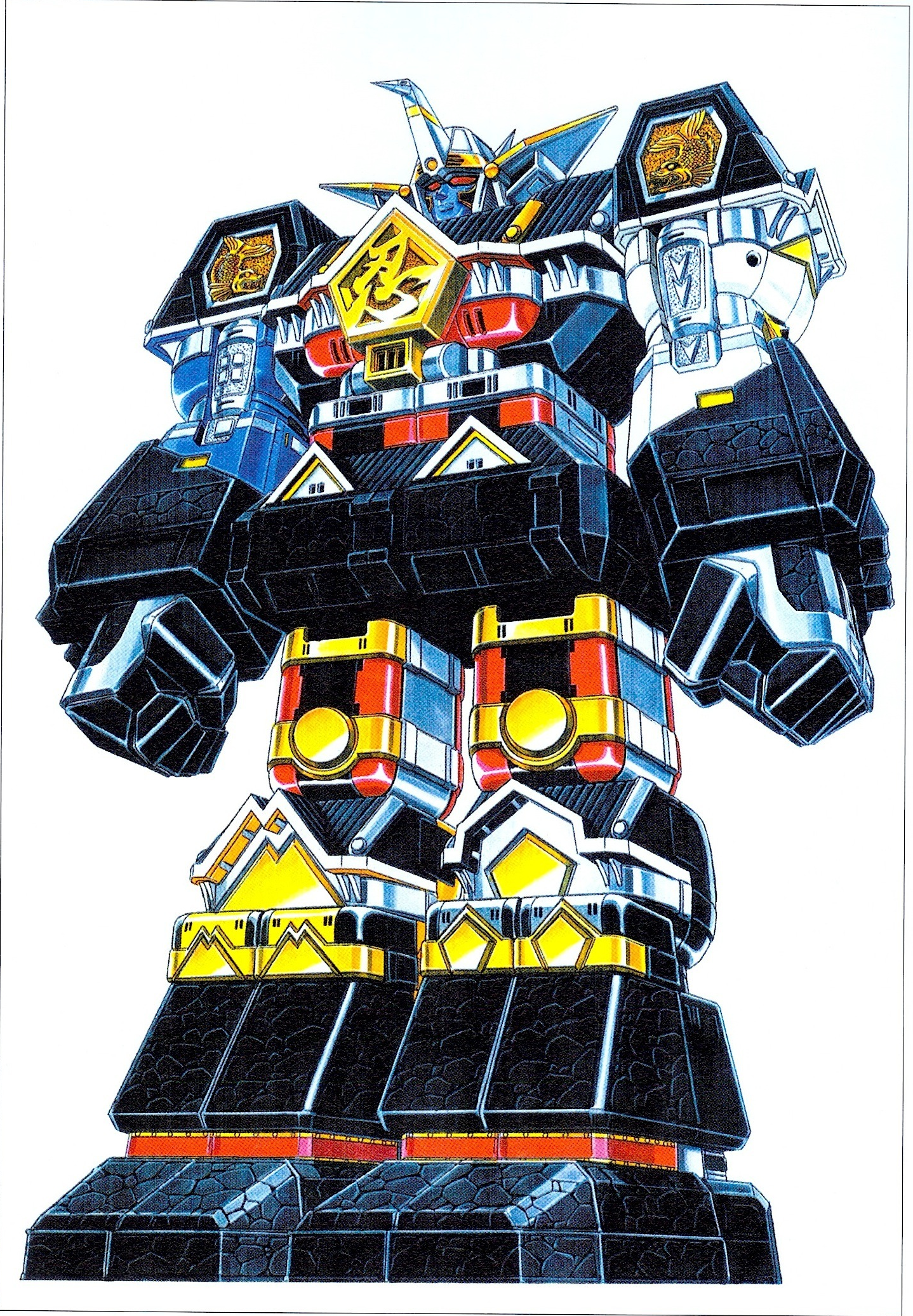
The finished design: an armored warrior with the roofs and stonework of a Japanese castle. Cropped from the artbook’s Muteki Shogun page.
Super Sentai Art Collection · MediaWorks, 2002 · printed p. 072 · PDF p. 80
02 / The toy
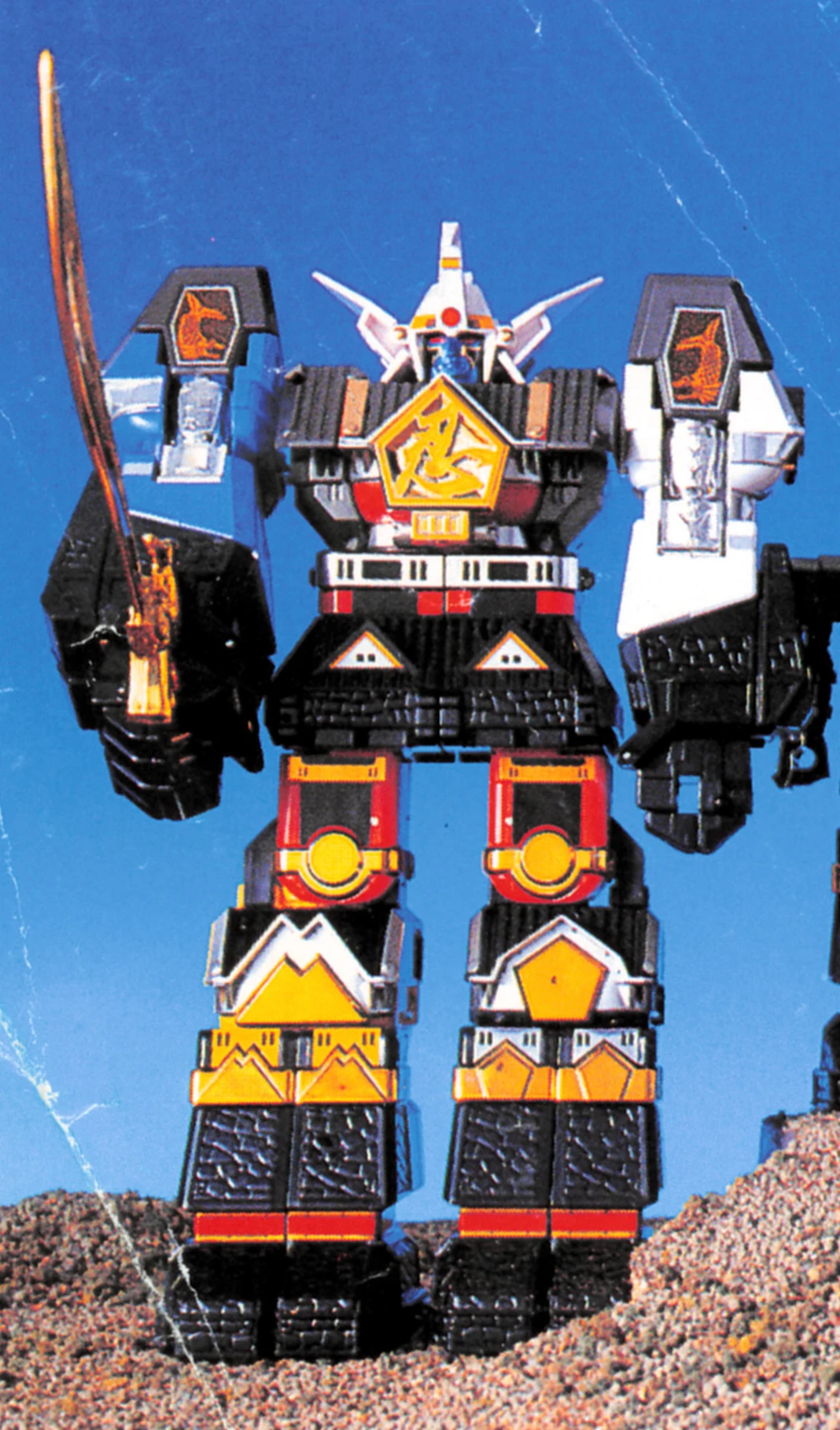
The catalog toy: Ninja Combination DX Muteki Shogun, pictured with its sword. This crop shows the standard combined robot.
1994 Bandai Catalogue · Bandai; scan by Gaming Alexandria · printed p. 3 · PDF p. 4
In the story
The seal has broken. Yokai are loose in modern Japan, and five young people inherit a fight that began centuries before they were born. That is the world of Ninja Sentai Kakuranger, the television series that introduced Muteki Shogun in 1994. Tsuruhime brings Sasuke, Saizou, Seikai, and Jiraiya together as a new ninja team. Their enemies can become enormous. Their answer needs to be enormous, too. Series synopsis — Toei Video.
Muteki Shogun is a guardian with an identity of its own. The artbook describes it as one of three divine generals, linked to the souls of sages who fought the yokai 2,000 years earlier. Among the trio’s qualities of mind, technique, and body, Muteki Shogun represents the body: physical power. Its weapon is the Kaen Shogun Ken, a great flaming sword.
Five giant guardians unite through “Ninja Combination” to take this form: Red Saruder, White Kark, Blue Logan, Yellow Kumard, and Black Gammer. Their red, white, blue, yellow, and black identities remain visible in the individual figures, but together they become a much darker, fortress-like warrior. The artbook shows each guardian’s animal-faced design alongside the combined robot. Artbook, pp. 072–073.
Before the combination
The five guardians deserve a look on their own. Red Saruder’s face has a monkey’s features; White Kark, Blue Logan, Yellow Kumard, and Black Gammer carry the crane, wolf, bear, and frog motifs into individual armored warriors. The finished front and rear views, head studies, and weapons appear in the images below. Artbook, p. 073.
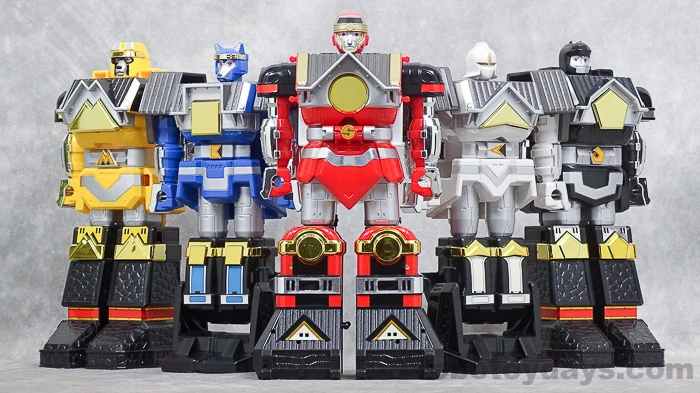
Beside those drawings, the original Japanese DX toy lineup shows five complete figures before they join. Their separate colors are much brighter than the assembled warrior’s dark castle armor. Follow the white and blue figures into the arms and the yellow and black figures into the legs in the photographed assembly. Toy photographs — RoboToyDays.
Look closer
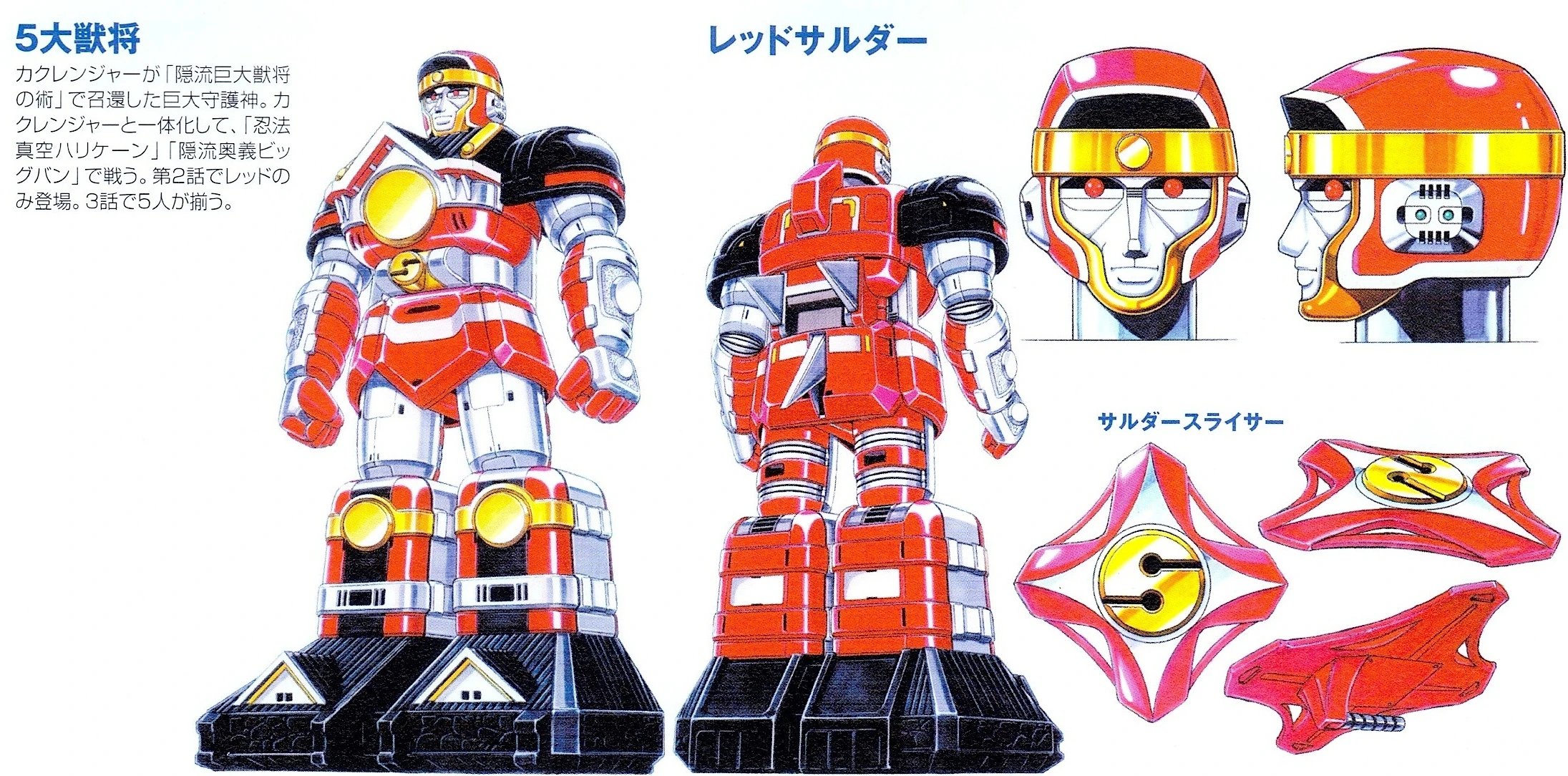
Red Saruder, shown separately with head and weapon studies. The red guardian has a complete identity before the five-part combination.
Super Sentai Art Collection · MediaWorks, 2002 · printed p. 073 · PDF p. 81
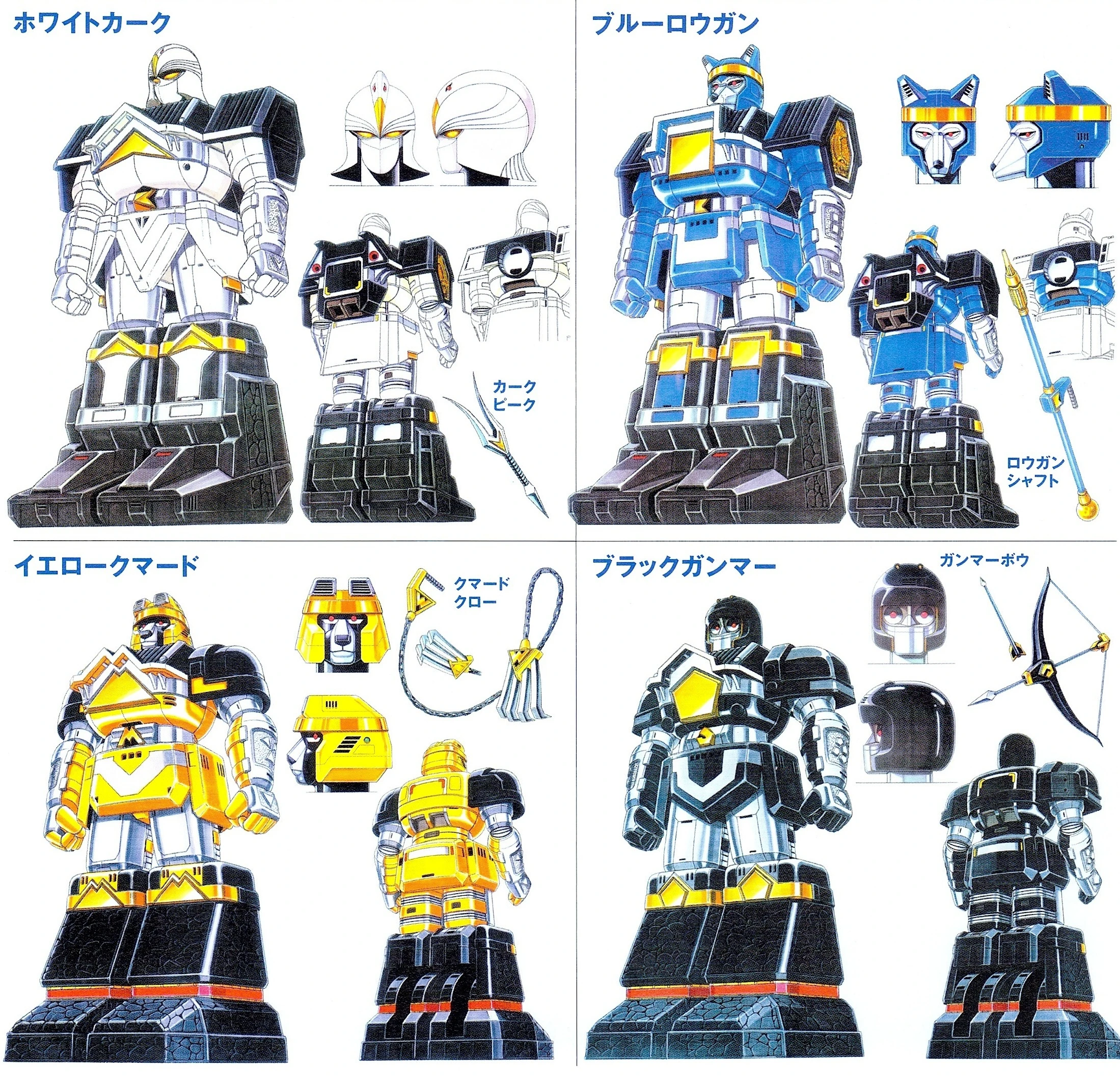
The other four guardians: White Kark, Blue Logan, Yellow Kumard and Black Gammer. Their crane, wolf, bear and frog motifs remain visible in the individual designs.
Super Sentai Art Collection · MediaWorks, 2002 · printed p. 073 · PDF p. 81
On the drawing board
Look at the finished artwork beside the catalog photograph. The flared black armor resembles tiled roofs. Small triangular gables sit at the waist and shins, and the feet have the texture of stone foundations. The gold emblem on the chest gives the eye somewhere to land amid all that architecture. These are features visible in the images, and they make the robot read like a building that has stood up and drawn a sword.
The early sketches make that connection explicit. The captions for drawings 39–41 describe an initial aim: five ninja robots, each approximately the same height, combining into an armored warrior. Drawings 42–44 introduce the castle motif. The accompanying note says the design was originally intended to transform into an actual castle as well.
That is the fascinating fork in the design’s path. One sketch looks almost entirely like a tiered keep on legs; others search for a balance between architecture and a human-shaped warrior. The later studies bring the animal-faced guardians back into the design. The book notes that the chest and shoulder accents were still absent in drawings 54–56. The finished color artwork lets us see how much those bright details contribute.
The drawings document ideas considered during development. They do not establish that a castle-transforming toy was manufactured. The catalog presents the five-robot combination instead. Early sketches, p. 149.
Look closer
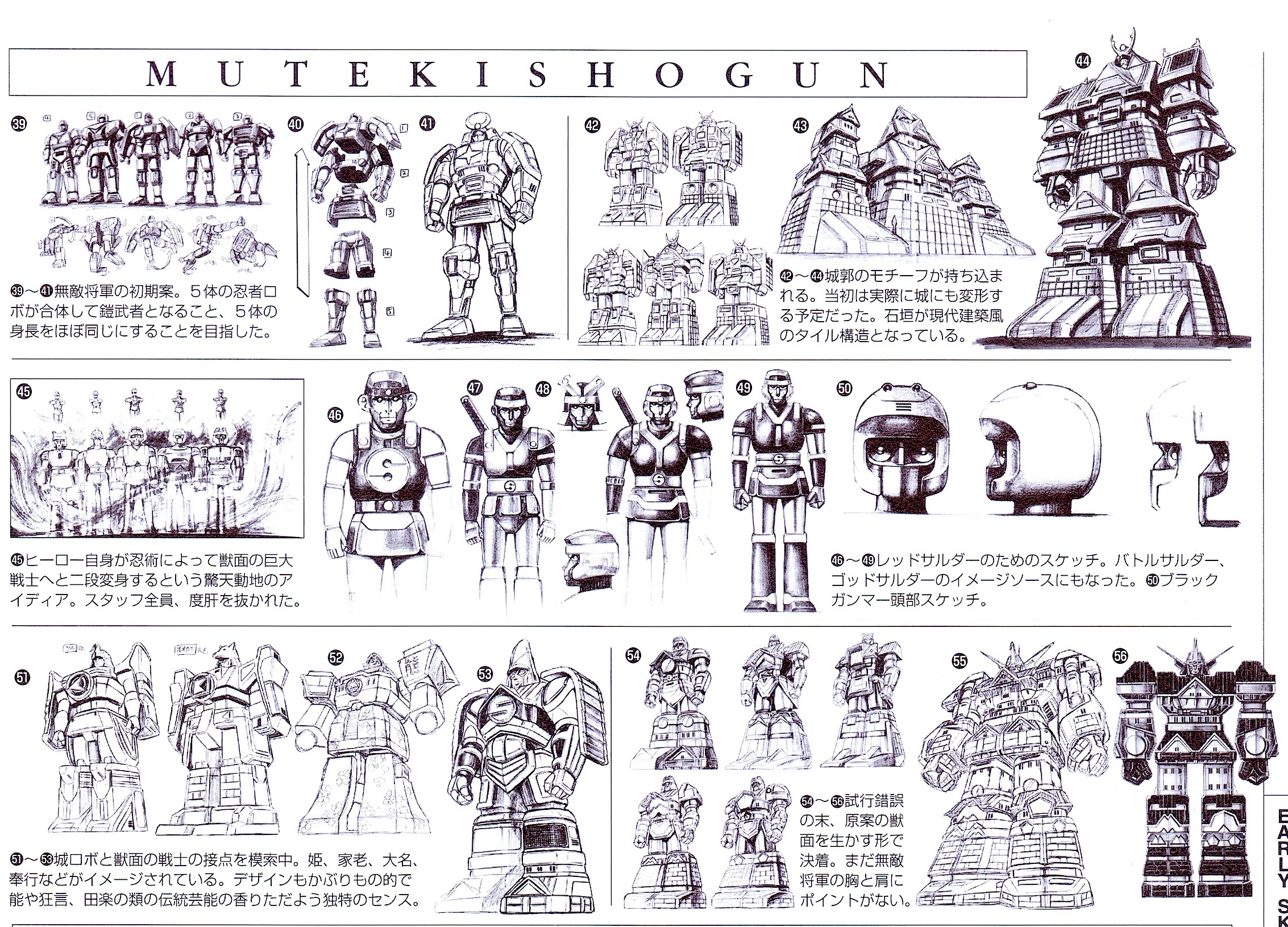
Early sketches 39–56. At the upper right, a literal castle stands beside a castle-shaped robot. Later drawings bring the animal-faced warriors and architectural armor together. Cropped to the Muteki Shogun section.
Super Sentai Art Collection · MediaWorks, 2002 · printed p. 149 · PDF p. 157
On the toy shelf
Bandai’s 1994 catalog names the product Ninja Combination DX Muteki Shogun (忍者合体 DX無敵将軍) and lists it at ¥7,800. The product description promises five combining guardians, the Kaen Shogun Ken, and weapons for the individual guardians. That price is the catalog’s historical listing, not a present-day collector value. Bandai catalog, printed p. 3 / PDF p. 4.
The toy carries over the design’s most recognizable features: broad black armor, a blue face under the pointed helmet, red legs, gold trim, and the prominent chest emblem. In the catalog photograph, the five-part construction gives the robot a straighter, more upright stance than the dramatic low-angle illustration. The two images let you compare the character’s visual identity with the physical object made to come apart and combine again.
The artbook adds two details about the DX set: the package had a carrying strap, and the five guardians’ weapons could also combine into a weapon for the larger robot. The play extended beyond assembling the body; even the accessories participated in the combination. Artbook, p. 072.
This pairing follows the original Japanese DX Muteki Shogun. The surrounding catalog pages also show other Kakuranger toys and powered-up combinations; those are separate subjects. Here, the connection is direct: the same guardian, its documented design development, and the Bandai toy that brought its five-part transformation into play.
In the advertisement
The commercial shows the separate guardians and their assembly into DX Muteki Shogun. This excerpt is from a compilation of Japanese Kakuranger product advertisements.
See the separate guardians assemble into DX Muteki Shogun.
Sources
- Super Sentai Art Collection: Sentai Robo Edition 1975–2002 — Muteki Shogun and the five guardians · MediaWorks · 2002 · page 072–073 · scan page 80
- Super Sentai Art Collection — Early Sketches: Muteki Shogun · MediaWorks · 2002 · page 149 · scan page 157
- 1994 Bandai Catalogue — Ninja Combination DX Muteki Shogun · Bandai · 1994 · page 3 · scan page 4
- Ninja Sentai Kakuranger DVD Collection Vol. 1 — series synopsis and broadcast period · Toei Video
- DX Muteki Shogun advertisement excerpt · G RAISER(ジーライザー) / YouTube
- Super Sentai Art Collection — Five Muteki Shogun guardians · MediaWorks · 2002 · page 073 · scan page 81
- RoboToyDays — original Bandai DX toy photographs · RoboToyDays
Artwork and toy photographs are credited reproductions from published sources. This is a virtual exhibit.