From design to toy · 1990s
Won Tiger: From Statue to Giant Warrior
A tiger statue becomes a transforming warrior—and the heart of Kiba Daioh. Follow the early sketches through the finished designs and Bandai’s original combining toys.
- From the world of
- Gosei Sentai Dairanger
- Toy maker
- Bandai
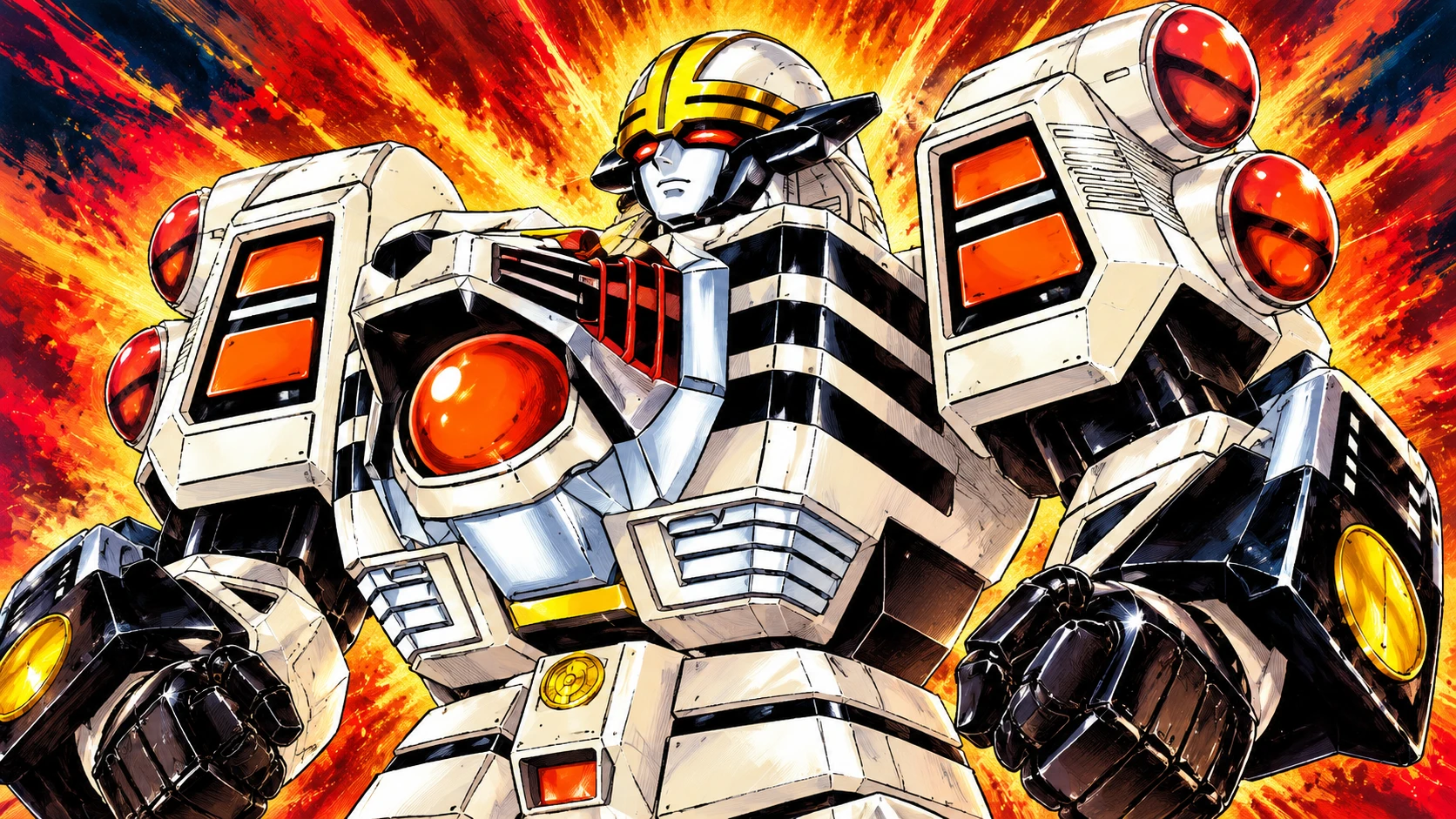
Original AI cover illustration inspired by the character design; historical artwork and toy photographs appear inside the article.
AI cover illustration · Rewind: Northwest RetroDesign reference ↗01 / The design
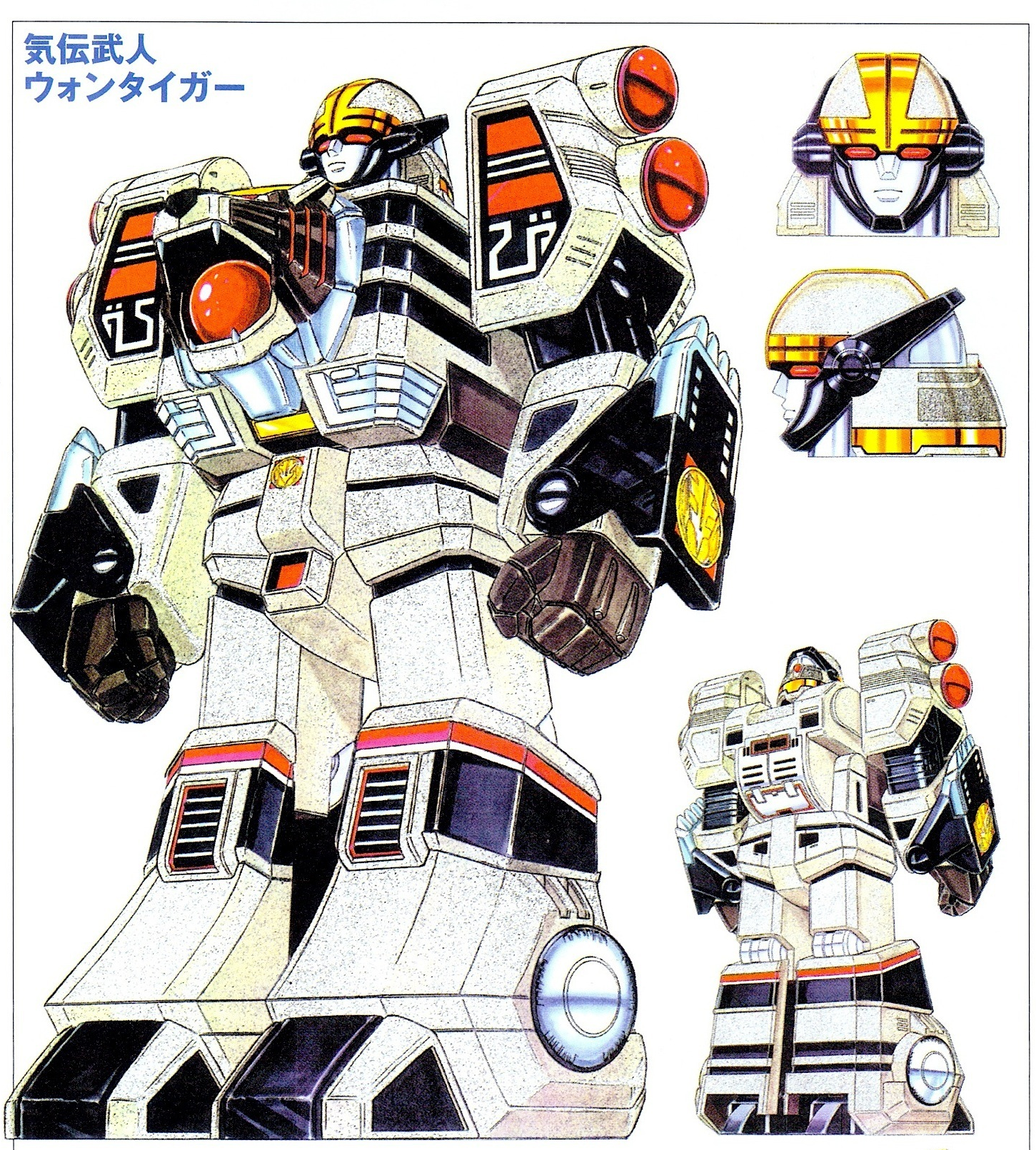
Won Tiger’s finished warrior design, with rear-view and helmet studies. Its white armor, dark stripes, and round shoulder details remain readable from several angles.
Super Sentai Art Collection · MediaWorks, 2002 · printed p. 083 · PDF p. 91
02 / The toy
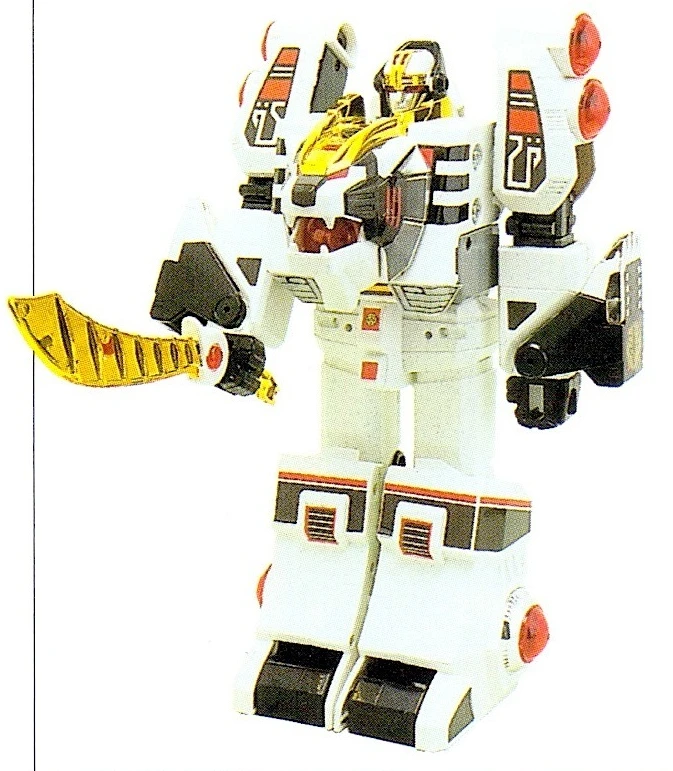
DX Won Tiger holding its Golden Sword. This crop comes from the original artbook scan, preserving the white armor’s printed surface detail.
Super Sentai Art Collection · MediaWorks, 2002 · printed p. 083 · PDF p. 91
On the drawing board
The first idea was surprisingly still. The caption for drawings 11–13 describes a combination in which the new warrior takes over the larger robot’s body, continuing an approach used for the previous year’s Goryujin. In that concept, the tiger was fixed to a stone pedestal, with the warrior’s limbs concealed inside the base. The book describes it as a tiger statue, rather than a tiger itself. Early sketches, p. 150.
Drawings 14–16 continue that statue theme. Their caption compares the beast form to a fixed icon or sculpture: it would begin moving only after transforming into a warrior. Compare the squat seated study with the tall armored figures around it. The immobile form and active warrior were being developed as two different expressions of the same subject. Early sketches, p. 150.
The next group, drawings 17–20, begins exploring a tiger form more directly. The caption describes an armored image for drawing 18 and identifies 19 and 20 as its warrior and Kiba Daioh modes. In drawings 21–23, paired spheres on the shoulders already resemble the circular details in the finished artwork. The caption proposes swapping these with the orb inside the tiger’s mouth to reveal characters such as fire and water. That proposal belongs to the development account; it does not establish an interchangeable-orb mechanism in the displayed DX toy. Early sketches, p. 150.
Look closer
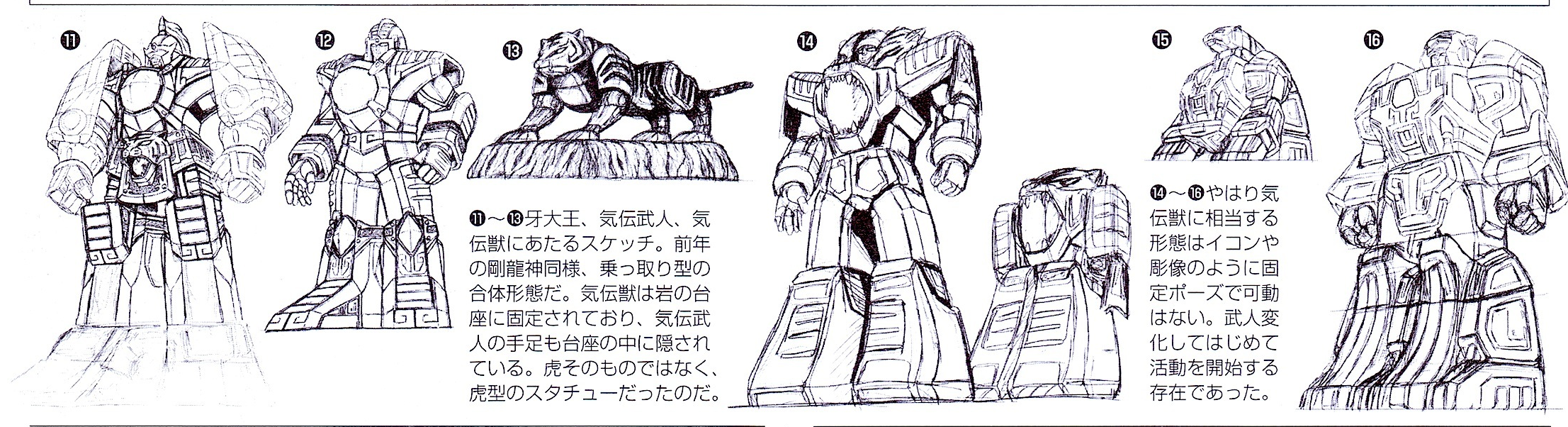
Drawings 11–16 explore the early statue concept. The captions describe a tiger fixed to a stone pedestal and later concepts whose beast form remains motionless until it changes into a warrior.
Super Sentai Art Collection · MediaWorks, 2002 · printed p. 150 · PDF p. 158
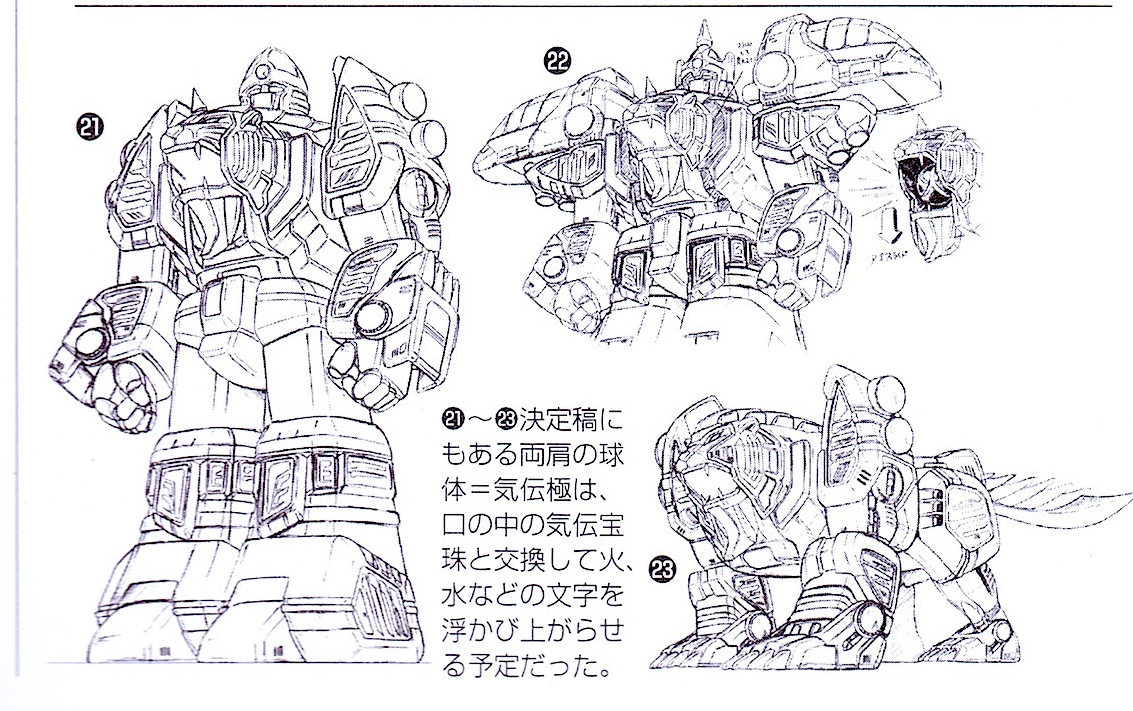
Drawings 21–23 carry the paired shoulder spheres toward the final design. Their caption proposes exchanging them with the tiger’s mouth orb to display characters such as fire and water. This documents a design idea, rather than a verified feature of the photographed toy.
Super Sentai Art Collection · MediaWorks, 2002 · printed p. 150 · PDF p. 158
In the story
The artbook identifies Won Tiger as the sixth Kiden Beast and records its debut in episode 21. It transforms into a Kiden Warrior and fights with the Golden Sword (Ogon Ken). The accompanying finished designs show both the four-legged tiger and the upright warrior. These describe the fictional character; the paired product photograph shows its DX toy interpretation. Artbook, p. 083.
Won Tiger also joins Tenku Kiden, the formation made from the four companion beasts featured in the Dairenoh exhibit. Their New-Star Combination creates Kiba Daioh, first combined in episode 22. The blue and yellow lower legs and the creature-shaped shoulders distinguish that combined warrior from Won Tiger alone. The opening design and toy pair show Won Tiger’s individual warrior form; the images below show Kiba Daioh in both artwork and assembled toys. Artbook, p. 082.
Look closer
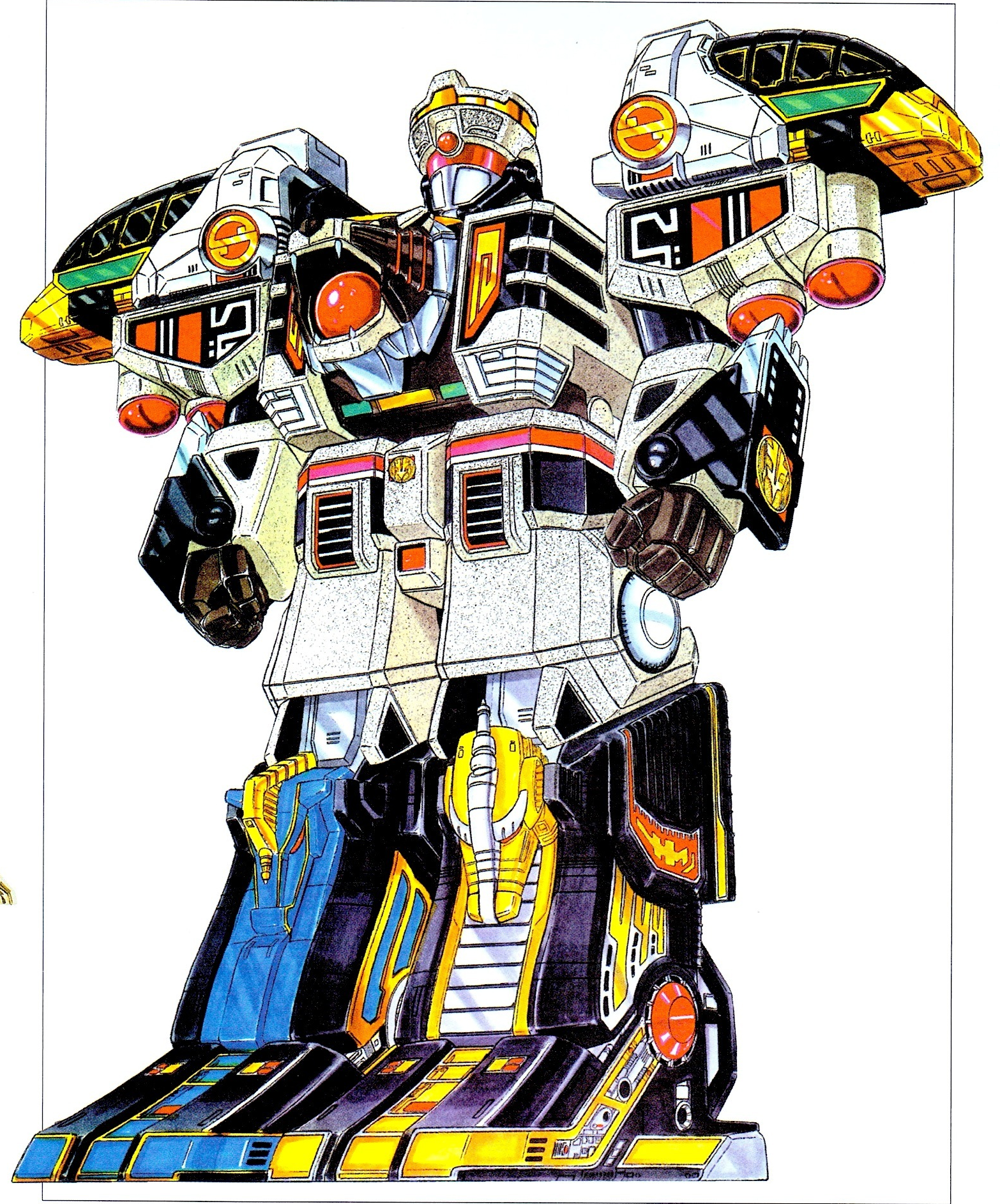
A bigger combination: Won Tiger joins Tenku Kiden to become Kiba Daioh. The white central warrior gains bird-headed shoulders and the companion beasts’ colored lower legs.
Super Sentai Art Collection · MediaWorks, 2002 · printed p. 082 · PDF p. 90
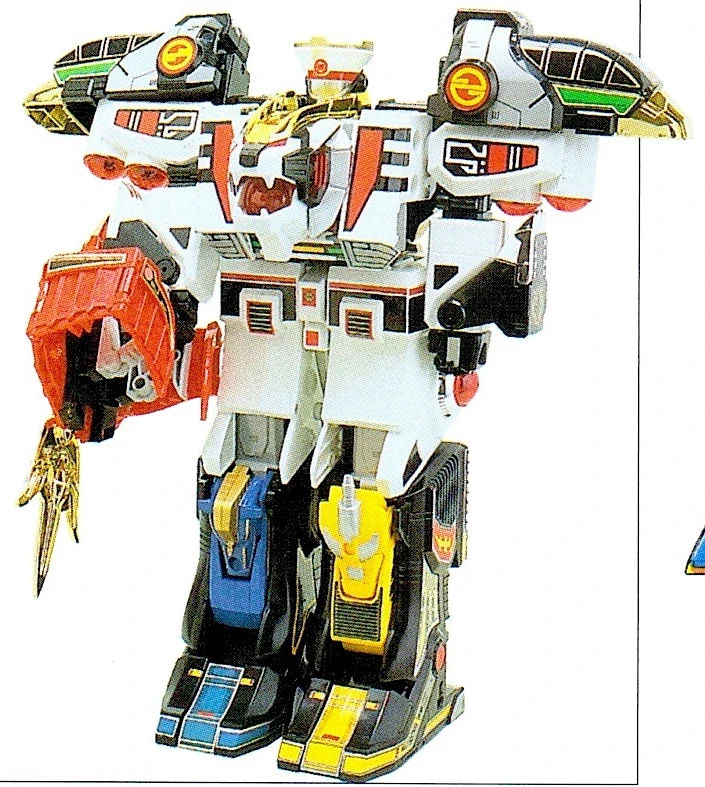
The combining toy shown beneath the artbook’s Mythical Qi Beast Great Combination Set heading. The red Star Phoenix forms its arm-mounted weapon. This is the lower product photograph on page 082.
Super Sentai Art Collection · MediaWorks, 2002 · printed p. 082 · PDF p. 90
From tiger to warrior
The finished four-legged design and the matching DX tiger photograph can be compared with the opening warrior views and the Kiba Daioh images above. Compare the long gold tail, striped armor, and round red details across the beast and warrior forms. These are two configurations of Won Tiger; Kiba Daioh adds the four companion beasts, whose separate designs are also shown below. Artbook, pp. 081–083; DX tiger photograph — RoboToyDays.
Look closer
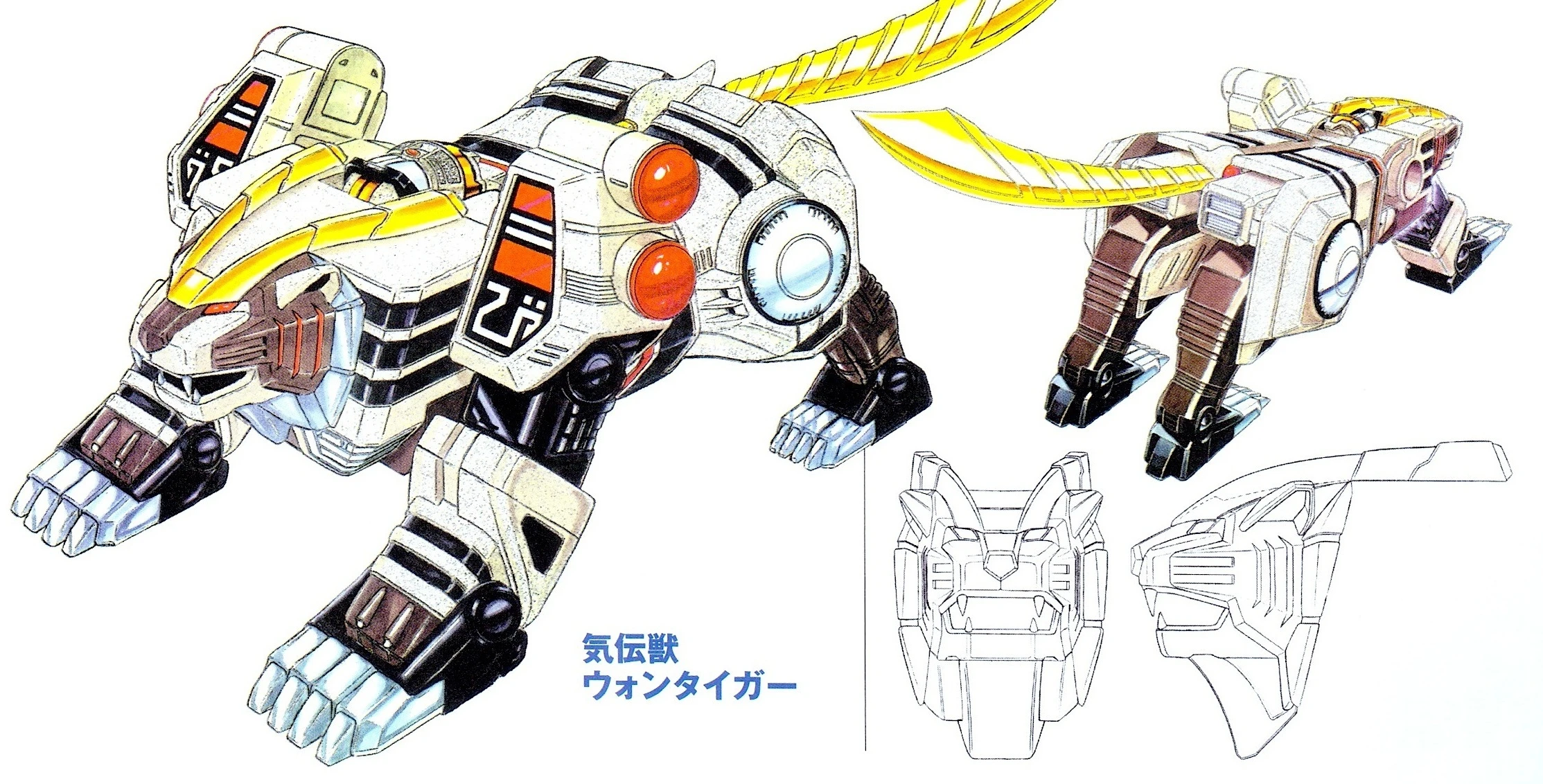
Won Tiger in its finished four-legged beast form, accompanied by side and transformation studies. Compare it with the upright warrior above.
Super Sentai Art Collection · MediaWorks, 2002 · printed p. 083 · PDF p. 91
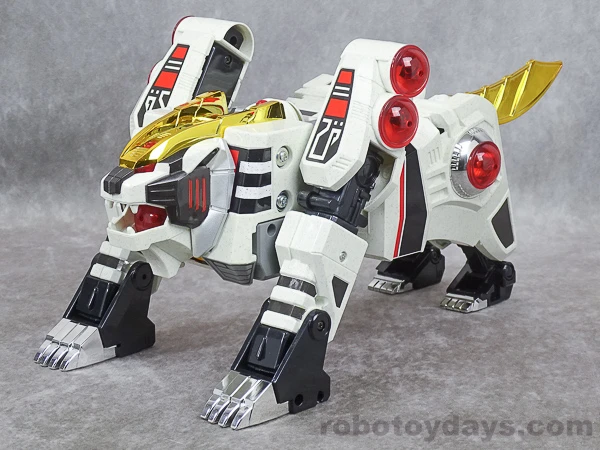
The original DX Won Tiger in tiger mode. The white armor, stripes and circular details carry across from the finished design.
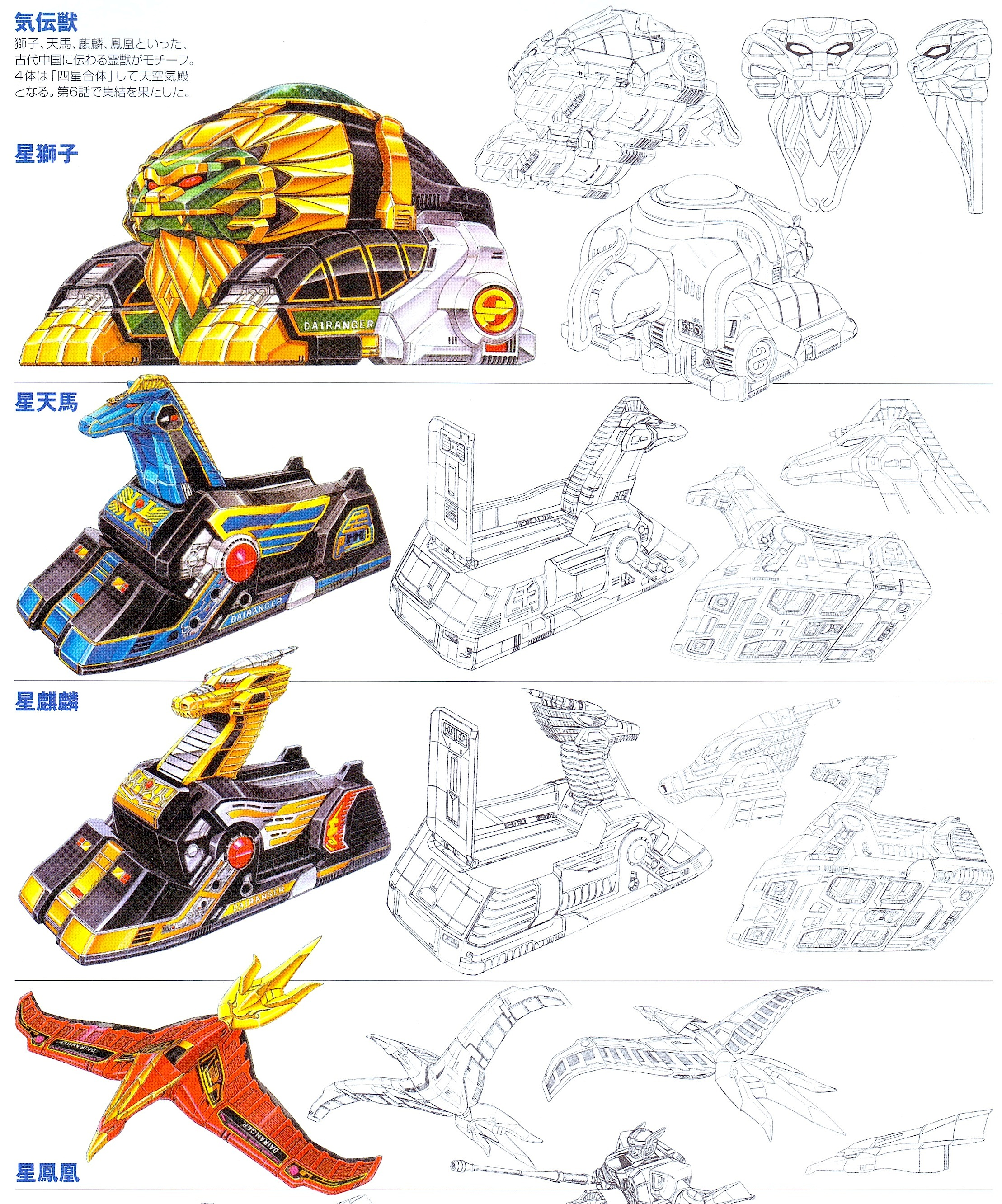
The four companions that combine with Won Tiger as Kiba Daioh: Star Lion, Star Tenma, Star Kirin and Star Phoenix.
Super Sentai Art Collection · MediaWorks, 2002 · printed p. 081 · PDF p. 89
On the toy shelf
The artbook labels the photographed product DX Won Tiger (DXウォンタイガー). Its retrospective note describes an EL unit providing light and sound features and a body molded with a distinctive stone-like pattern. The stone-like surface is a feature of the finished toy; the book does not say it was inherited from the statue proposal. Artbook, p. 083.
The Kiba Daioh photograph shows what happens when the central warrior gains the companion beasts. The product note above this lower photograph, headed Mythical Qi Beast Great Combination Set, says this form shares many parts with Dairenoh. It singles out changes in color and shoulder position as ways to make the result look like a different robot, and records that a set box was also sold. The red Star Phoenix on the toy’s arm makes the weapon arrangement visible alongside the shared blue and yellow lower legs. Artbook, p. 082.
Return to the tiger on its pedestal. Across these drawings, the designers move from a creature imagined as a statue to an armored animal, an active warrior, and the center of a larger combination. The final white armor and bold dark bands tie those identities together.
Sources
- Super Sentai Art Collection: Sentai Robo Edition 1975–2002 — Won Tiger and DX toy · MediaWorks · 2002 · page 083 · scan page 91
- Super Sentai Art Collection — Kiba Daioh and its combination · MediaWorks · 2002 · page 082 · scan page 90
- Super Sentai Art Collection — Early Sketches: Won Tiger, drawings 11–23 · MediaWorks · 2002 · page 150 · scan page 158
- Super Sentai Art Collection — Dairanger’s broadcast period · MediaWorks · 2002 · page 079 · scan page 87
- RoboToyDays — original Bandai DX toy photographs · RoboToyDays
- Super Sentai Art Collection — Four companion beasts and Tenku Kiden · MediaWorks · 2002 · page 081 · scan page 89
Artwork and toy photographs are credited reproductions from published sources. This is a virtual exhibit.