From the archive Batman
Painting the Dark Knight: Three Batman Color Models
A blue strip gives Batman’s black cowl its shape; a green streak cuts through the Joker’s hair; red and black trade places across Harley Quinn’s suit. Three painted models turn those choices into a reference an animator can follow.
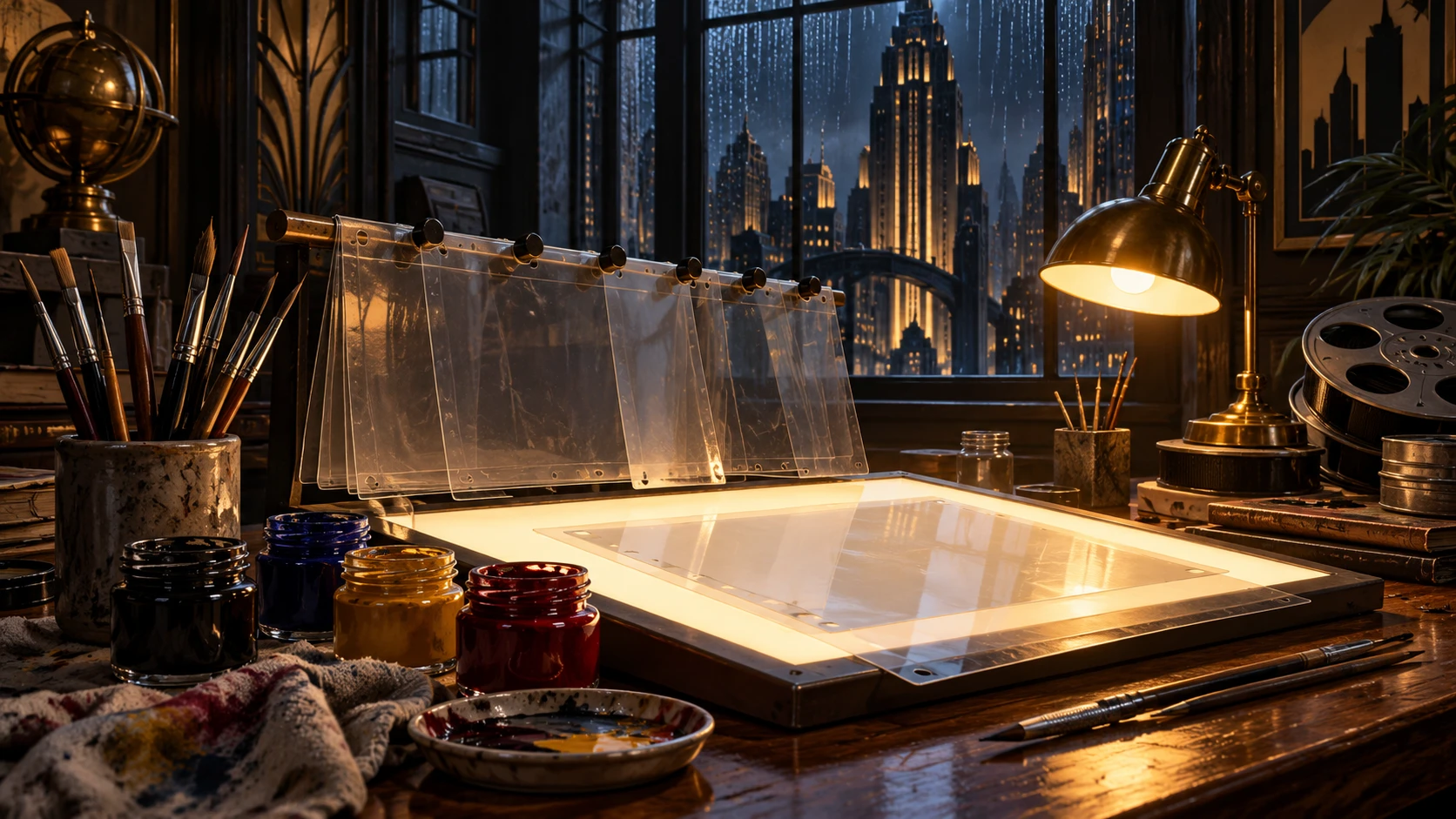
New editorial illustration of an imagined animation workbench. The historical character and production sheets appear below.
AI editorial illustration · Rewind: Northwest RetroDesign reference ↗01 Historical source
Internet Archive · Source image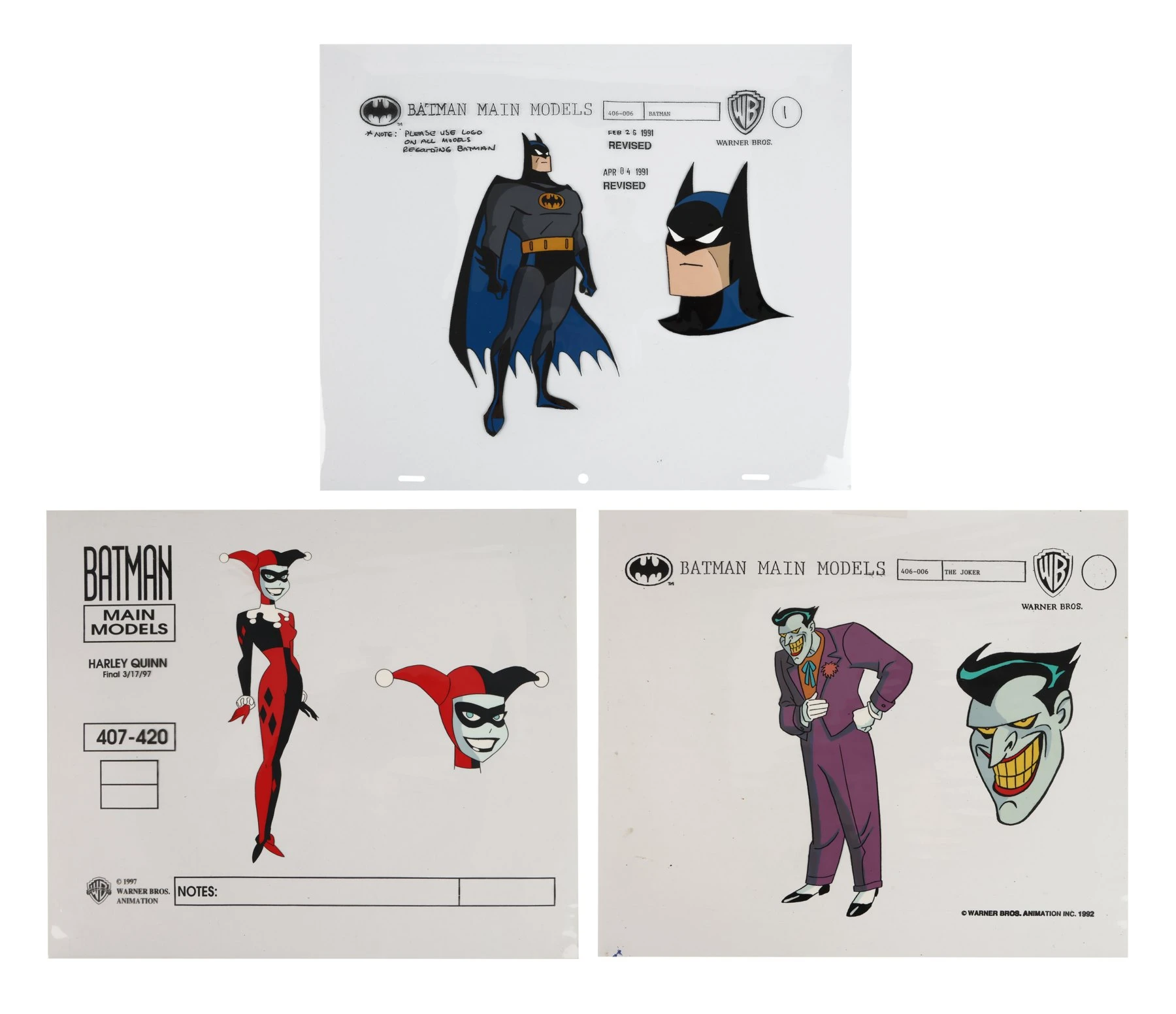
Three painted color-model cels photographed on white: Batman with header and revision stamps at top, Harley Quinn on a later 'BATMAN MAIN MODELS' form at lower left, and the Joker at lower right.
Color models © Warner Bros. / DC · photograph via Internet ArchiveBatman’s cowl looks black, but the enlarged head beside his full figure tells a more precise story. A blue band curves over the forehead, and another blue shape runs along the neck. The dark mask stays readable because its highlights have their own boundaries.
That is the useful thing about these three painted color models of Batman, the Joker and Harley Quinn: they let us pause over decisions that pass quickly in animation. Each sheet pairs a full figure with a larger head. One view establishes the whole costume; the other gives the face enough space to be copied consistently.
Batman: giving black a shape
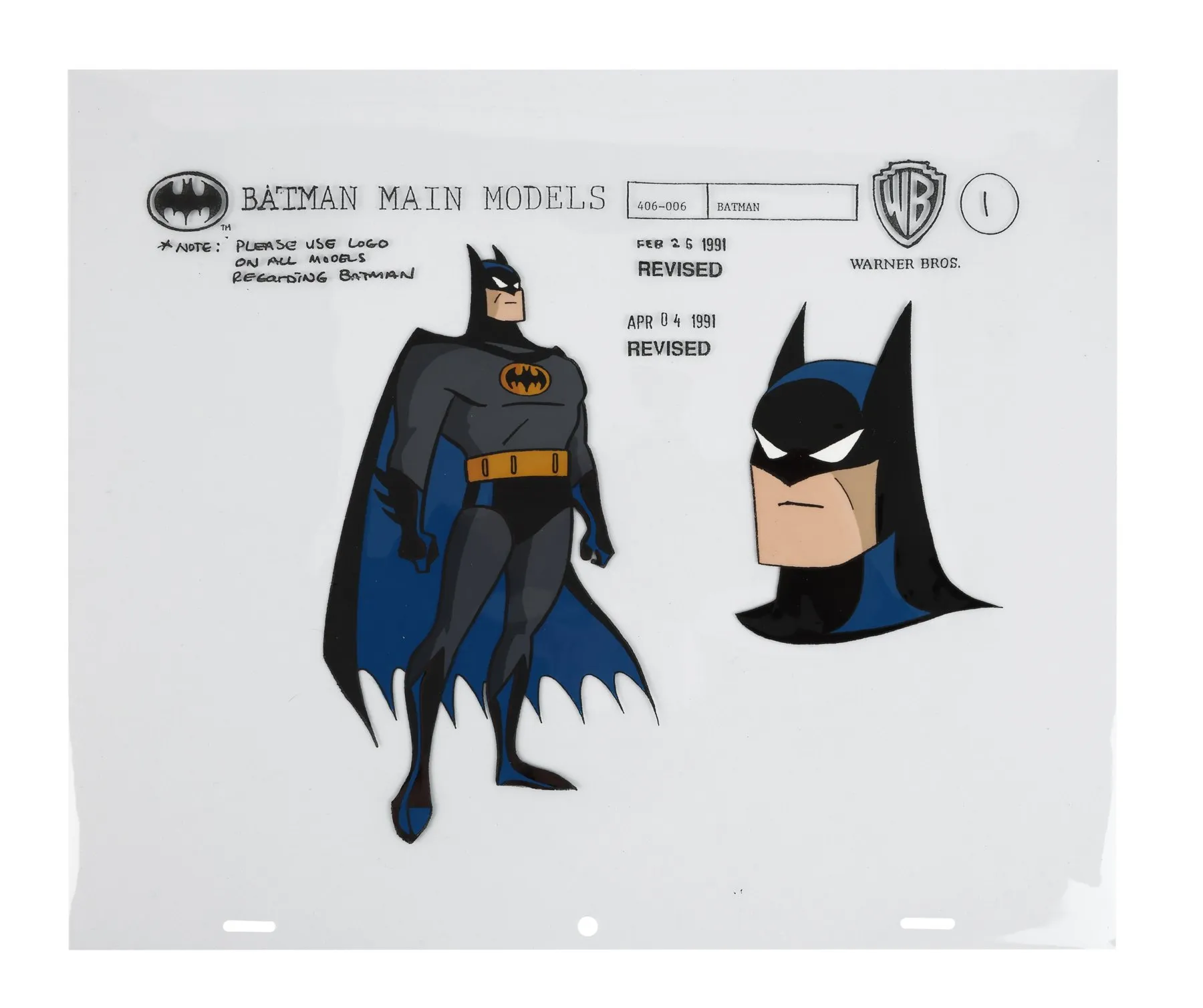
Follow the blue from the cape lining to the enlarged cowl. Color model © Warner Bros. / DC; original photograph via Internet Archive.
The blue inside the cape separates its hanging folds from Batman’s grey legs. At the head, the same contrast describes a curved surface with a few flat shapes. There is no smooth gradient to explain the roundness. The edge between two colors does the work.
The warm belt and chest emblem interrupt that cool, dark figure. They are small areas, but they pull the eye toward the waist and chest. Compare the large head with the full figure: the blue cowl highlight survives the change in scale, while the white eyes remain sharply enclosed in black.
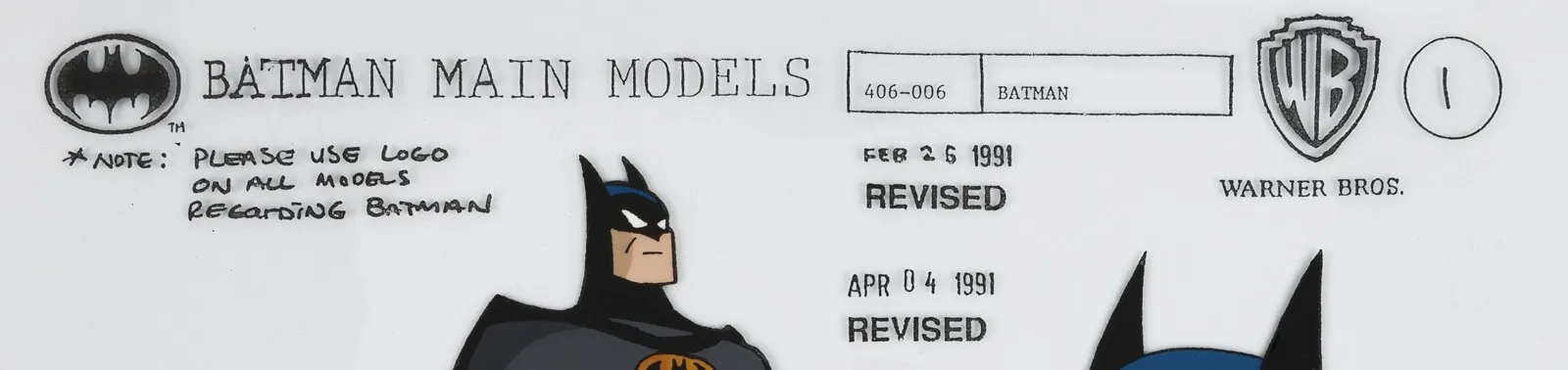
Two revision stamps on the Batman reference. © Warner Bros. / DC; photograph detail.
The February 26 and April 4, 1991 stamps make this more than a character portrait: it is a reference that was revised. They do not show what the earlier versions looked like. The handwritten instruction about using the logo is another reminder that the sheet carried directions as well as paint.
The Joker: a grin built from color
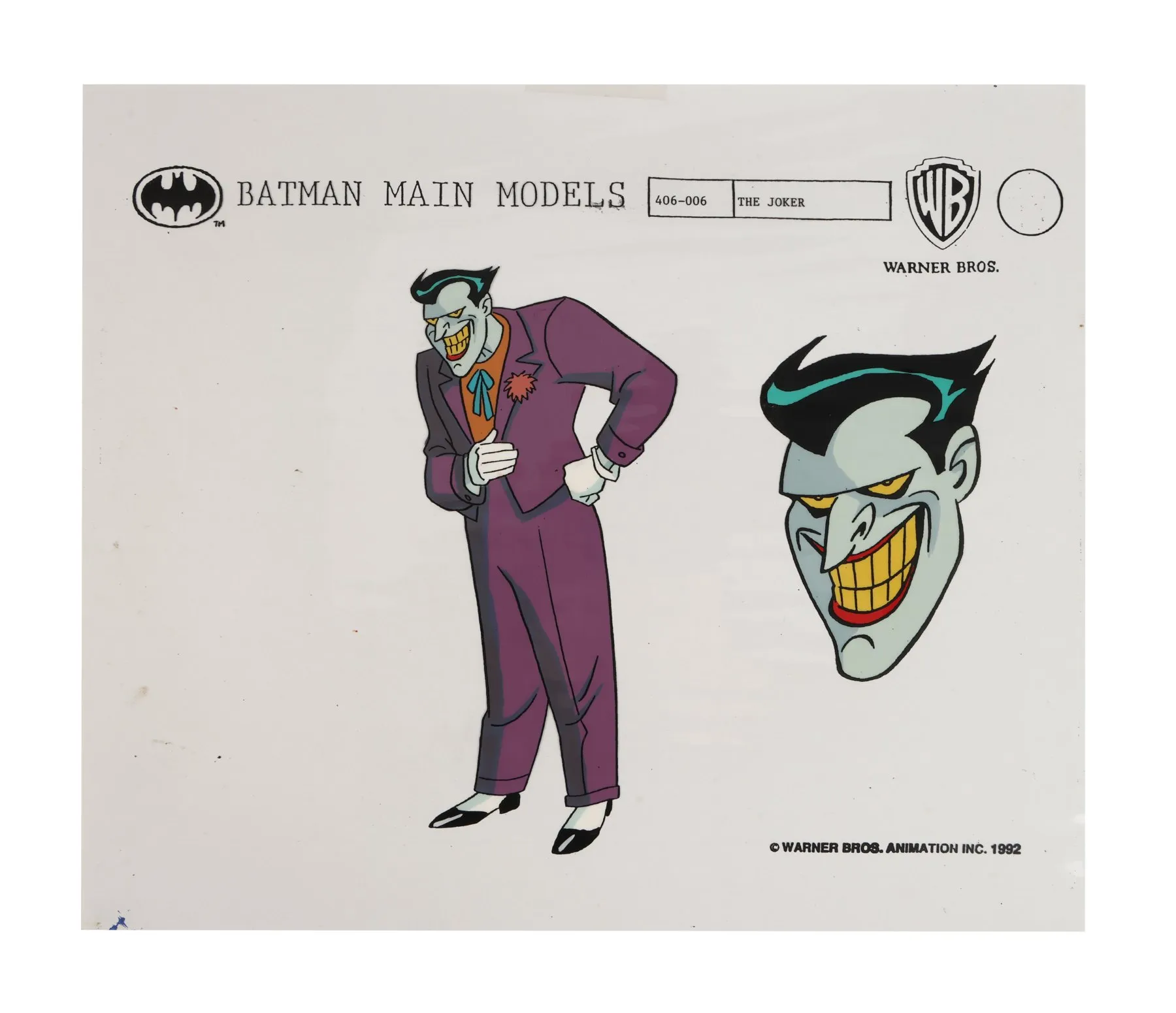
The full costume and enlarged grin use the same hard-edged color shapes. © Warner Bros. / DC; original photograph.
The Joker’s orange vest pushes forward against his purple suit. A teal bow tie sits between them; the green streak through his black hair repeats that cooler accent above the face. Compared with Batman’s restrained grey and blue, the colors crowd together around his chest and head.
The enlarged grin makes the construction especially clear. Yellow teeth sit inside a red rim, surrounded by pale skin and a heavy black outline. The shadow across the forehead is another painted shape, just as definite as a lapel. Even the parts we read as light and shade have edges to follow.
This sheet shares Batman’s printed form, but its visible 1992 date is a copyright line, not a revision stamp. Those two kinds of marking tell us different things.
Harley Quinn: the pattern is the costume
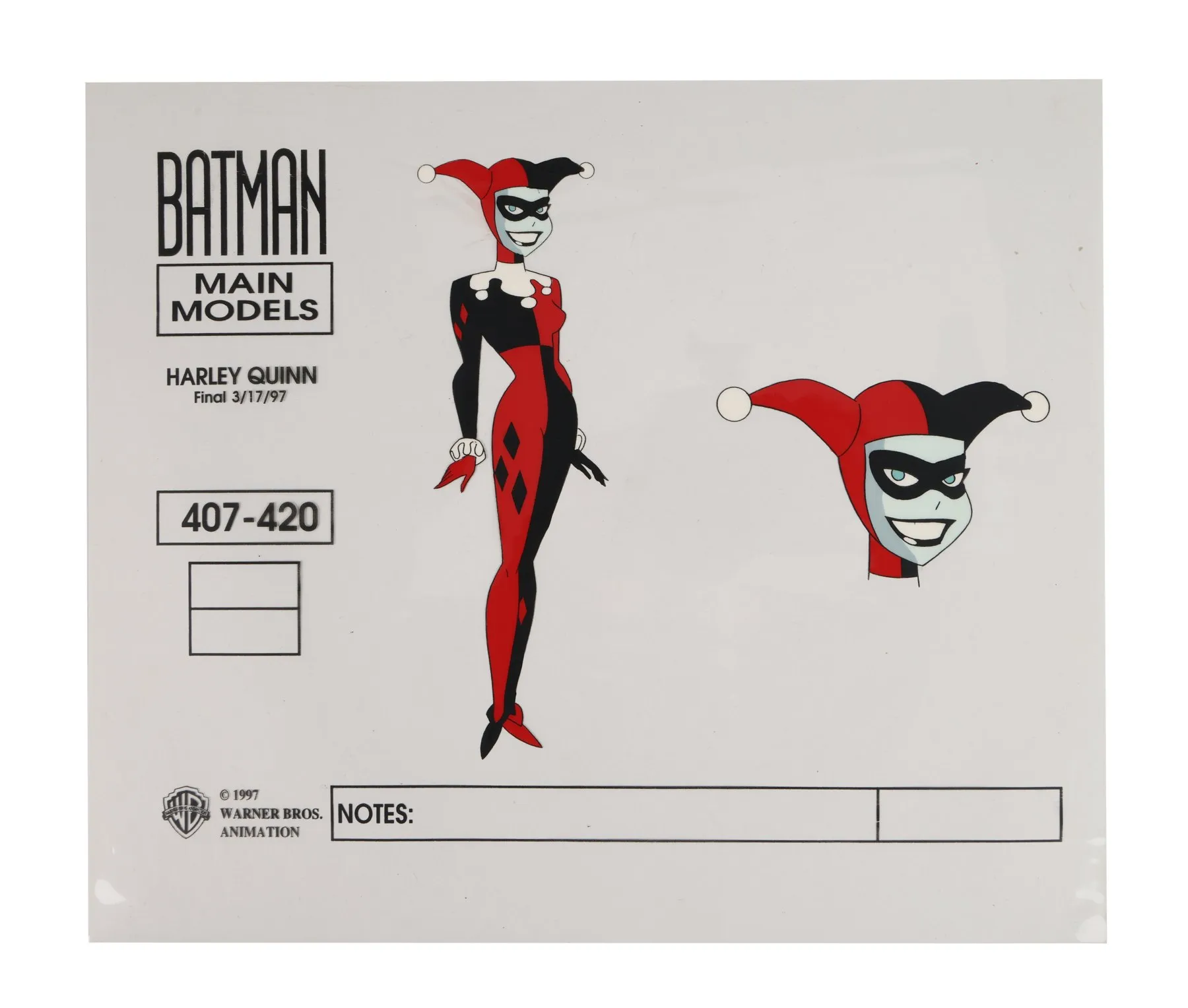
Red and black exchange sides across the costume. The label reads “Final 3/17/97.” © Warner Bros. / DC; original photograph.
Harley’s suit turns a small palette into a pattern that has to stay organized. A red leg sits beneath the black half of the torso; the other side reverses the arrangement. Contrasting diamonds remain visible within those blocks, while the white collar and cuffs divide the costume from her face and hands.
Her head repeats the red-and-black split in the two points of the cap. The separate close-up makes the pale face, black mask and white cap tips easy to distinguish. Here a misplaced color would change the design itself, rather than merely making the costume lighter or darker.
The form labels this version “Final 3/17/97.” Put that beside Batman’s “Revised” stamps and the sheets become working decisions: these are the shapes and colors to carry forward. Their pleasure is in seeing how little each needs—a blue curve, a green streak, a reversed pair of colors—to keep three very different characters unmistakable.
Source note
The photographs come from one Internet Archive lot, whose uploader describes the pieces as hand-painted acetate models. No painter is credited on the sheets. The uploader marks the photographs CC0; the underlying characters and artwork remain © Warner Bros. / DC. Existing excerpts are reproduced without retouching. These are readings of the photographed paint and labels, not calibrated color measurements or a comparison with restored television frames.
Sources
Artwork and toy photographs are credited reproductions from published sources.