From the archive Lunar
Thirty Questions About Lunar: The Scenario Answers, 1995
A 1995 official setting book for Game Arts' two Lunar games closes out its making-of section with thirty questions answered by Kei Shigema: what Shigema said about Hiro’s unknown parentage, why so many heroes have one parent or none, how much money Lemina saved, and whether Lunar would come back.
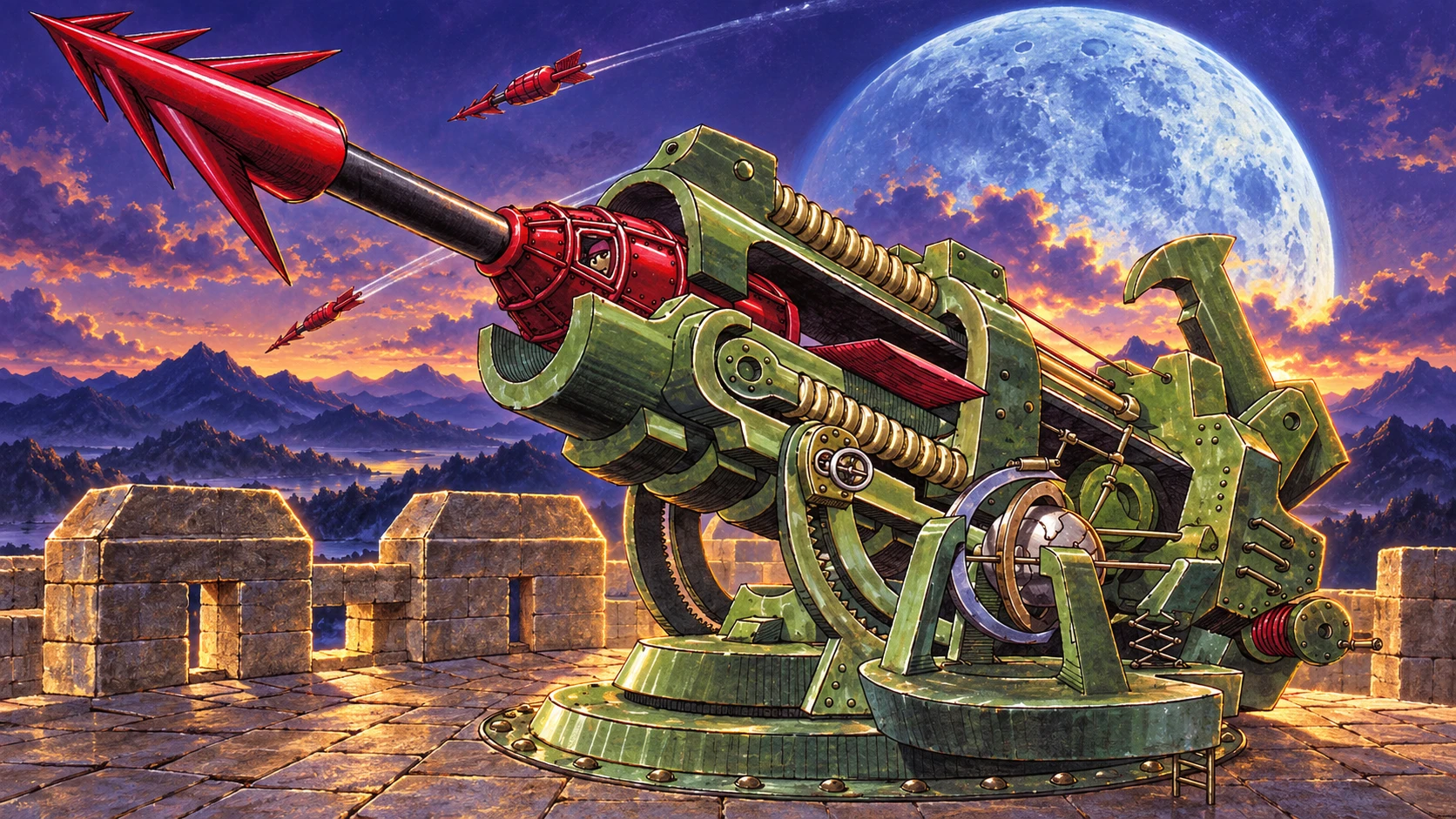
An imaginative editorial illustration inspired by an unused early Lunar design. This is not a machine depicted in a released game.
AI editorial illustration · Rewind: Northwest RetroDesign reference ↗01 Historical source
SoftBank · p. 77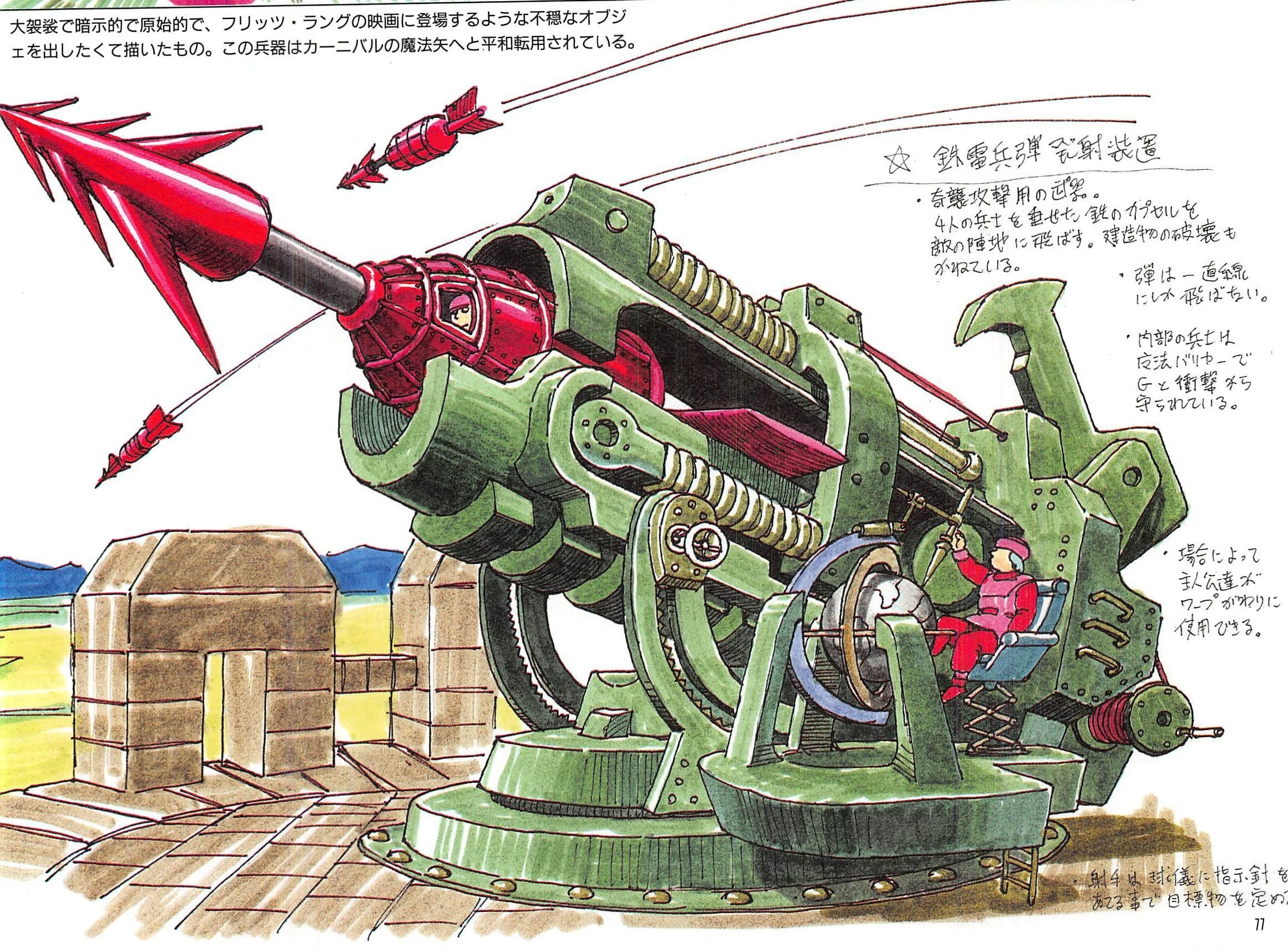
Unused early Lunar design in marker: a green siege gun firing red arrows, with the caption about Fritz Lang's films and the Carnival's magic arrow.
LUNAR I・II 公式設定資料集 (Lunar I・II Official Setting Material Collection), SoftBank Corp., 1995 · p. 77 (PDF 79; IA n78), lower half · © GAME ARTS / STUDIO ALEX.The book is LUNAR I・II 公式設定資料集 (Official Setting Material Collection). Its colophon dates the first printing April 6, 1995 (平成7年4月6日) and names SoftBank’s publishing division as publisher. Editing is credited to the Sega Saturn Magazine editorial department and an amusement books department. Production cooperation is credited to Game Arts, and editorial cooperation to 重馬敬 (Kei Shigema) and 赤司雄俊. The cover illustration is by 窪岡俊之 (Toshiyuki Kubooka). The copyright line credits him with the character design and 佐藤肇 (Hajime Satou) with the image illustration. LUNAR I・II, colophon (PDF p. 146). (Japanese quotations and romanized names in this Story are working translations. Character names use their common English spellings. In this scan the PDF page is the printed page plus two.)
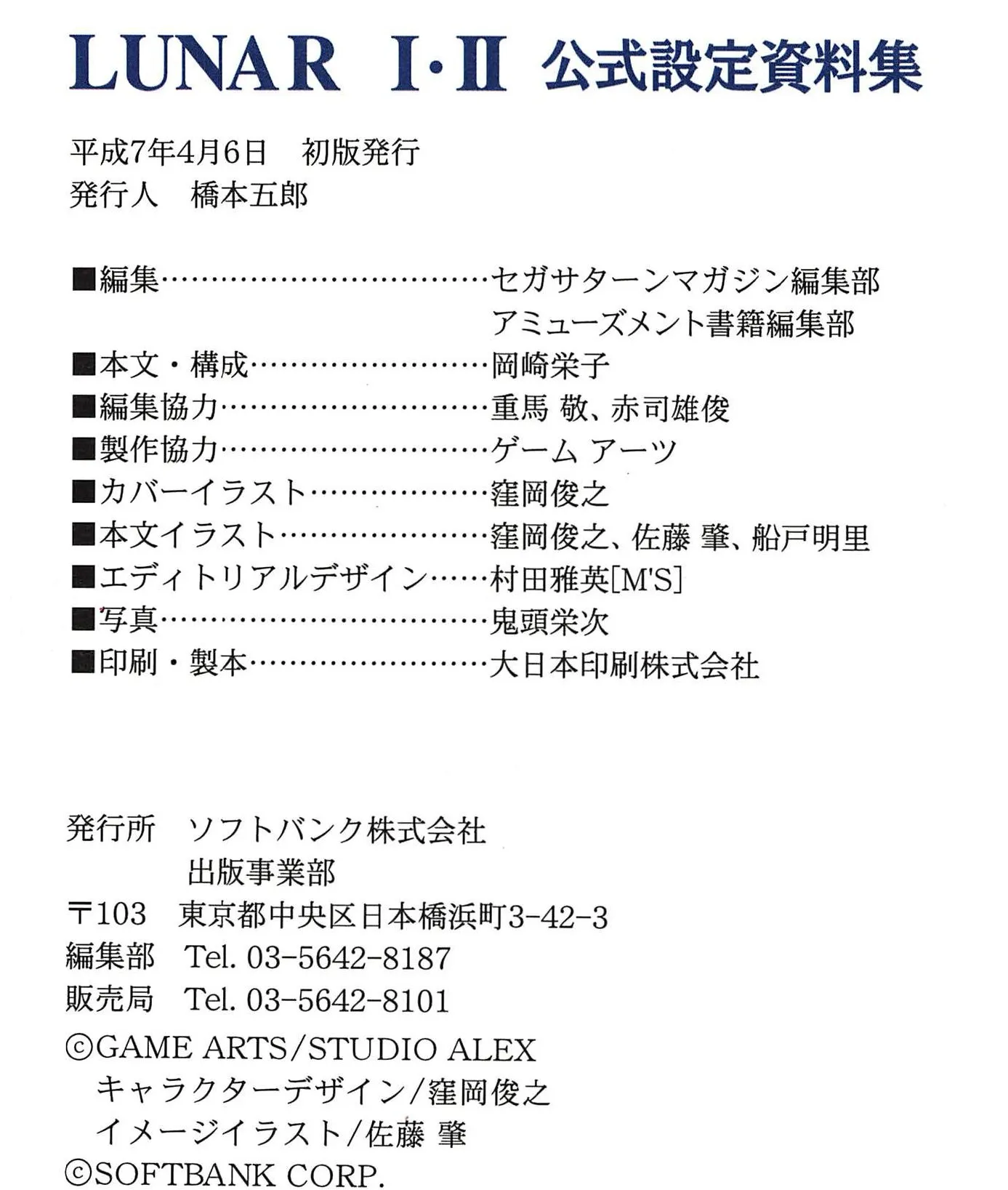
Colophon of the Lunar I・II setting book: first printing April 6, 1995, with editing, cooperation and illustration credits. LUNAR I・II 公式設定資料集 (Lunar I・II Official Setting Material Collection), SoftBank Corp., 1995 · colophon (PDF 146; IA n145), credits block · © GAME ARTS / STUDIO ALEX..
Most of the book covers LUNAR ETERNAL BLUE: character sheets, world settings and a “production process” section. The contents end that section with “30 questions about LUNAR / answers: Kei Shigema,” p. 109, then a column. LUNAR I・II, contents (PDF p. 4).
Before there was a plot
The world-setting chapter ends with a page headed “Unused design proposals” (未使用デザイン案). Its note explains: “These are some of the pieces drawn from around the end of ’92 to firm up the early image. At that stage there wasn’t even a plot, so the direction was set by drawing lots of things that might be usable, with the aim of building parts of the story while drawing.” LUNAR I・II, p. 77 (PDF p. 79).
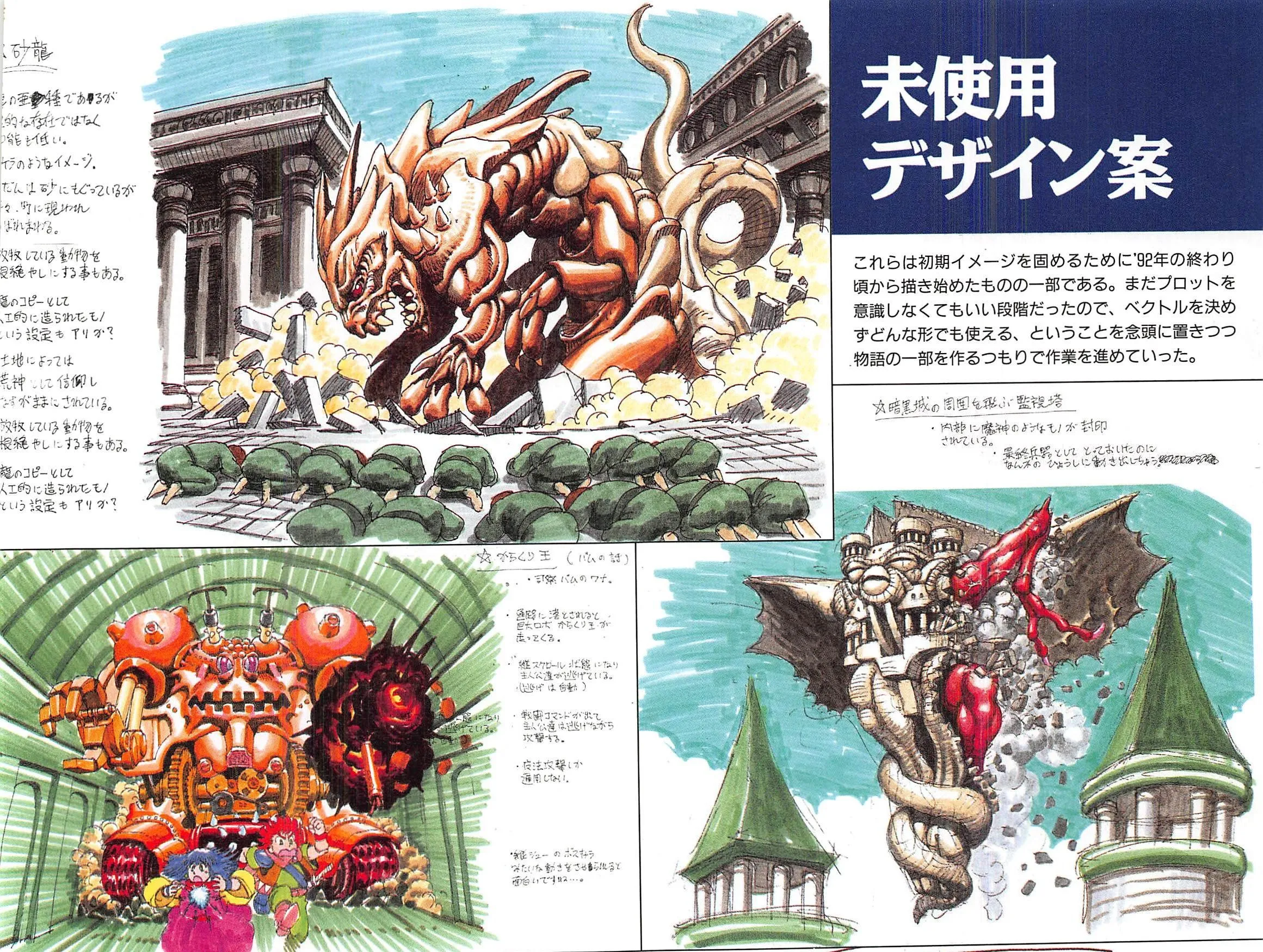
‘Unused design proposals’ header and note dating the sketches to around the end of 1992, with monster, machine and tower sketches. LUNAR I・II 公式設定資料集 (Lunar I・II Official Setting Material Collection), SoftBank Corp., 1995 · p. 77 (PDF 79; IA n78), upper half · © GAME ARTS / STUDIO ALEX..
The page shows marker drawings of a horned monster among temple columns, a giant red machine in a tunnel, a winged, tentacled shape wrapped around a tower, and a green siege gun firing red arrows, with a soldier at the controls. A caption explains one of them: “Drawn aiming for a large-scale, suggestive and primitive, uncanny object like the ones in Fritz Lang’s films. This weapon was peacefully converted into the Carnival’s magic arrow.” LUNAR I・II, p. 77 (PDF p. 79).
Thirty questions
The Q&A runs across pp. 109–111. Its introduction says: “The story of LUNAR II is grand enough to make you sigh.” So the editors put questions to Kei Shigema “in one go”: details the game couldn’t fully tell, matters “close to the essence of the LUNAR world,” and small doubts. “Read the answers with care!” LUNAR I・II, p. 109 (PDF p. 111).
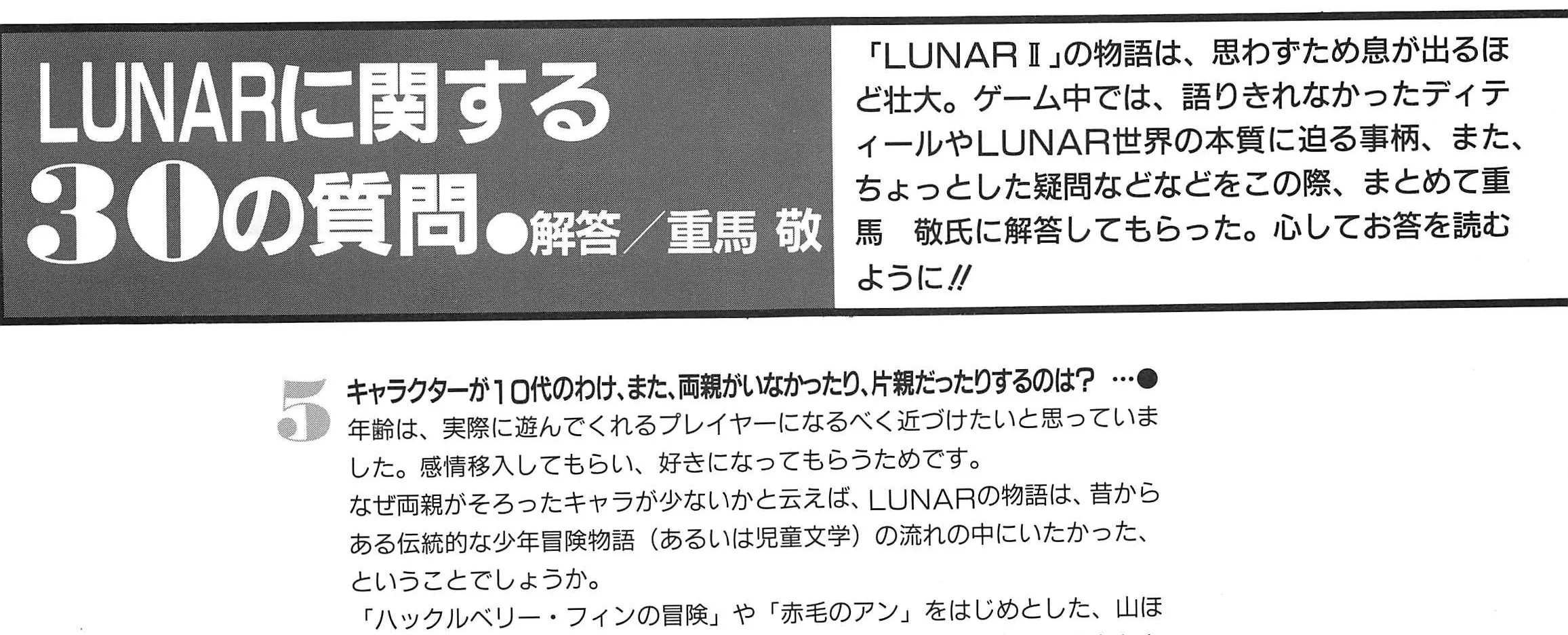
Header of ‘30 questions about LUNAR, answers: Kei Shigema’, with the introduction and question 5 about teenage heroes and missing parents. LUNAR I・II 公式設定資料集 (Lunar I・II Official Setting Material Collection), SoftBank Corp., 1995 · p. 109 (PDF 111; IA n110), middle band · © GAME ARTS / STUDIO ALEX..
The first questions are about the world itself. Lunar’s first role, Shigema writes, was “an emergency refuge from the Blue Star, which had collapsed and met an eternal winter.” The goddess Althena and the dragons then remade it as “the magic world LUNAR,” to create a new civilization and bring the Blue Star back. He calls Lunar “a kind of energy-generating, radiating device” for that purpose. The magic power of its people and creatures would turn the frozen, dying Blue Star back into green land. “As Lucia said, LUNAR really did exist ‘for the Blue Star.’” Over the years that memory was lost, and the Blue Star survived only as a legendary homeland. LUNAR I・II, p. 109 (PDF p. 111).
Asked about Althena and Lucia, he writes that Althena, Lucia and Zophar “are probably the same kind of being.” You could call them gods, he says, “but the reality seems a little different. Then what are they? If you ask me that … I don’t quite know. Well, it isn’t SF, so please let me leave it vague (laughs).” LUNAR I・II, p. 109 (PDF p. 111).
Teenagers, and missing parents
Question 5 asks why the characters are teenagers, and why so few have both parents. On age, Shigema says he set it as close as he could to the people actually playing, “so you’d feel for them and come to like them.” On parents, he places Lunar in “the line of traditional boys’ adventure stories (or children’s literature).” He names two: “If you think of The Adventures of Huckleberry Finn, Anne of Green Gables and the many fine works like them, I think you’ll understand what I’m trying to say.” LUNAR I・II, p. 109 (PDF p. 111).
Question 6 asks about Hiro’s parents. “Between you and me, Grandpa Gwyn is not actually Hiro’s grandfather.” Hiro’s parents are unknown, Shigema says. Gwyn took him in as a baby, “and beyond that, nothing at all is known.” A later answer adds that Gwyn, as a young man, was “quite the adventurer,” and seems to have met Hiro’s parents on one of those adventures. LUNAR I・II, pp. 109–110 (PDF pp. 111–112).
Short answers
Question 9 asks why the female characters took longer to settle than the male ones. “Women characters take more time to fix the image. That’s what Mr. Kubooka says.” Then: “Well, I think it’s a difference in kodawari” — how particular you are. LUNAR I・II, p. 109 (PDF p. 111).
Some answers are jokes. Asked why Ronfar looks older than he is, Ronfar answers for himself: “Shut up! Mind your own business. Leave my face alone!” Asked whether an underage Ronfar can drink, Shigema writes: “Well, it’s another world.” LUNAR I・II, pp. 109–110 (PDF pp. 111–112).
Question 15 asks how much Lemina saved. “That’s a secret.” There’s a big savings box under her bed, and her hobby is counting coins before she sleeps, but she collects mostly small change, “so it doesn’t look like she’s earned a lot. Surely it isn’t much.” LUNAR I・II, p. 110 (PDF p. 112).
Question 16 asks why Ruby thinks she’s the red dragon’s child. When she was small, the answer says, Hiro told her there used to be a red dragon, and she began insisting she was one. When she tried, she could breathe fire, which “deepened her conviction. But whether she really believes it is doubtful.” LUNAR I・II, p. 110 (PDF p. 112).
Nall, Ghaleon and the end
Question 19 links the two games. After Alex and Luna finished their lives as humans, Nall “was very lonely.” He traveled Lunar, but found no friend he could hand Althena’s sword to, and in his own mind “the Dragonmaster was Alex alone.” So, “lonely and sulking,” Nall gathered children in the mechanical castle and made “a kingdom ‘where time stopped’” to forget his loneliness. LUNAR I・II, p. 110 (PDF p. 112).
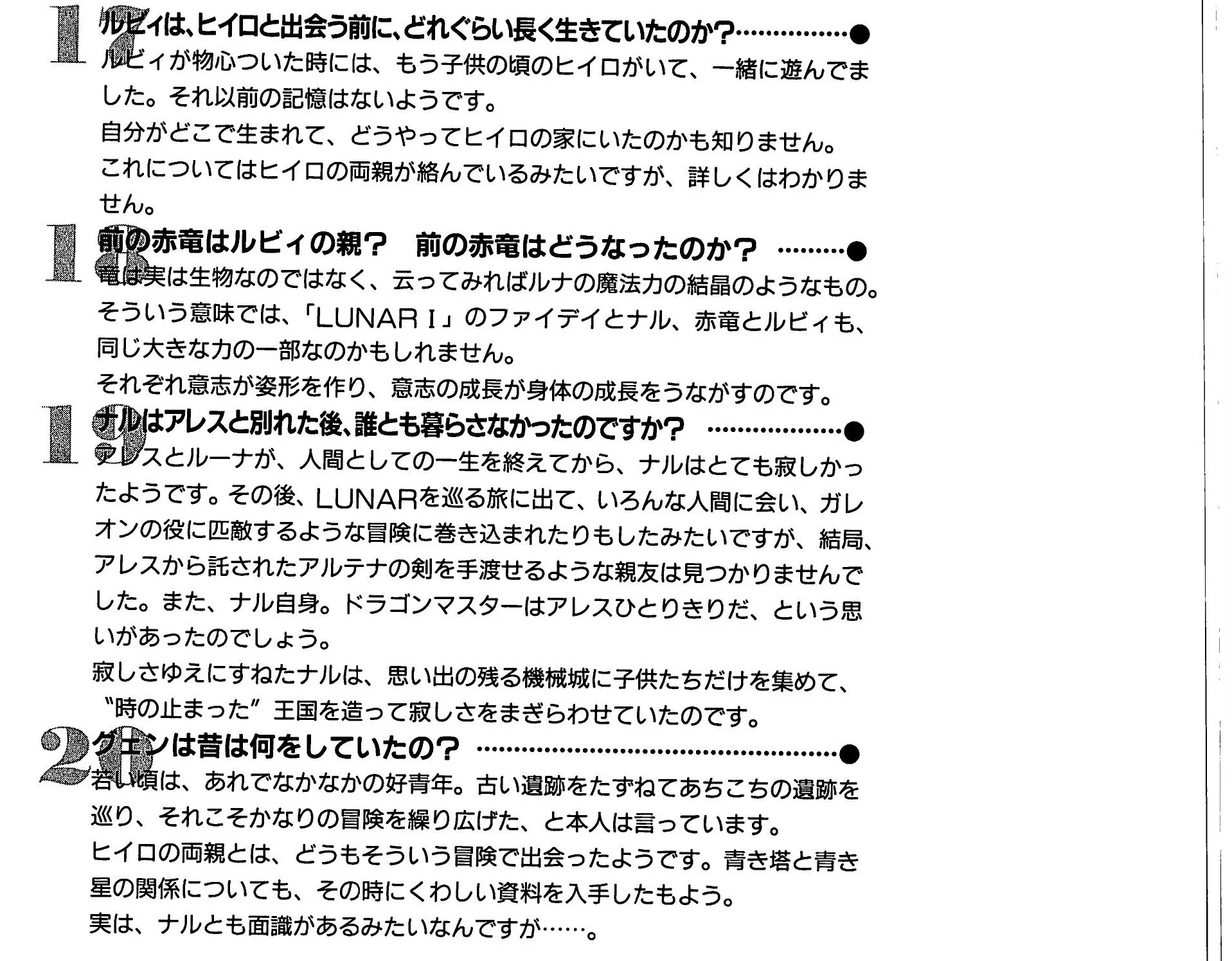
Questions 17 to 20 of the Lunar Q&A, including Nall’s ‘kingdom where time stopped’ and Gwyn’s past. LUNAR I・II 公式設定資料集 (Lunar I・II Official Setting Material Collection), SoftBank Corp., 1995 · p. 110 (PDF 112; IA n111), lower block · © GAME ARTS / STUDIO ALEX..
Question 25 asks about Ghaleon. Shigema writes that what Ghaleon felt in LUNAR II was “‘shame’ rather than ‘guilt.’” He was a man who “chose to live on in shame” to make up for past wrongs. “He’s a complicated person, so I don’t really understand him well …” But because Ghaleon says “My friend …” at the very end, he thinks the bad feeling faded and Ghaleon could meet Dyne. LUNAR I・II, p. 111 (PDF p. 113).
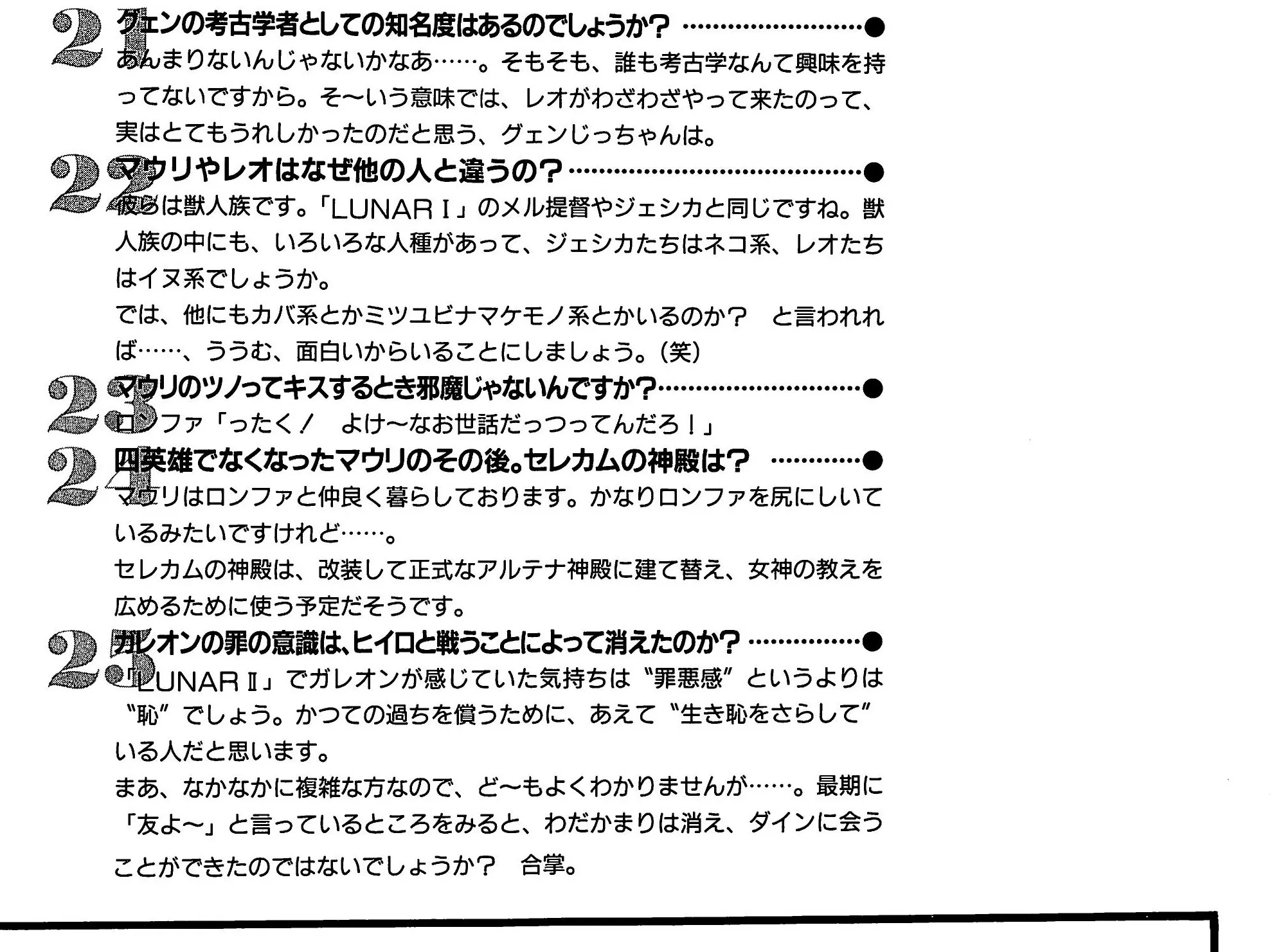
Questions 21 to 25 of the Lunar Q&A, ending with Ghaleon’s ‘shame rather than guilt’. LUNAR I・II 公式設定資料集 (Lunar I・II Official Setting Material Collection), SoftBank Corp., 1995 · p. 111 (PDF 113; IA n112), upper block · © GAME ARTS / STUDIO ALEX..
Question 30 asks whether Lunar has a future. “The history of LUNAR will go on. If all of you love this story, I think we’ll meet again some day. Surely.” LUNAR I・II, p. 111 (PDF p. 113).
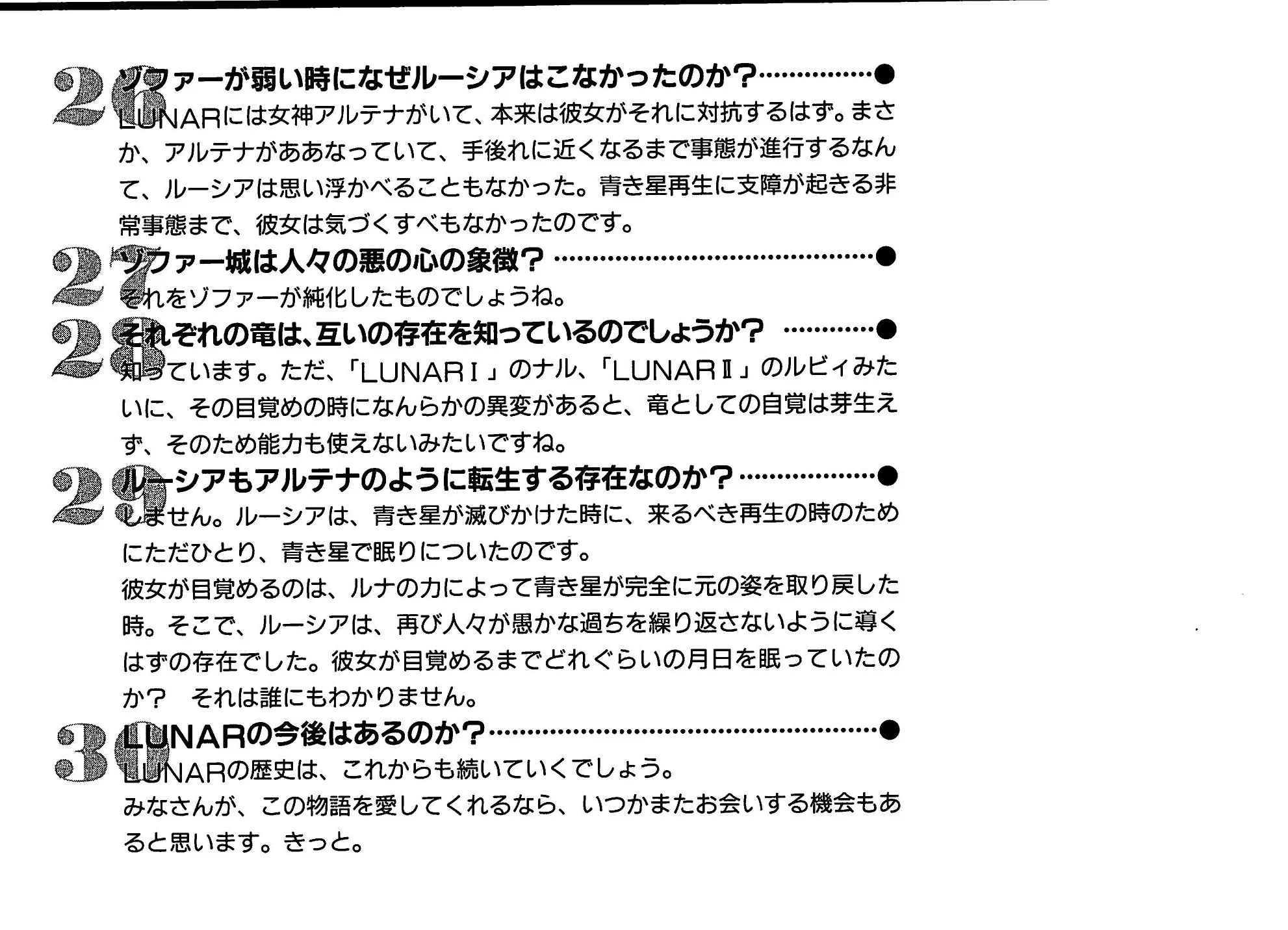
Questions 26 to 30 of the Lunar Q&A, ending with ‘The history of LUNAR will go on’. LUNAR I・II 公式設定資料集 (Lunar I・II Official Setting Material Collection), SoftBank Corp., 1995 · p. 111 (PDF 113; IA n112), lower block · © GAME ARTS / STUDIO ALEX..
What the pages say, and don’t
These pages record how the scenario side of Lunar explained its world and characters in an official 1995 book: Shigema’s answers, Kubooka’s reported view on female designs, and early design sketches dated from around the end of 1992. They don’t give release dates, platforms, prices or sales for either game, and nothing here covers the games’ U.S. versions. The last answer isn’t an announcement. It’s a hope, conditional on readers.
Sources
- LUNAR I・II — contents · SoftBank · 1995 · scan page 4
- LUNAR I・II — unused design proposals · SoftBank · 1995 · page 77 · scan page 79
- LUNAR I・II — "30 questions about LUNAR," Q1–10 · SoftBank · 1995 · page 109 · scan page 111
- LUNAR I・II — Q11–20 · SoftBank · 1995 · page 110 · scan page 112
- LUNAR I・II — Q21–30 · SoftBank · 1995 · page 111 · scan page 113
- LUNAR I・II — colophon · SoftBank · 1995 · scan page 146
Artwork and toy photographs are credited reproductions from published sources.