From the archive Pac-Man
Walk Lines and Float Lines: Drawing Pac-Man’s Television Cast
Hanna-Barbera's Pac-Man model sheets give the family a walk line, the ghosts a float line, and a growing cast a shared sense of scale. Five drawings show how the ensemble fits together.
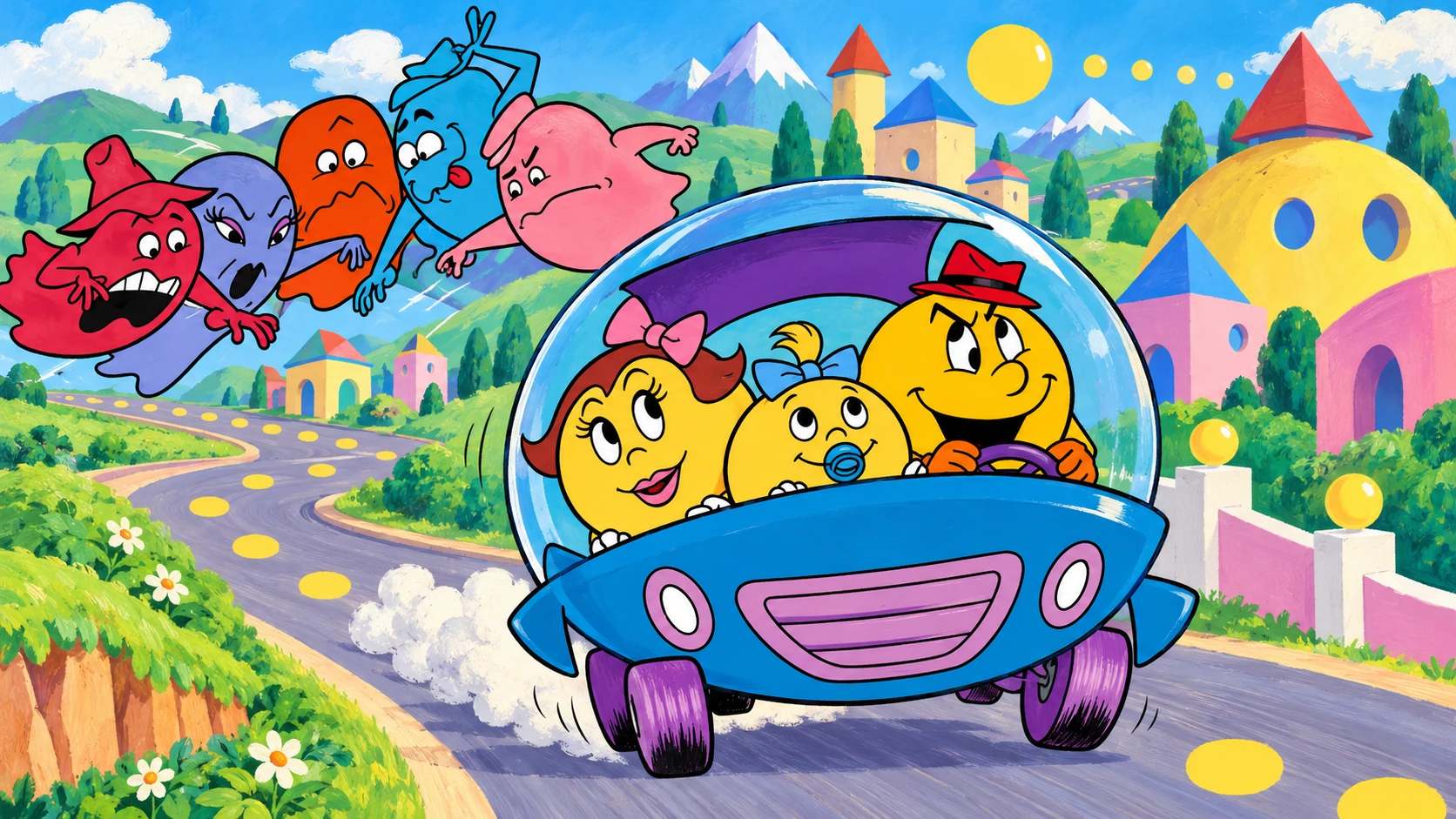
New editorial illustration inspired by the historical material below; the source images remain credited separately.
AI editorial illustration · Rewind: Northwest RetroDesign reference ↗01 Historical source
Internet Archive (scan host) · scan p. 2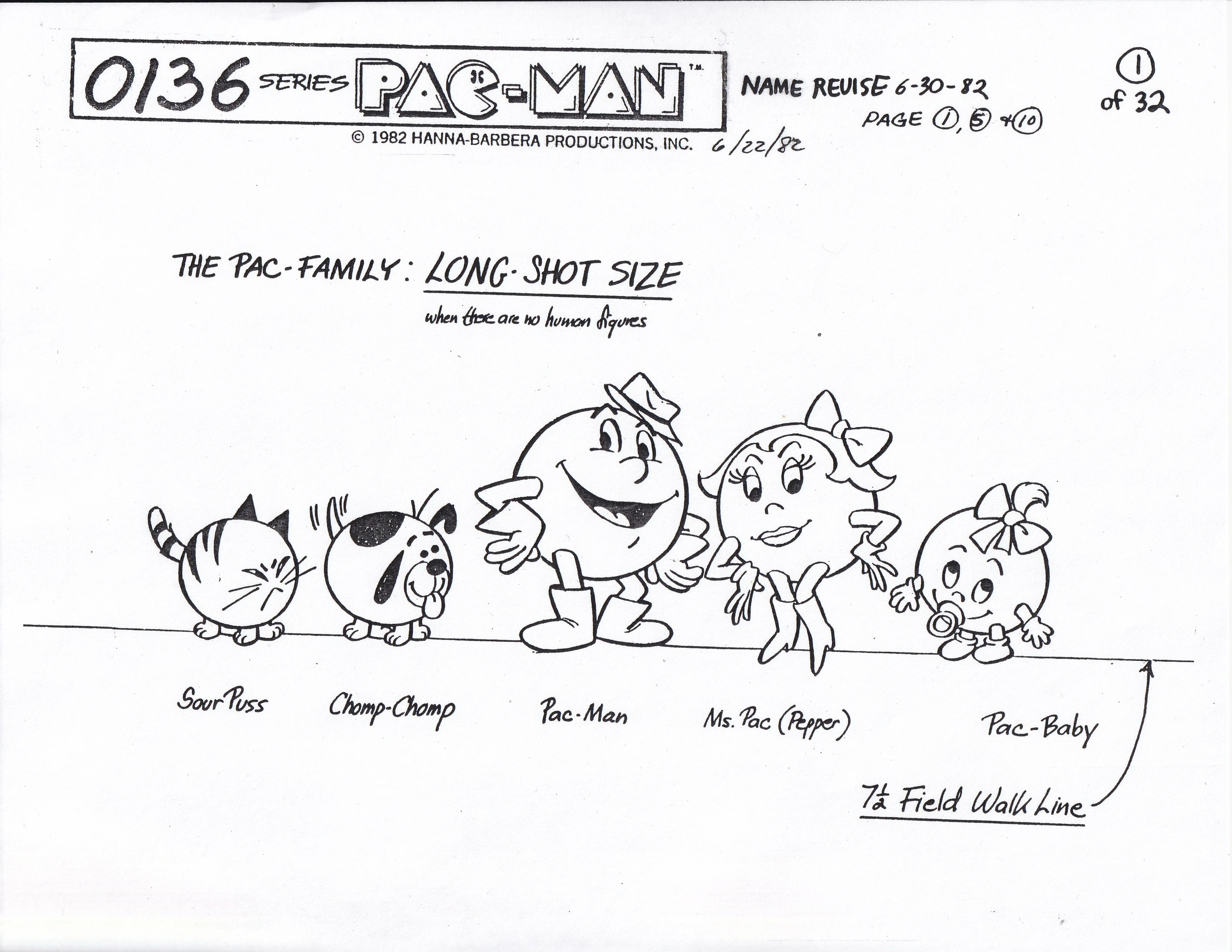
The 1982 Pac-Family at long-shot size: five figures sharing a walk line. Sheet 1, dated June 22, 1982.
Hanna-Barbera Productions, 1982 · Internet Archive scan · PDF p. 2Pac-Man and his family have feet on the line. Their ghostly pursuers hover above little shadows. Hanna-Barbera’s model sheets turn that small difference into an instruction: one group gets a walk line, the other a “float” line.
These drawings do more than introduce a cast. They show how characters should share a picture—who stands taller, who hovers, and what changes when a new relative joins the group. Across the 1982 and 1983 sheets, a family portrait becomes a practical reference for drawing an ensemble.
Feet, shadows and a shared line
The 1982 family sheet above places Sour Puss, Chomp-Chomp, Pac-Man, Ms. Pac and Pac-Baby along one ruled baseline. The adults rise above the pets and baby, but their feet return to the same ground. The handwritten heading calls this the family’s long-shot size, with an important qualification: “when there are no human figures.”
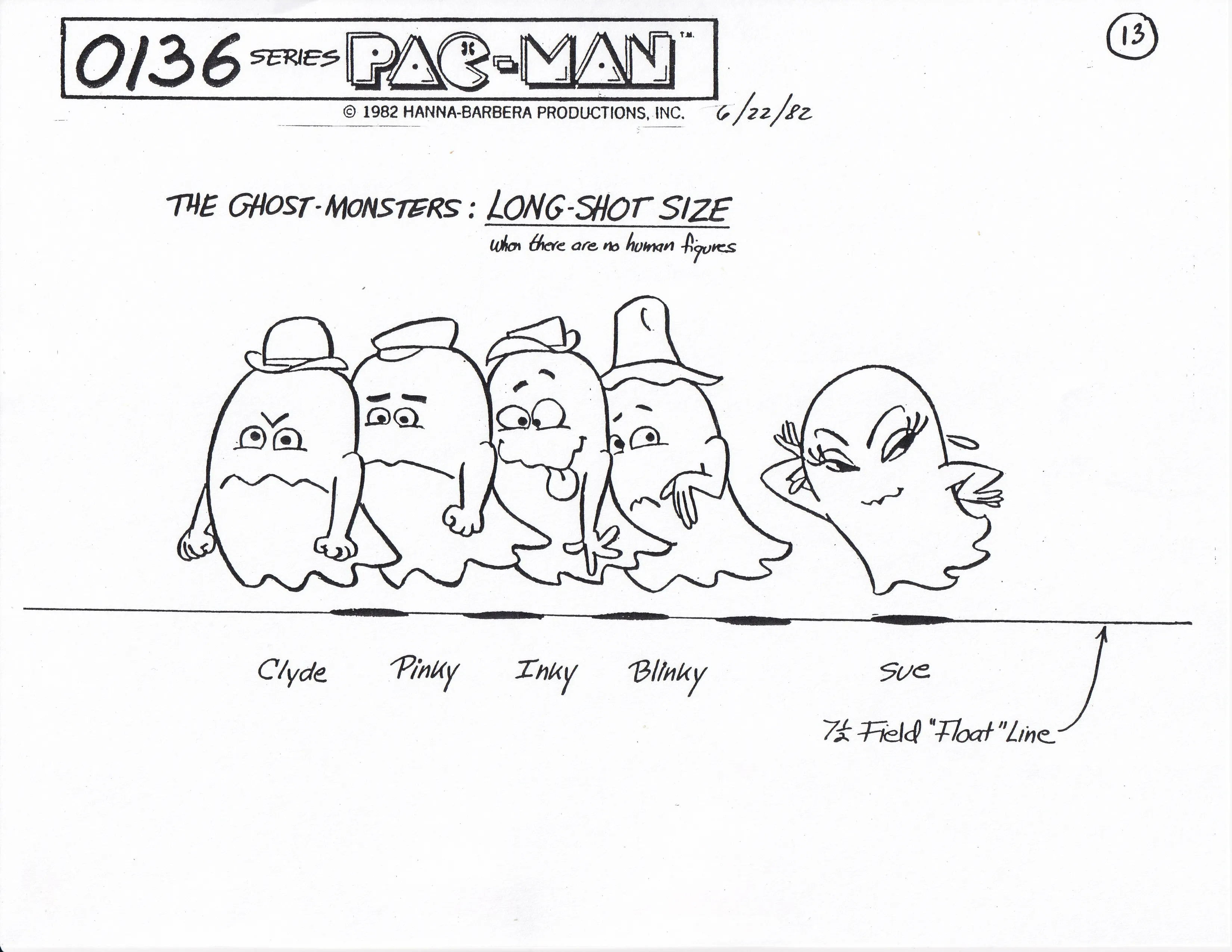
Sheet 13 gives the ghost-monsters a float line instead of the family’s walk line. Scan p. 15.
The ghost lineup uses the same 7½ field label but changes the word “walk” to “float.” Clyde, Pinky, Inky, Blinky and Sue hang above small black shadows. Their lower edges stop short of the baseline: the empty space is part of how they belong in the scene.
Reading the handwritten lines
Family, sheet 1: “7½ Field Walk Line”
Ghosts, sheet 13: “7½ Field ‘Float’ Line”
Typed readings of the source labels; the drawings retain the original handwriting.
The shared layout makes the difference easy to see. Both sheets establish a ground reference, but only one cast stands on it. Even before a character moves, its relationship to that line tells us something about how it inhabits the cartoon.
Making room for two more
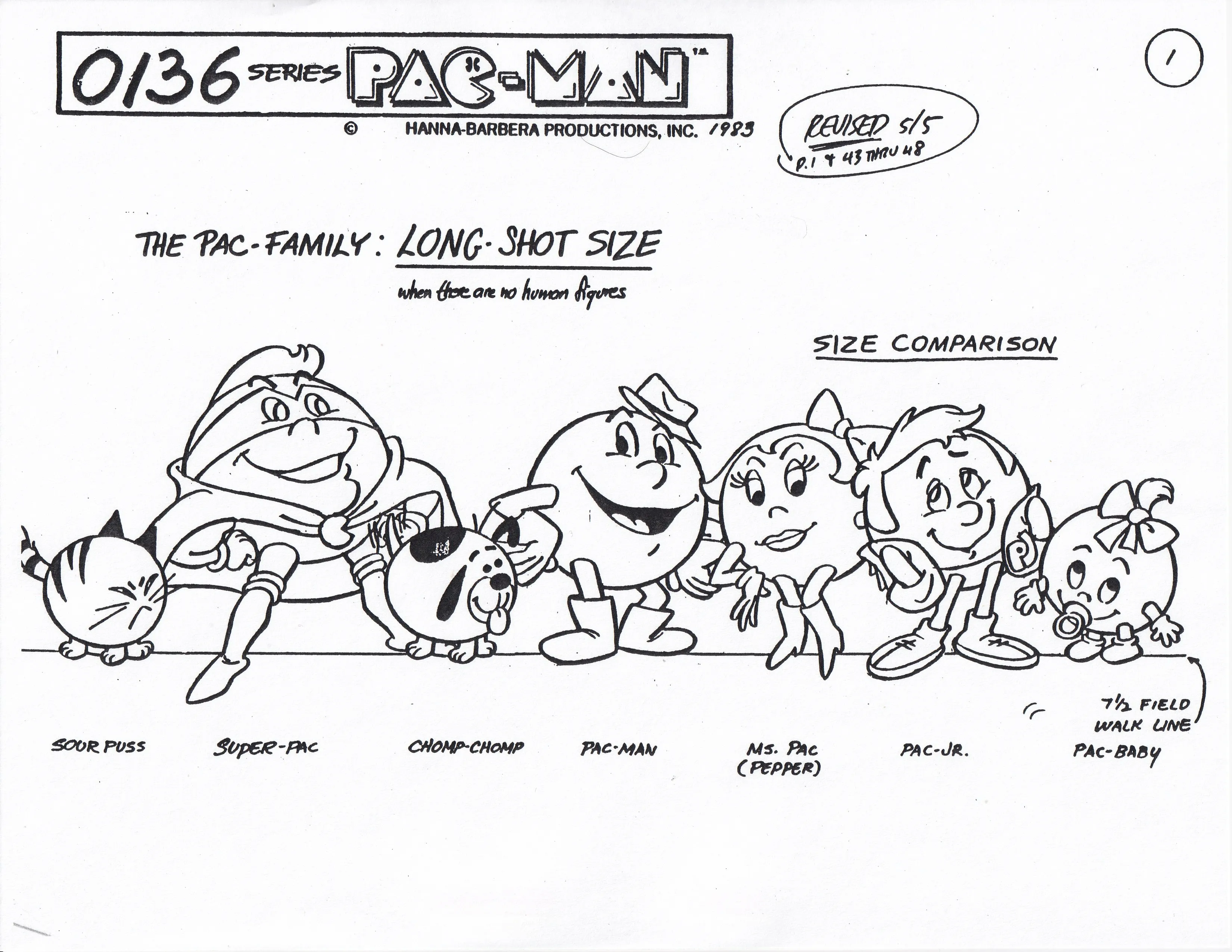
Revised sheet 1, with Super-Pac and Pac-Jr. added to the family comparison. Scan p. 3.
The 1983 version of sheet 1 keeps the walk line and expands the row from five figures to seven. Super-Pac arrives between the cat and dog; Pac-Jr. stands between Ms. Pac and the baby. A new “SIZE COMPARISON” heading states the purpose plainly.
Super-Pac’s cape and broad body fill the space above the pets, while Pac-Jr.’s hair and headphones distinguish him beside the adults. The additions are fitted into the same shared reference instead of being left as isolated portraits. Comparing the two sheets lets us see both a larger family and the drawing problem that comes with it: everyone still has to look right beside everyone else.
Four ghosts, one close-up
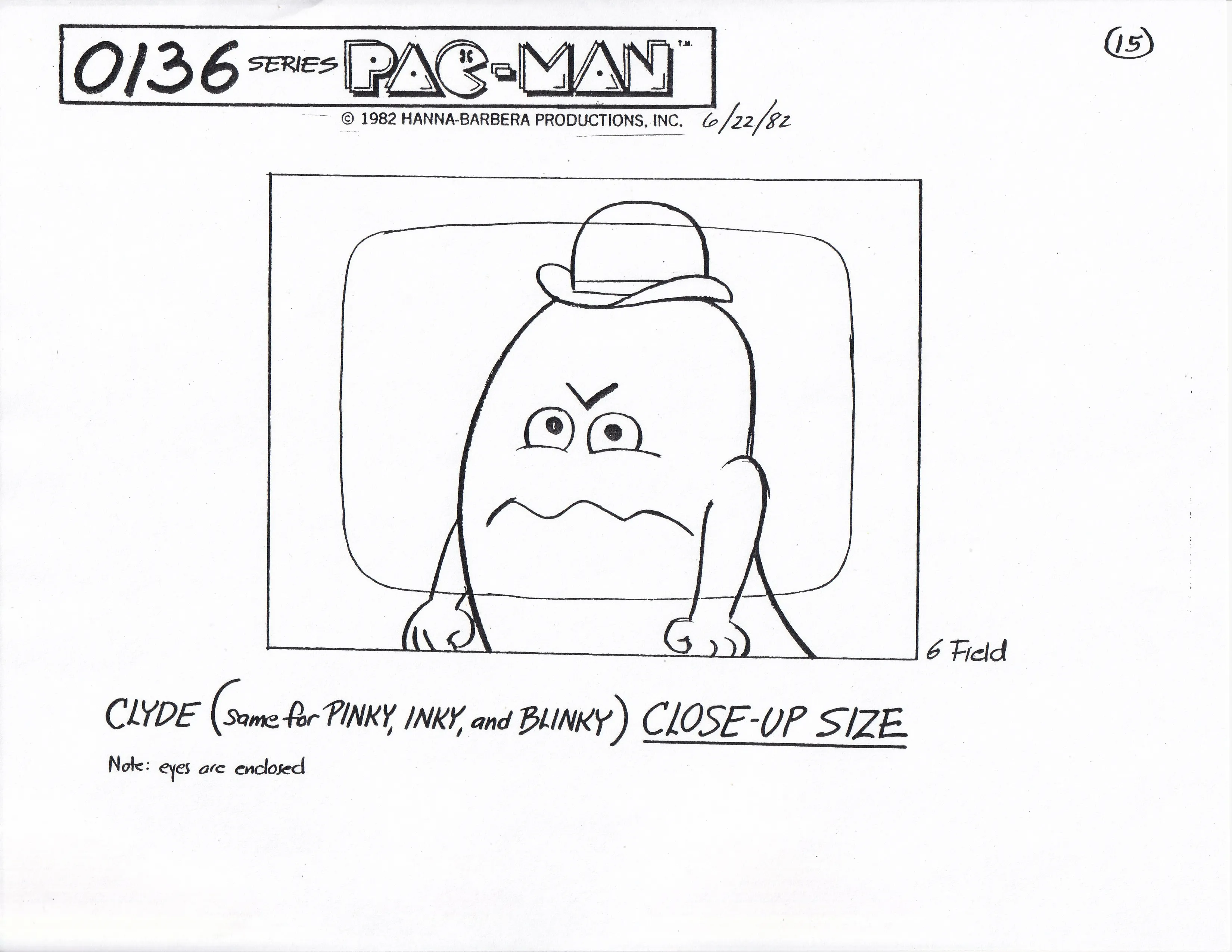
Sheet 15: Clyde’s close-up also sets the size for Pinky, Inky and Blinky. Scan p. 18.
The ghost lineup gives the first four ghosts different hats and gives Sue long eyelashes. The close-up sheet then reveals how much four of those designs share. Under Clyde’s face, the instruction reads “same for PINKY, INKY, and BLINKY.” One framed drawing sets the close-up size for four characters.
That shared instruction makes the hats in the lineup more interesting. Distinct silhouettes let the characters read as individuals, while the close-up reference holds their underlying proportions together. Sue is not included in that particular instruction.
When a human enters the picture
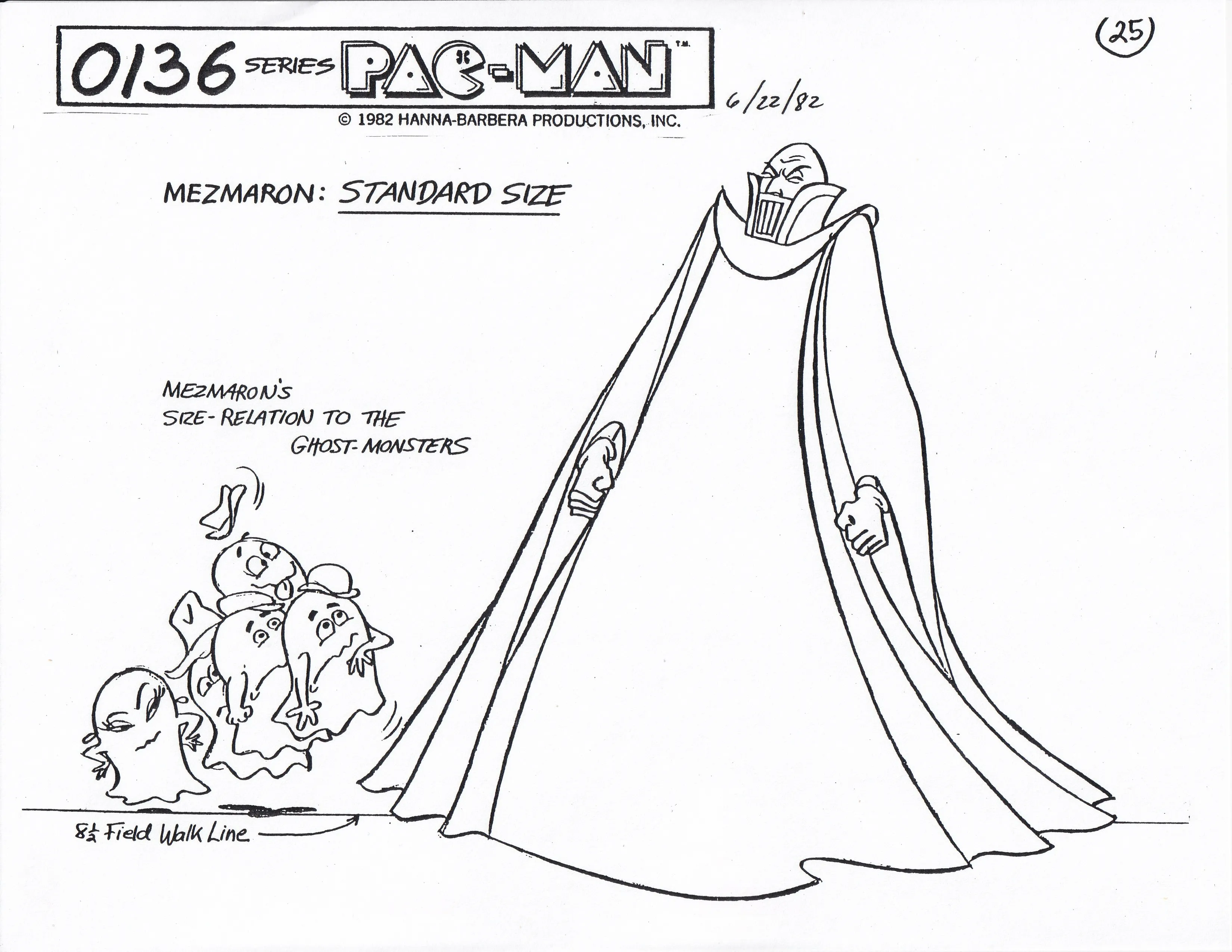
Sheet 25 puts Mezmaron and the ghosts in one size comparison. Scan p. 28.
Mezmaron’s sheet answers the qualification on those earlier lineups. The cloaked figure towers over a cluster of ghosts beside him. The label explicitly calls it his size relation to the ghost-monsters, and the baseline here is marked “8½ Field Walk Line.” The ghosts that filled their own page now occupy a small corner of his.
The comparison is funny as well as useful: even bunched together, the ghosts look outmatched. It brings the sheets’ quiet work into focus. A line, a gap beneath a body, or a second figure placed nearby can tell an artist how a whole cast belongs together—and tell a viewer who seems powerful before anyone speaks.
Source note
Hanna-Barbera Pac-Man model sheets, © 1982/1983 Hanna-Barbera Productions, Inc., hosted in the Internet Archive item linked below. The five images here are full sheets from the original PDF’s 3,300-pixel-wide scans, replacing smaller web copies; the uploader is pacmanyoshiproductions. The item’s CC BY-ND scan label is not a grant of rights to the underlying character artwork. The scans do not establish whether the photographed sheets are studio originals or later copies. The separate illustrated cover remains labeled as editorial artwork.
Sources
- Model sheet 1, 1982 (name revise note) · Internet Archive (scan host) · scan page 2
- Model sheet 1, revised 1983 · Internet Archive (scan host) · scan page 3
- Model sheet 13, ghost-monsters · Internet Archive (scan host) · scan page 15
- Model sheet 15, Clyde close-up · Internet Archive (scan host) · scan page 18
- Model sheet 25, Mezmaron · Internet Archive (scan host) · scan page 28
Artwork and toy photographs are credited reproductions from published sources.