From the archive Sailor Moon
Sailor Moon, Two Ways
In May 1994, Bandai's Japanese catalogue listed Sailor Moon S wands, compacts and a grail. In 1995, DiC sent American TV stations a pink binder that started the show over from episode one, with Usagi renamed Serena.
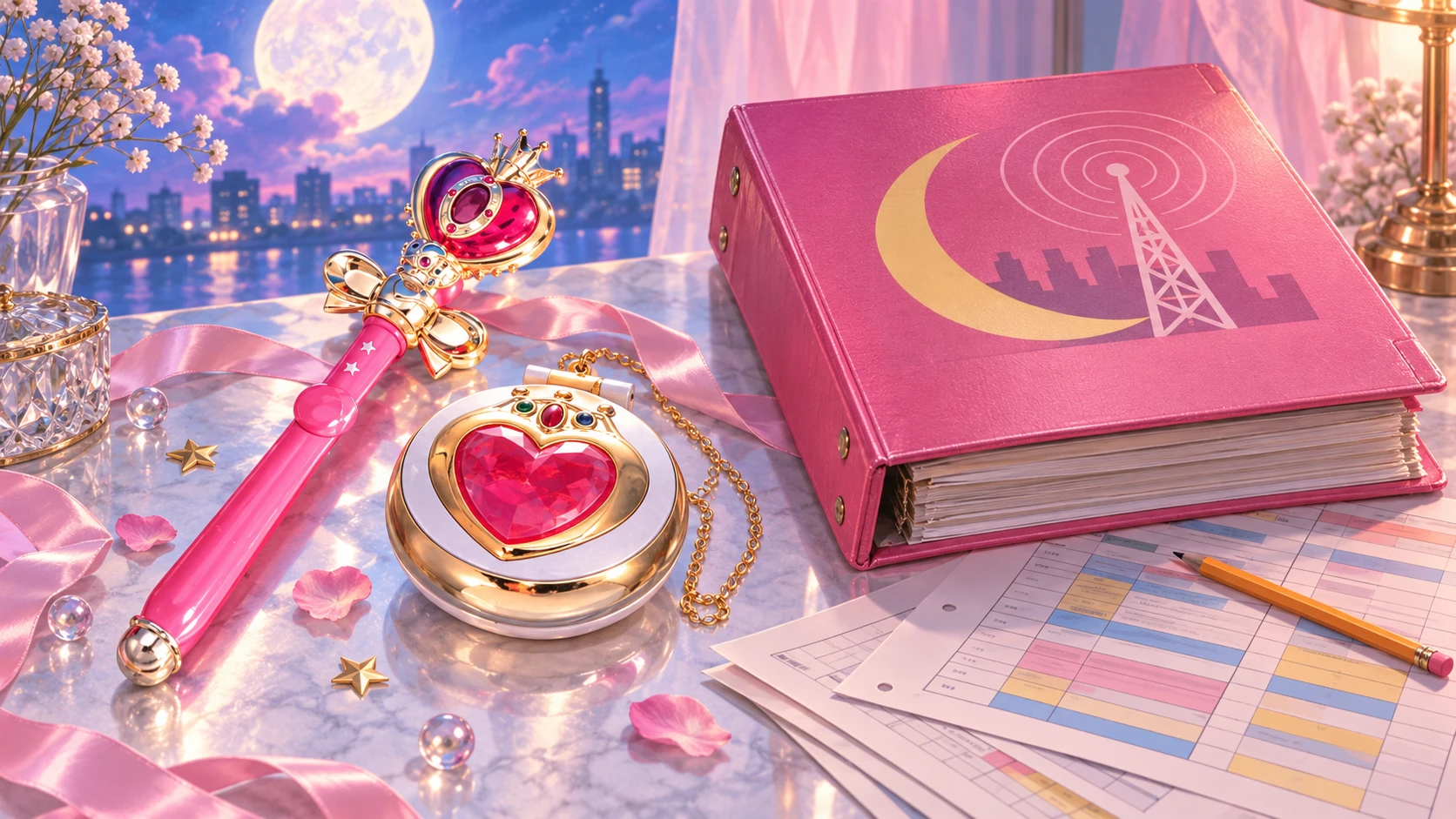
Original editorial illustration comparing Japanese Sailor Moon merchandise with a North American station binder. Source scans appear below.
AI editorial illustration · Rewind: Northwest RetroDesign reference ↗01 Historical source
Bandai · p. 059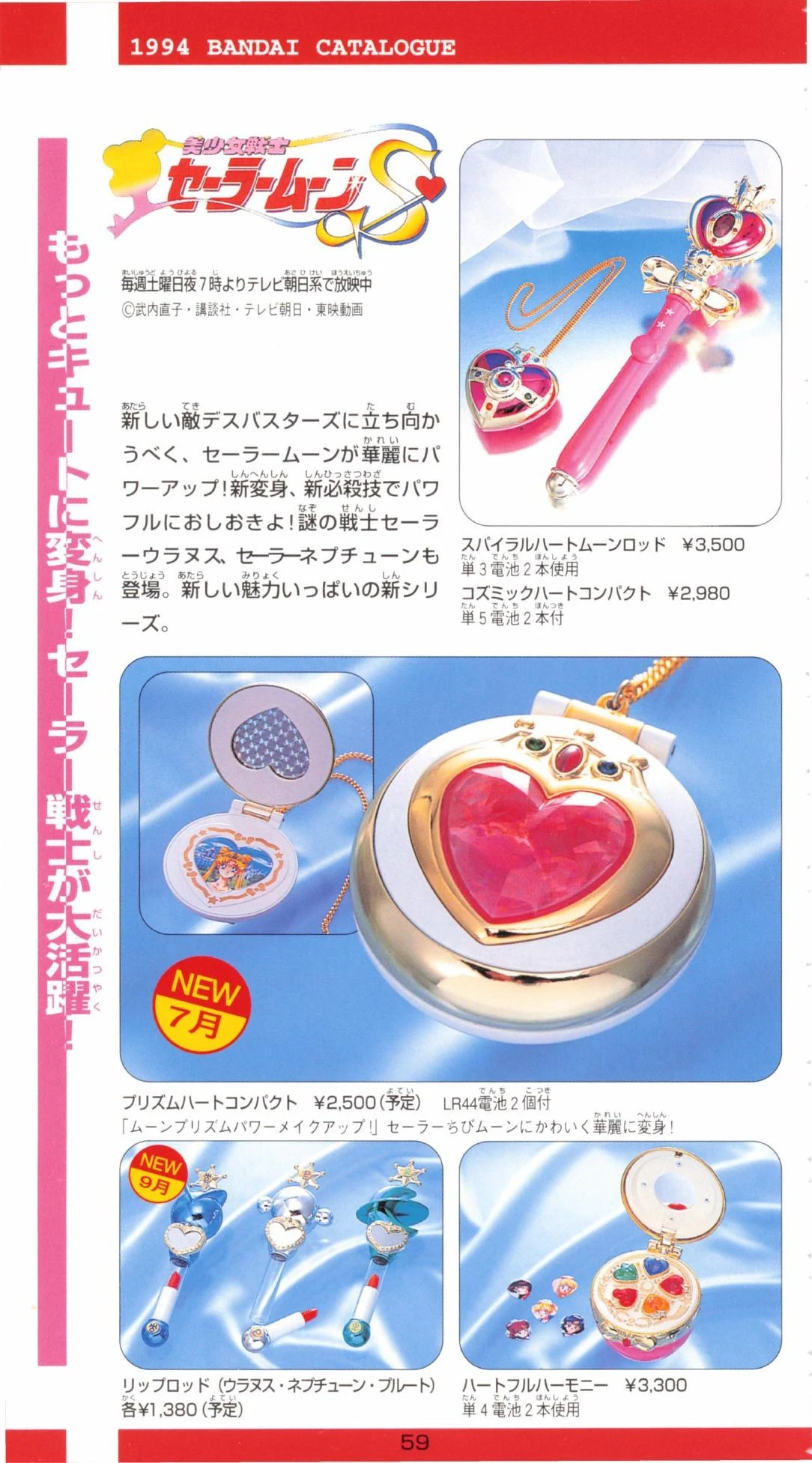
The *Sailor Moon S* opener in Bandai's 1994 catalogue: Spiral Heart Moon Rod, compacts, Lip Rods, Heartful Harmony. 1994 Bandai Catalogue, p. 059.
1994 Bandai Catalogue · printed p. 059 · scan p. 60Two documents from opposite sides of the Pacific show the same heroine on two timelines. One is Bandai’s Japanese toy catalogue. The other is a promotion kit addressed to station promotion managers. Neither was written for fans, and both end up telling collectors a lot. (All Japanese quotations in this Story are working translations.)
Saturday nights, 7 p.m.
Toei Animation’s own listings give the Japanese timeline. Bishoujo Senshi Sailor Moon aired from March 7, 1992, to February 27, 1993: 46 episodes, Saturdays from 7:00 to 7:30 p.m., on the TV Asahi network. Toei Animation, Sailor Moon page. Sailor Moon S followed, running from March 19, 1994, to February 25, 1995, in the same Saturday 7 p.m. slot. Toei Animation, Sailor Moon S page.
The 1994 Bandai Catalogue caught S in its first months. Its index notes that “this catalogue is current as of May 20, Heisei 6 [1994],” and that prices are manufacturer’s suggested retail, with consumption tax not included for most items. 1994 Bandai Catalogue, p. 114.
Wands, compacts and a grail
The Sailor Moon section opens on p. 59 with the S logo and a broadcast line: “On air every Saturday from 7 p.m. on the TV Asahi network.” The pitch is pure TV energy: “To stand up to the new enemy, the Death Busters, Sailor Moon powers up gorgeously! With a new transformation and new special moves, she punishes powerfully! The mysterious warriors Sailor Uranus and Sailor Neptune appear too. A new series full of new charm.” 1994 Bandai Catalogue, p. 59.
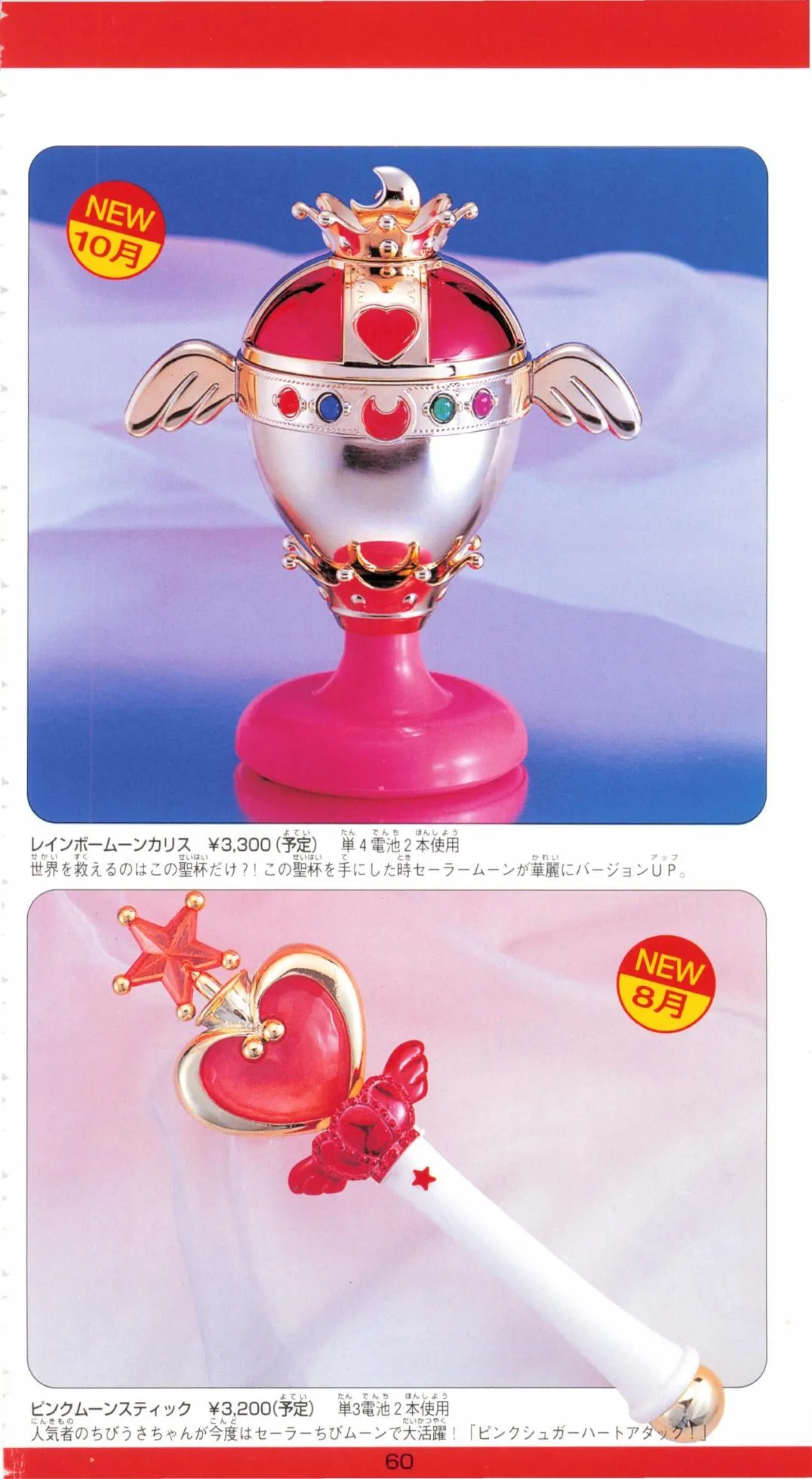
Rainbow Moon Chalice (“NEW October”) and Pink Moon Stick (“NEW August”), both priced “planned.” p. 060. 1994 Bandai Catalogue · printed p. 060 · scan p. 61.
Then comes the role-play hardware. Each item is listed with its price and batteries:
- Spiral Heart Moon Rod, ¥3,500, using two AA batteries. It’s pictured as a pink wand topped with a heart and a gold bow.
- Cosmic Heart Compact, ¥2,980, with two N-size batteries included.
- Prism Heart Compact, ¥2,500, marked “planned” (予定), with two LR44 cells included and a “NEW July” badge. The caption gives the call: “‘Moon Prism Power, Make Up!’ Sailor Chibi Moon transforms, cute and gorgeous!”
- Lip Rods for Uranus, Neptune and Pluto, ¥1,380 each (planned), with a “NEW September” badge.
- Heartful Harmony, ¥3,300, using two AAA batteries. It’s shown as a round case, opened to reveal colored hearts inside.
All on 1994 Bandai Catalogue, p. 59.
Page 60 is given over to two big photographs. The Rainbow Moon Chalice (¥3,300, planned, two AAA batteries, “NEW October”) is a winged, crowned cup on a pink stand: “Is this holy grail the only thing that can save the world?! When Sailor Moon takes it in hand, she gorgeously versions up.” The Pink Moon Stick (¥3,200, planned, two AA, “NEW August”) is a white wand topped with a red heart and a star: “Popular Chibiusa is a big hit this time as Sailor Chibi Moon! ‘Pink Sugar Heart Attack!’” 1994 Bandai Catalogue, p. 60.
“Planned,” with a month attached, is the catalogue’s own hedge. Four of the seven items on these two pages carry a provisional price and a month badge. The catalogue doesn’t say whether any month slipped.
A few pages on, the heroine’s everyday name shows up as a playset: “Welcome to Usagi’s Room” (ようこそうさぎのおへやへ), ¥3,980, “a room full of Usagi-chan’s favorite things.” 1994 Bandai Catalogue, p. 63.
The same heroine on cartridge
The game section carries her too. On p. 102, Super Famicom: Bishoujo Senshi Sailor Moon S: Kondo wa Puzzle de Oshioki yo!, a puzzle game for two players at once, 4M, ¥6,800 before tax, “NEW July.” It has mouse support and password continue. “The newest characters appear, and everyone is a big hit with their special moves. Whoever clears blocks fastest wins: a puzzle game with simple rules that anyone can play. You can enjoy the same transformation poses and voices as the TV anime!” The page credits ©ZOO corporation and ©BANDAI 1994. 1994 Bandai Catalogue, p. 102.
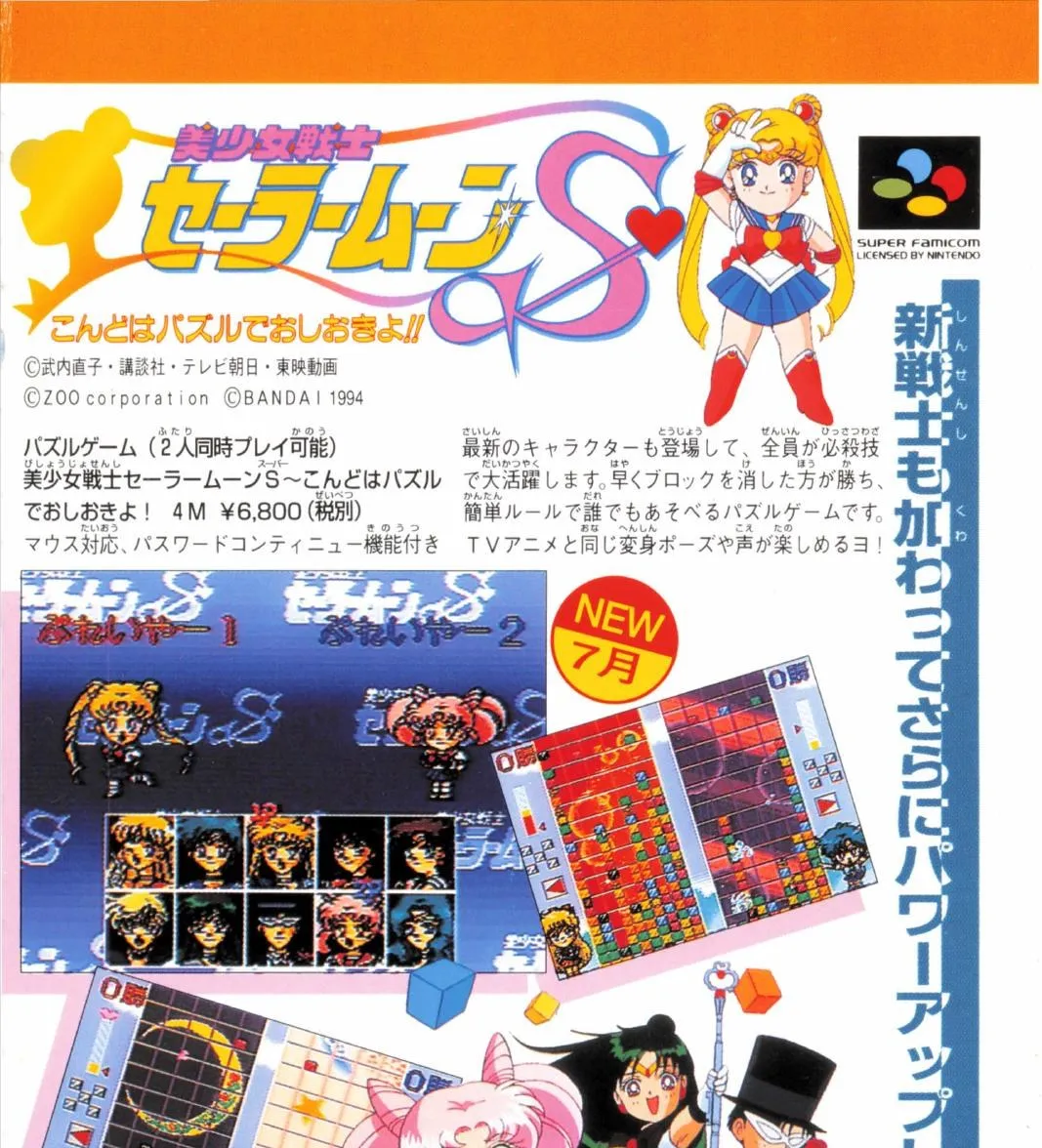
Super Famicom Sailor Moon S puzzle game, 4M, ¥6,800. p. 102. 1994 Bandai Catalogue · printed p. 102 · scan p. 103.
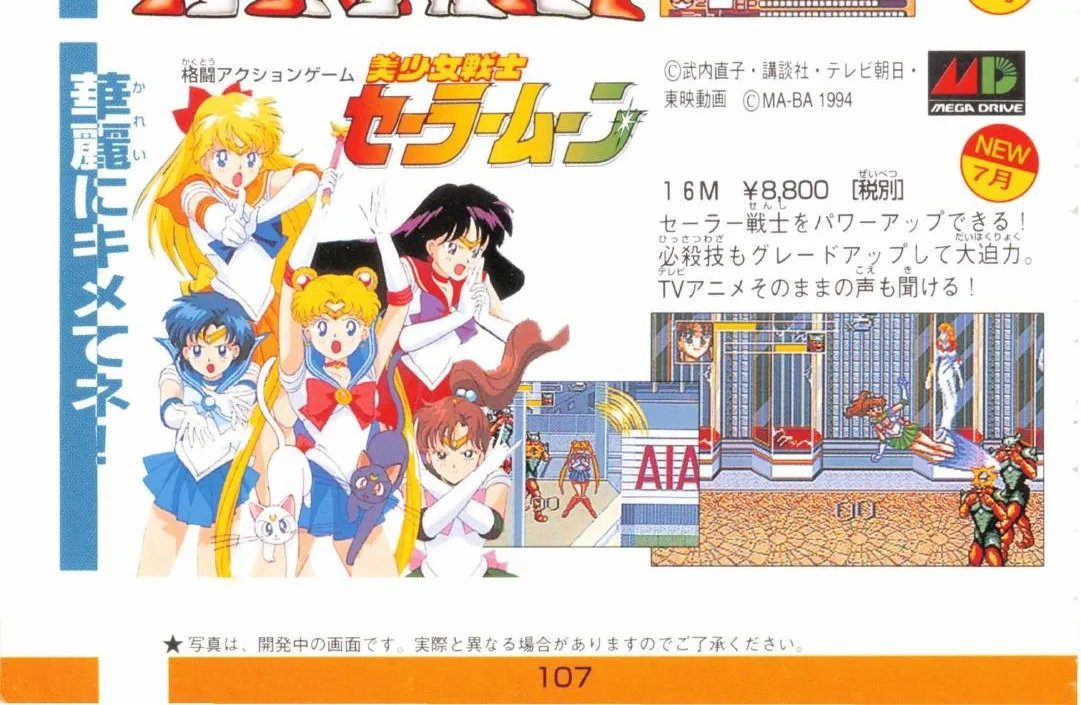
Mega Drive Sailor Moon, 16M, ¥8,800. p. 107. 1994 Bandai Catalogue · printed p. 107 · scan p. 108.
On p. 107, Mega Drive: Bishoujo Senshi Sailor Moon, a fighting action game, 16M, ¥8,800 before tax, also “NEW July,” credited ©MA-BA 1994. “Power up the Sailor warriors! Special moves upgraded for big impact. You can even hear the voices straight from the TV anime!” 1994 Bandai Catalogue, p. 107. Both pages carry the same note: the photos are screens still in development and may differ from the final game. 1994 Bandai Catalogue, pp. 102, 107.
“Dear Promotion Manager”
Now cross the Pacific. The station kit scanned for the Internet Archive is a pink three-ring binder with tabbed sections (DiC station kit, scan page 25). Its cover letter reads: “This is your station promotion kit for DIC’s newest animated childrens’ series, SAILOR MOON. We have included everything in this binder that you will need to advertise, publicize and promote this exciting new half hour strip.” It lists a contact sheet, satellite feed information, a format sheet, an air schedule, a show overview and synopsis, character introductions, B/W line art, logos, color slides and B/W prints, and “Information on the SAILOR MOON Fan Club.” It closes: “Like SAILOR MOON, we’ll never turn our back on a friend! Good luck!” It’s signed by Bob Siegal (GM, Cable & Syndicated Programming, DIC Entertainment) and Sue Raymer (Promotion & Marketing Consultant). DiC station kit, scan page 2.
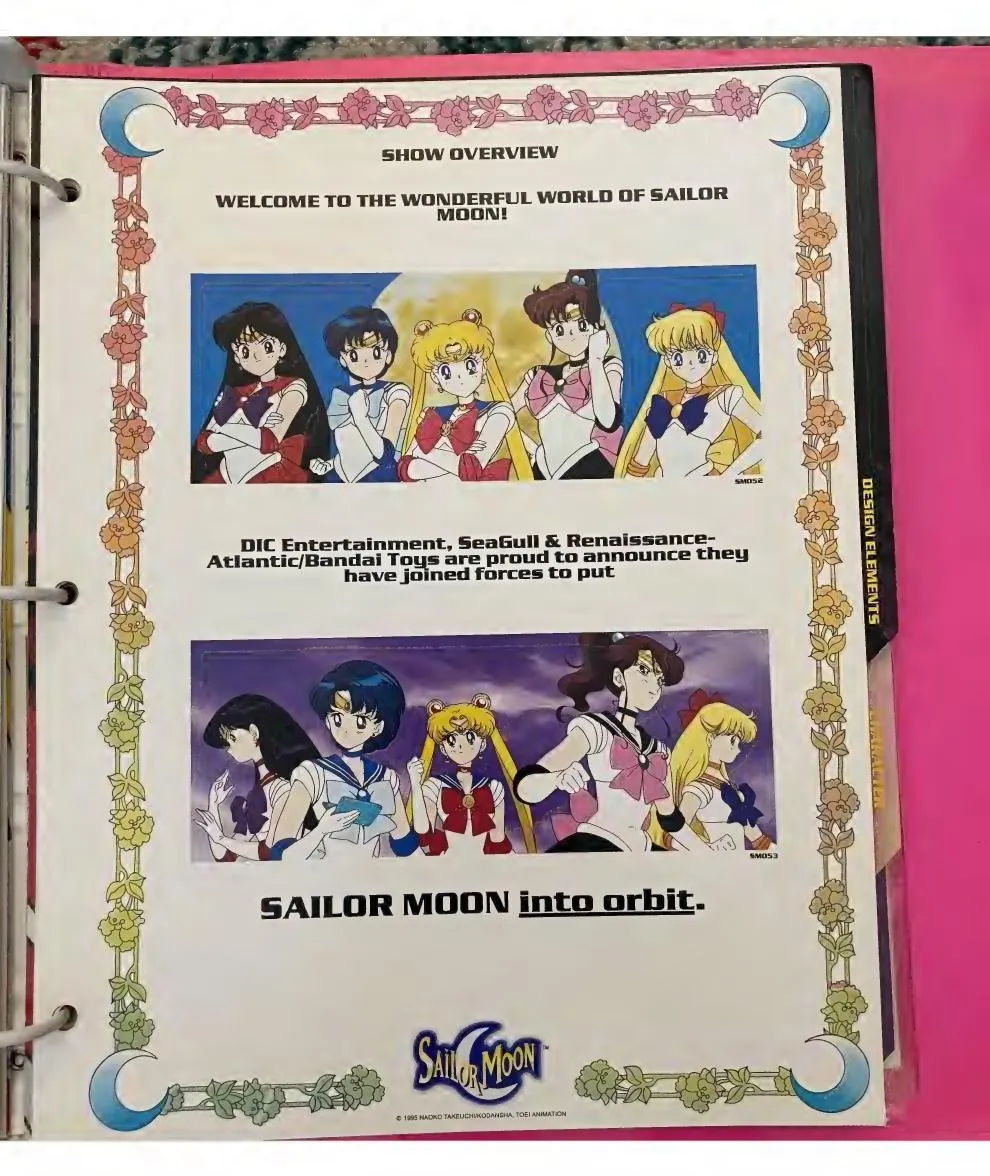
“Show Overview”: DiC, SeaGull and Renaissance-Atlantic/Bandai Toys “put SAILOR MOON into orbit.” DiC TV Station Promotional Binder · 1995 · scan p. 25.
The kit’s pages carry the footer “© 1995 Naoko Takeuchi/Kodansha, Toei Animation.” DiC station kit, scan pages 2, 7.
The “Show Overview” announces a partnership: “DIC Entertainment, SeaGull & Renaissance-Atlantic/Bandai Toys are proud to announce they have joined forces to put SAILOR MOON into orbit.” DiC station kit, scan page 25. The kit doesn’t say which American toys were planned.
Episode one, again
The schedule sheet makes the time gap plain. “Sailor Moon Titles & Air Dates” begins with 9/11/95, episode 254-101, “A Moon Star is Born,” and runs weekday by weekday: “Talk Radio” on 9/12, “Slim City” on 9/13, and so on to “A Friend in Wolf’s Clothing” on 10/6/95. DiC station kit, scan page 7. A later insert tells promotion managers: “Enclosed are story synopsis for all 65 episodes of Sailor Moon.” DiC station kit, scan page 12. These are the kit’s planned dates. They don’t show when any particular station actually aired the show.
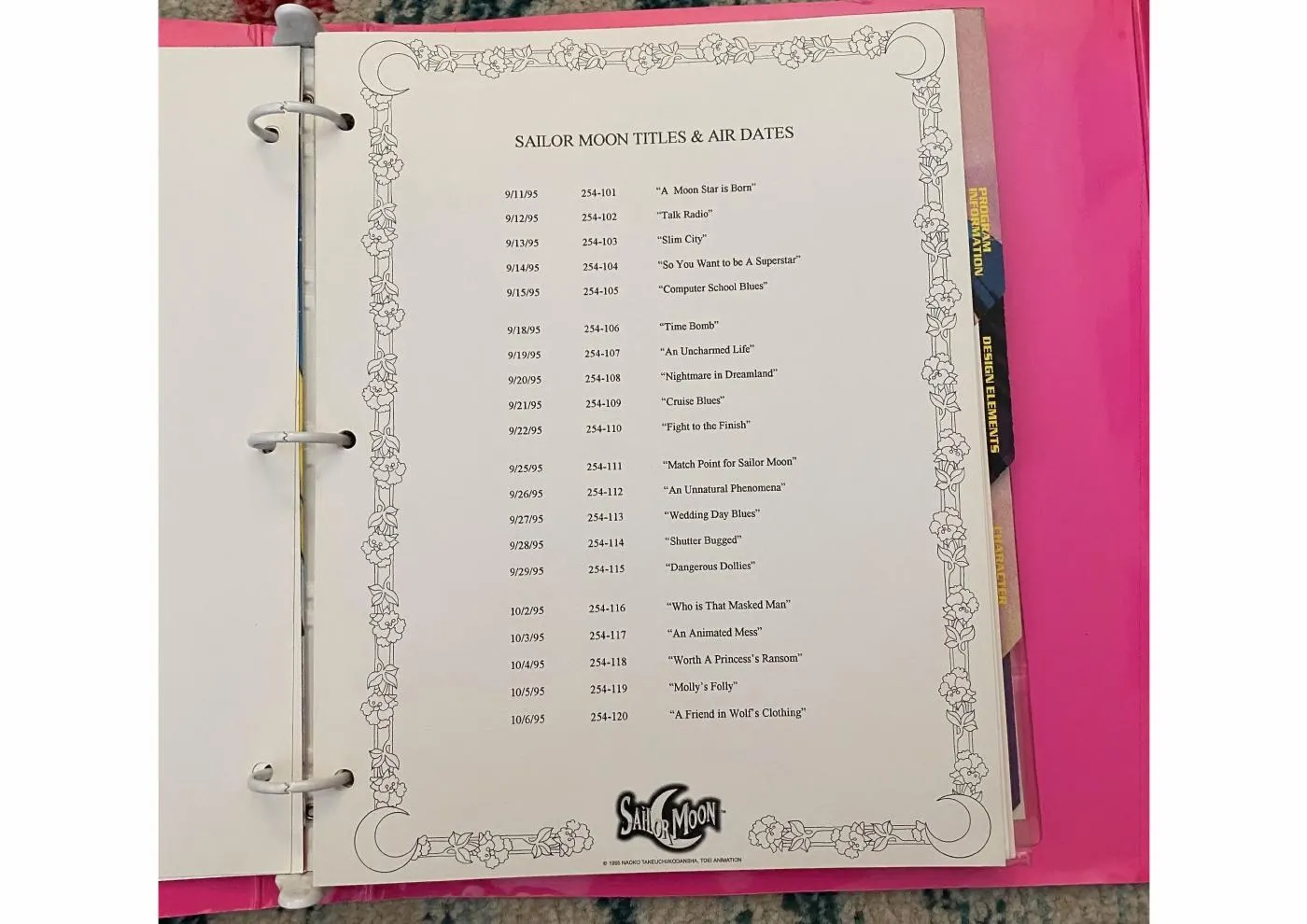
“Sailor Moon Titles & Air Dates,” 9/11/95–10/6/95, in the station binder. DiC TV Station Promotional Binder · 1995 · scan p. 7.
The synopsis for #101 sets the scene: “In this premiere episode, 14 year old schoolgirl, Serena learns that she is ‘Sailor Moon’ and that her destiny is to save the world from the evil Queen Beryl.” It ends with a moral: “believe in yourself and anything is possible.” DiC station kit, scan page 13.
So in the fall of 1995, the kit was launching U.S. stations at the very start of the story, with Queen Beryl as the enemy. In Japan, by Toei’s dates, the series had begun in March 1992, and the May 1994 catalogue was already selling S, with its Death Busters, Uranus and Neptune.
Usagi becomes Serena
A second scanned copy of DiC’s syndication binder includes the program pages that do the renaming. “SAILOR MOON – (Earthly name: SERENA) – is the leader of the SAILOR SCOUTS,” the story page says, joined by Raye, Amy, Lita and Mina, with the enemy in “the NEGAVERSE, an evil parallel dimension.” Her call is printed as “MOON PRISM… POWER!” DiC syndication binder, program information, scan page 3. The next page adds Luna and Artemis, “in form of talking cats,” and Tuxedo Mask, whose “Earthly name is DARIEN.” It likens Serena and Darien to “Lois Lane and Clark Kent.” DiC syndication binder, program information, scan page 4.
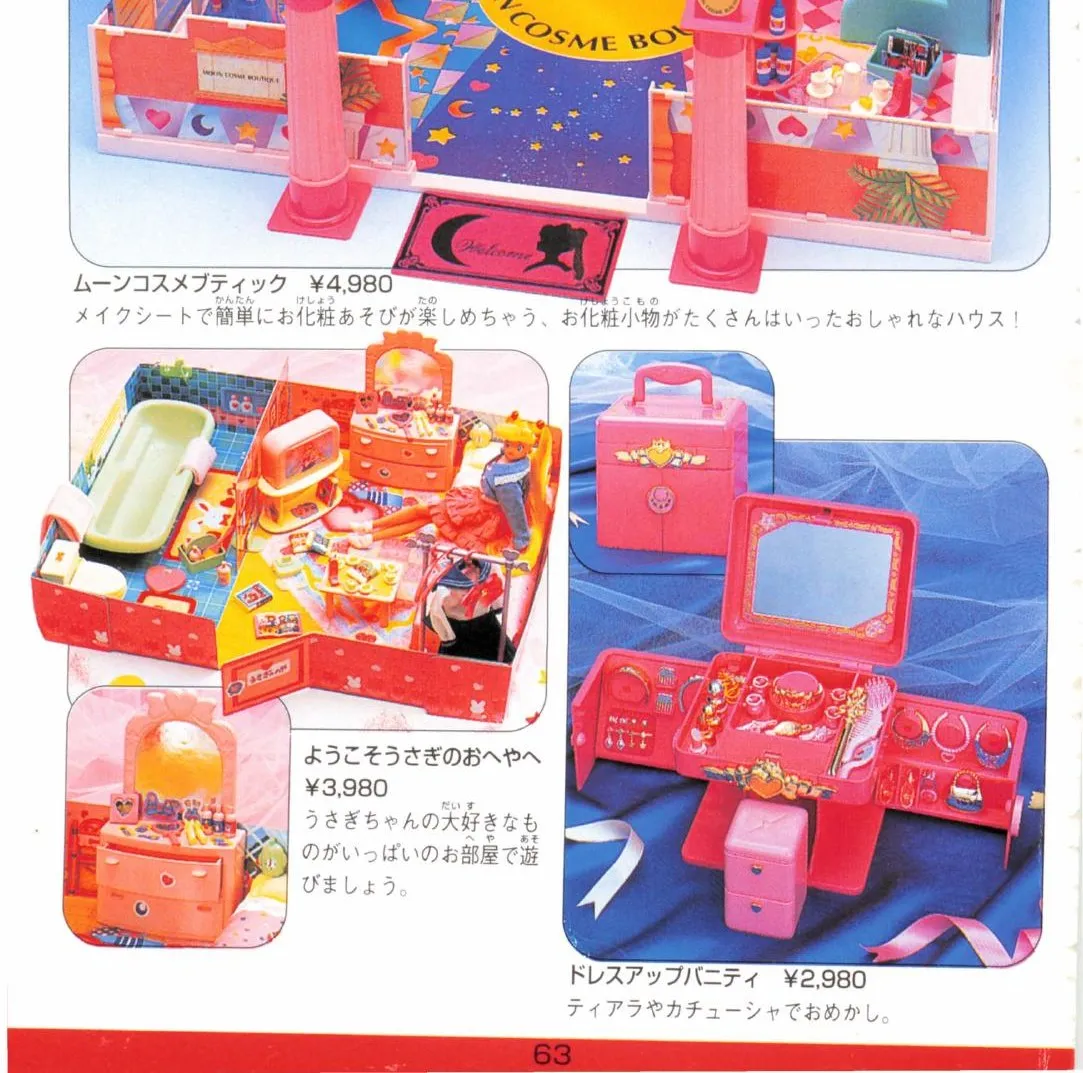
“Welcome to Usagi’s Room,” ¥3,980. p. 063. 1994 Bandai Catalogue · printed p. 063 · scan p. 64.
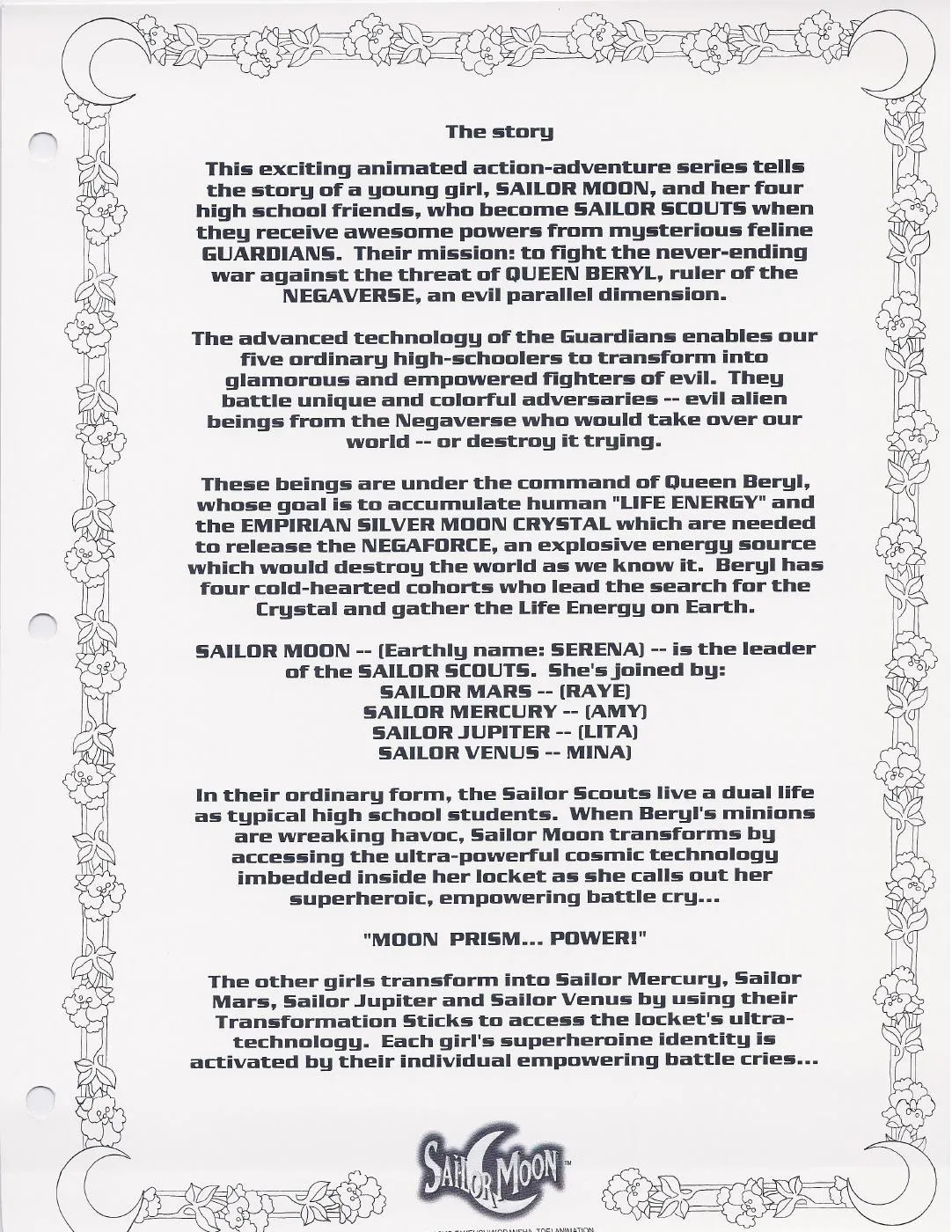
“SAILOR MOON – (Earthly name: SERENA).” DiC syndication binder · scans by Sailor V, courtesy Corza Moon · program information, scan p. 3.
Put the two documents side by side and the details trade places. Bandai’s caption for a toy compact quotes the call as “Moon Prism Power, Make Up!” DiC prints “MOON PRISM… POWER!” Bandai sells a playset called “Usagi’s Room.” DiC’s heroine is Serena. The binder describes the Scouts as high schoolers, yet its own episode synopsis calls Serena a “14 year old schoolgirl.” DiC syndication binder, program information, scan page 3; DiC station kit, scan page 13.
What the documents can’t tell us
The catalogue lists prices, planned months and batteries. It can’t confirm that any item shipped on schedule. The binder lists a launch date, a partnership and a set of names. It can’t tell us which stations aired the show, when, or what toys followed. Each was a sales tool, and each has to be read that way. Read together, they show the same girl being pitched twice: in Japan, through compacts and a grail partway through Sailor Moon S, and in America as a new weekday strip starting from episode one.
Sources
- 1994 Bandai Catalogue — Sailor Moon S opener: Spiral Heart Moon Rod, compacts, Lip Rods, Heartful Harmony · Bandai · 1994 · page 059 · scan page 60
- 1994 Bandai Catalogue — Rainbow Moon Chalice, Pink Moon Stick · Bandai · 1994 · page 060 · scan page 61
- 1994 Bandai Catalogue — Welcome to Usagi's Room · Bandai · 1994 · page 063 · scan page 64
- 1994 Bandai Catalogue — Super Famicom: Sailor Moon S puzzle game · Bandai · 1994 · page 102 · scan page 103
- 1994 Bandai Catalogue — Mega Drive: Sailor Moon · Bandai · 1994 · page 107 · scan page 108
- 1994 Bandai Catalogue — index and notes (current as of May 20, 1994) · Bandai · 1994 · page 114 · scan page 115
- Sailor Moon TV Station Promotional Binder — cover letter · DIC Entertainment · 1995 · scan page 2
- Sailor Moon TV Station Promotional Binder — Titles & Air Dates · DIC Entertainment · 1995 · scan page 7
- Sailor Moon TV Station Promotional Binder — synopsis insert · DIC Entertainment · 1995 · scan page 12
- Sailor Moon TV Station Promotional Binder — synopsis #101–#106 · DIC Entertainment · 1995 · scan page 13
- Sailor Moon TV Station Promotional Binder — Show Overview · DIC Entertainment · 1995 · scan page 25
- Sailor Moon: Original DiC Syndication Binder — program information · DIC Entertainment · 1995
- 美少女戦士セーラームーン — broadcast data · Toei Animation · 2026
- 美少女戦士セーラームーンS — broadcast data · Toei Animation · 2026
Artwork and toy photographs are credited reproductions from published sources.