From the archive Micro Machines
Secret Auto Supplies
A wax tin becomes a car wash, a motor-oil can becomes a garage, and a gas can conceals a mountain road. Galoob's 1990 Micro Machines catalogue makes the container part of the toy.
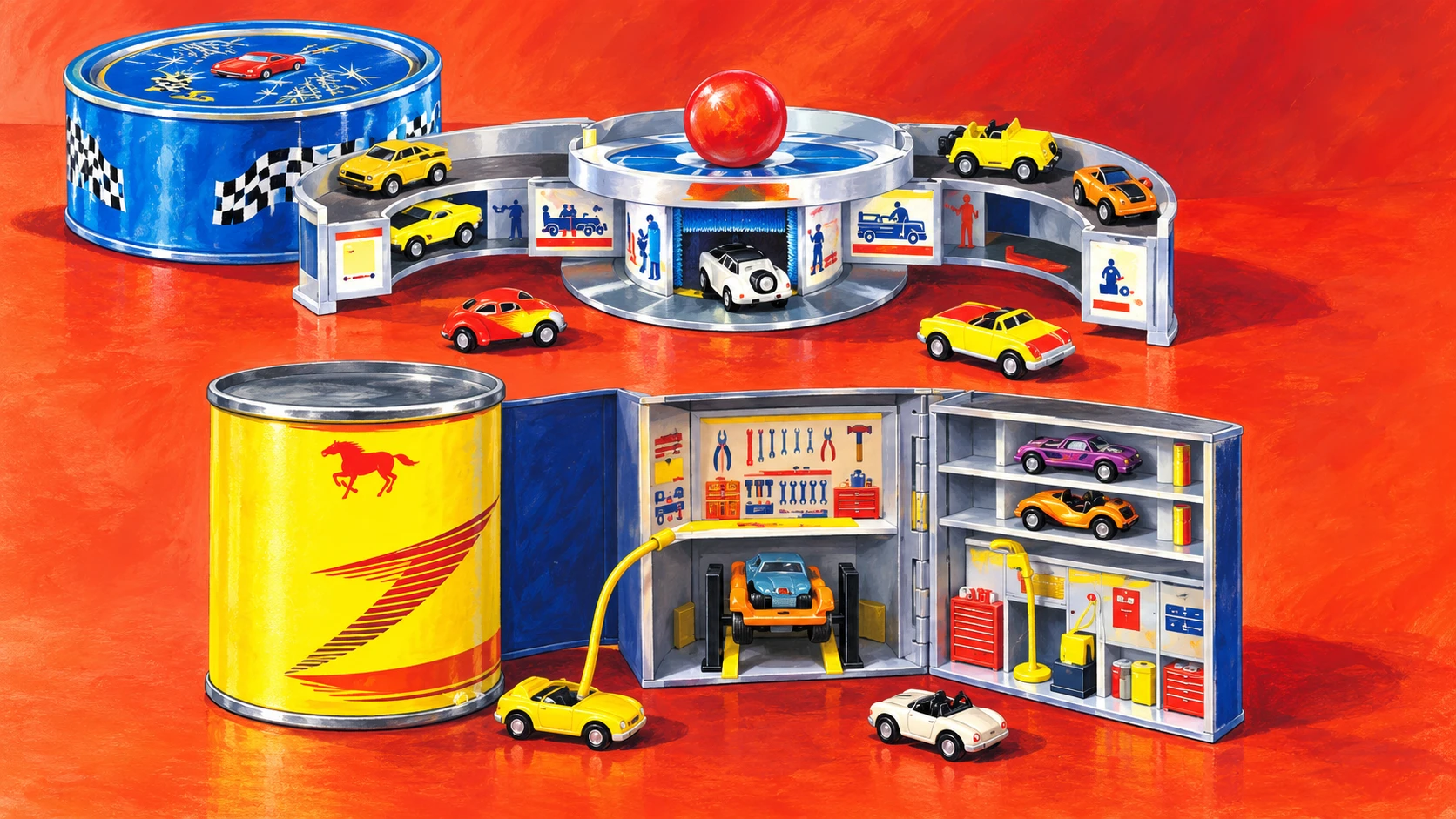
Original editorial illustration inspired by Galoob’s 1990 Secret Auto Supplies catalogue page. The historical page appears below.
AI editorial illustration · Rewind: Northwest RetroDesign reference ↗01 Historical source
Lewis Galoob Toys · scan p. 14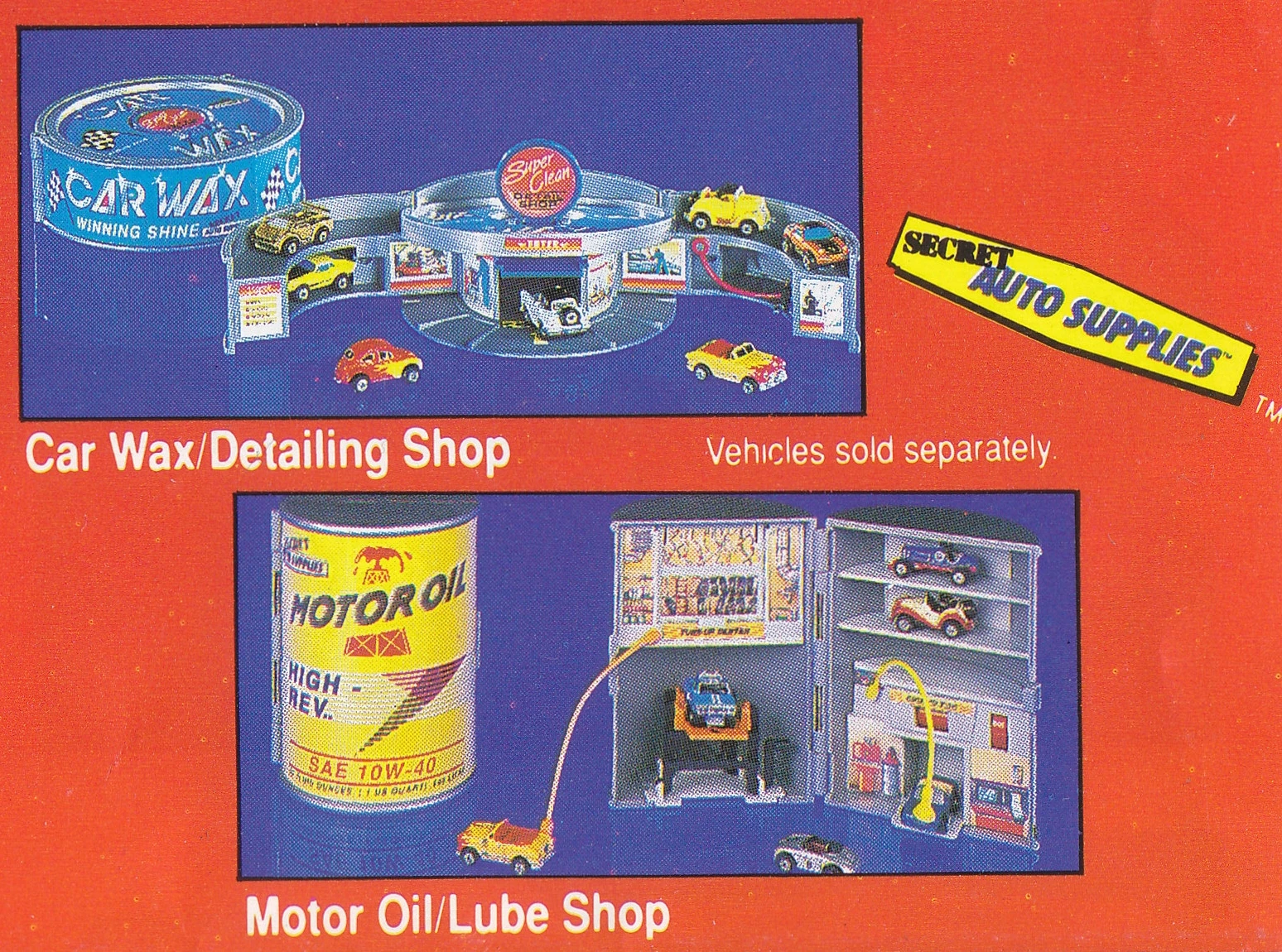
"Secret Auto Supplies": Car Wax/Detailing Shop and Motor Oil/Lube Shop. Micro Machines 1990, scan page 14.
1990 Micro Machines Catalog · Lewis Galoob Toys · scan p. 14A can of car wax is an unlikely place to park a fleet of tiny cars. Open it, though, and the disguise makes sense: the blue tin becomes a circular detailing shop. The motor-oil can beside it opens into a garage. In Galoob’s 1990 Micro Machines catalogue, the things used to care for cars become places for cars to go.
The label is “Secret Auto Supplies.” Each photograph gives away the secret immediately, showing the ordinary-looking container beside its miniature interior. That before-and-after comparison is the attraction: the closed object offers a clue, and the open one rewards looking again.
The shape survives the disguise
The Car Wax/Detailing Shop keeps the round tin’s shape at the heart of the scene. A central wash bay sits inside the circle, while opened sections extend to either side. Cars can gather around an object that, when shut, looks as though it belongs on a garage shelf.
The Motor Oil/Lube Shop makes a different use of its container. The tall yellow can becomes an upright workshop, with a car on a lift on one side and shelves holding two more cars on the other. The height that sells the oil-can disguise also gives the open garage space to stack vehicles. A yellow hose-like line reaches from the workshop toward a car outside.
Both toys match their hidden activity to the product printed on the outside: wax suggests washing and detailing; oil suggests servicing. The container supplies a theme as well as a place to put the scene away. The pictures even preserve the contrast in shapes—a low circle beside a tall cylinder—after both are opened.
A battery with a runway
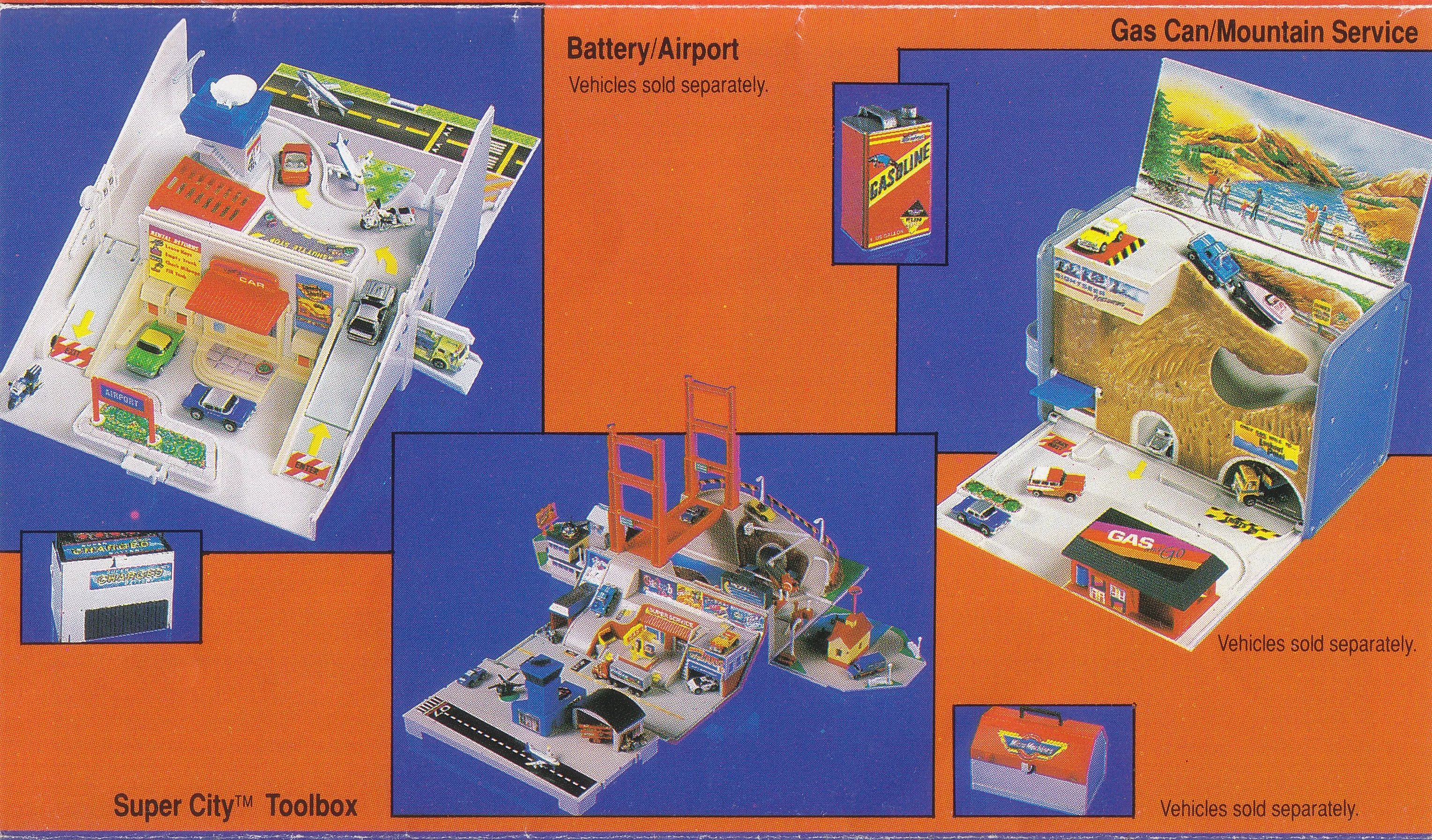
Battery/Airport at left, Gas Can/Mountain Service at right, and Super City Toolbox below. Closed-container insets let you compare each disguise with its open scene. Micro Machines 1990, scan p. 15.
The next page stretches that relationship. The Battery/Airport pairs a squat white battery with a surprisingly long open scene: a runway across the back, a terminal and parked vehicles in front. The airport’s broad base and upright panels turn the little block into somewhere a plane can land.
The Gas Can/Mountain Service makes its red gasoline-can disguise the entrance to a road trip. Inside, a painted mountain backdrop rises behind a winding road, tunnels and a small stop marked “GAS.” Here the fuel container hints at the journey, while its height gives the mountain somewhere to rise. The nearby Super City Toolbox takes the same closed/open presentation to a larger city with an orange bridge.
The catalogue is showing finished configurations, not an assembly sequence. Its repeated “Vehicles sold separately” also matters: the busy traffic makes these places look inviting, but those pictured cars are not a promise of what comes in the playset.
The card becomes the destination
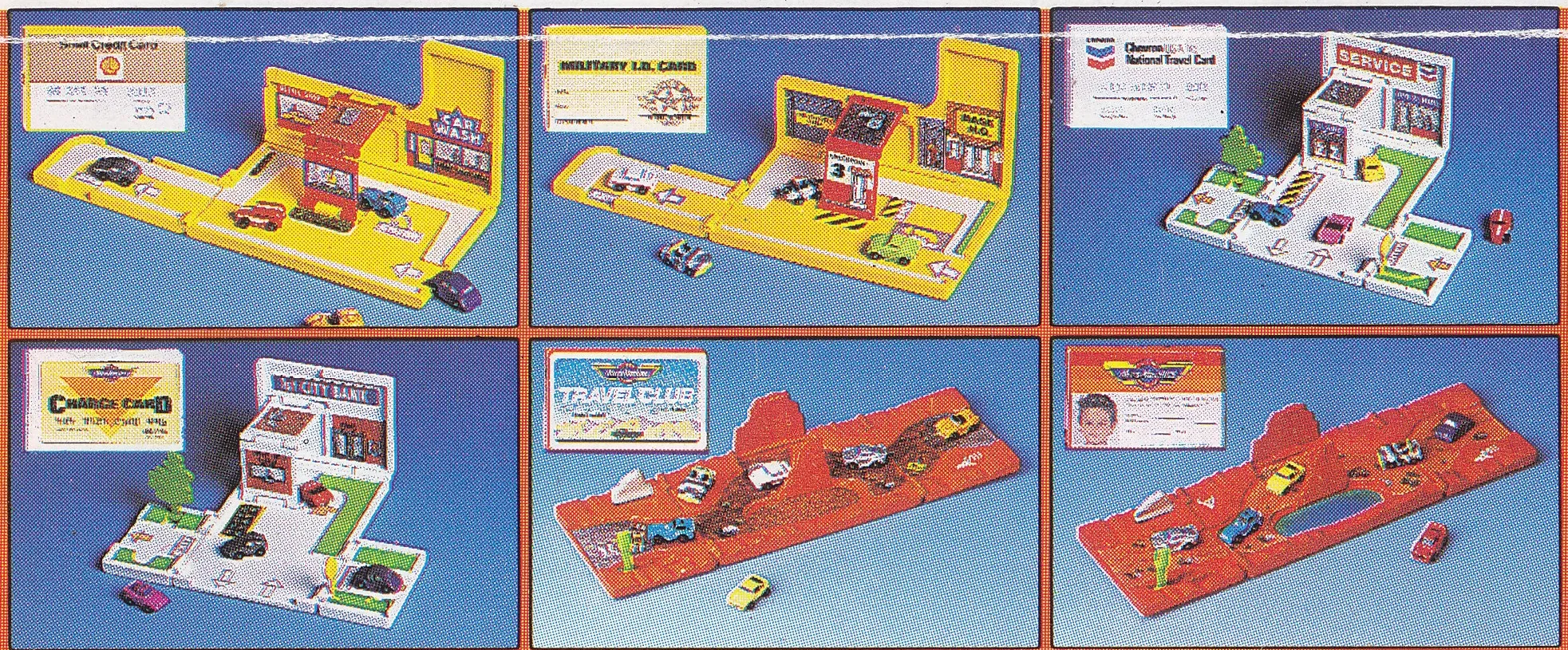
The six Insiders Credit Card Playsets, cropped from scan p. 9. Each card face supplies a different setting for the little scene.
The Credit Card Playsets compress the idea into flat rectangles. A Shell card accompanies a drive-through wash; a military ID goes with a command base. A Chevron card becomes a service stop and a Micro Machines charge card a city bank. The Travel Club and Drivers License versions trade buildings for red landscapes: Desert Dunes and Country Adventure.
Look across the six photographs and the visual economy becomes clear. Similar small bases can suggest a business, a military site or a holiday simply by changing the card face and scenery. The grander battery and gas-can sets build upward; these spread their worlds across a shallow surface.
That is the pleasure running through all of them. A container is recognizable before opening, then earns a second look afterward. The little cars have somewhere to go, and putting the place away restores the disguise.
Source note
1990 Micro Machines Catalog, Lewis Galoob Toys, scan pp. 9, 14–15; the fold-out has no printed page numbers. Images come from the original PDF scan, with crops for the wax/oil and card comparisons. Product pairings and visible shapes support the reading here; the catalogue does not establish exact dimensions or explain the opening mechanisms. Historical photographs credited to Lewis Galoob Toys.
Sources
- 1990 Micro Machines Catalog — Insiders Credit Card Playsets, Pocket Garages, Double Play · Lewis Galoob Toys · 1990 · scan page 9
- 1990 Micro Machines Catalog — City Scenes, Secret Auto Supplies · Lewis Galoob Toys · 1990 · scan page 14
- 1990 Micro Machines Catalog — Battery/Airport, Gas Can/Mountain Service, Super City Toolbox · Lewis Galoob Toys · 1990 · scan page 15
Artwork and toy photographs are credited reproductions from published sources.