From the archive ThunderCats
Cleared in 110 Markets: ThunderCats in the Pages of Broadcasting, 1984–85
Four issues of the trade weekly Broadcasting follow ThunderCats from a Telepictures ad promising a September 1985 debut to a column of early Nielsen averages. Together they show the barter deal that brought a Rankin/Bass strip to local stations.

New editorial illustration inspired by the historical material below; the source images remain credited separately.
AI editorial illustration · Rewind: Northwest RetroDesign reference ↗01 Historical source
Broadcasting Publications Inc. · scan p. 2
Full-page red Telepictures ad with show logos drawn as enamel pins and several 'COMING SOON' boxes, the Telepictures Corporation logo at the foot.
Advertisement © 1984 Telepictures Corporation; magazine pages © Broadcasting Publications Inc.; ThunderCats characters © their rights holders. Scans: World Radio History full-issue PDFs. Rendered at 200 dpi, cropped and downscaled; not retouched. · Broadcasting 3 Sep 1984, PDF p.2Fans tend to remember ThunderCats through its toys, its opening titles and Lion-O’s sword. Trade magazines preserve the language distributors used to pitch it to station managers. Broadcasting was the weekly of the American radio and television business, and its 1984–85 issues, scanned in full by World Radio History, let us watch a cartoon become a syndication product. The pages contain no episodes and no character designs. What they hold is percentages, barter minutes and booth addresses: the language a distributor used to sell a show ahead of its advertised launch.
The ad: “Coming soon”
The September 3, 1984 issue opens (PDF p. 2) with a full-colour Telepictures Corporation page on a red background. The company’s shows are drawn as enamel pins scattered across the page, under the line “We’re not hard to pin down.” Next to established titles such as The People’s Court and Love Connection are four “COMING SOON” boxes. One reads:
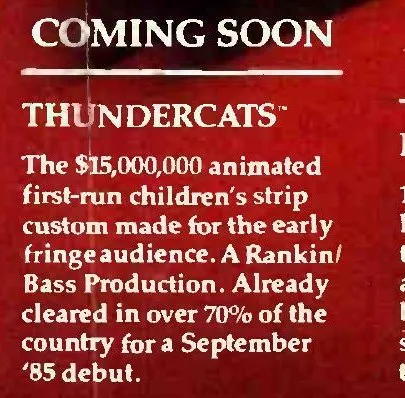
Close-up of white text on red: ‘COMING SOON / THUNDERCATS’, describing a $15,000,000 animated first-run strip cleared in over 70% of the country. Advertisement © 1984 Telepictures Corporation; magazine pages © Broadcasting Publications Inc.; ThunderCats characters © their rights holders. Scans: World Radio History full-issue PDFs. Rendered at 200 dpi, cropped and downscaled; not retouched. · detail of image 1.
“THUNDERCATS™ The $15,000,000 animated first-run children’s strip custom made for the early fringe audience. A Rankin/Bass Production. Already cleared in over 70% of the country for a September ’85 debut.”
Each phrase is a trade term. “First-run” means new episodes made for syndication, not network reruns. A “strip” runs every weekday rather than once a week. “Early fringe” is the late-afternoon slot before the evening news, when local independents chased children coming home from school. “Cleared” means stations had committed to carry the show. The $15,000,000 figure is the advertiser’s own claim about the budget; the page gives no breakdown, and this Story treats it as a sales figure, not an audited cost. The scan carries a library stamp from the Air University Library at Maxwell Air Force Base, a reminder that these copies survived as institutional subscriptions. The ad’s small print reads “© 1984 Telepictures Corporation.”
A year ahead of its debut, then, the show was already being sold on coverage. In 1984 the “70%” was the headline number, not any ratings figure.
NATPE, January 1985
The next stop is the January 14, 1985 issue, which covered the NATPE International programming convention, the annual market where distributors sold shows to station buyers. A news story headlined “Plenty of programing on NATPE display” (PDF p. 84) surveys the floor. Among its claims about what distributors had cleared ahead of the fall, it says: “Telepictures’ animated children’s series, Thundercats, has reached an 80% clearance level.”
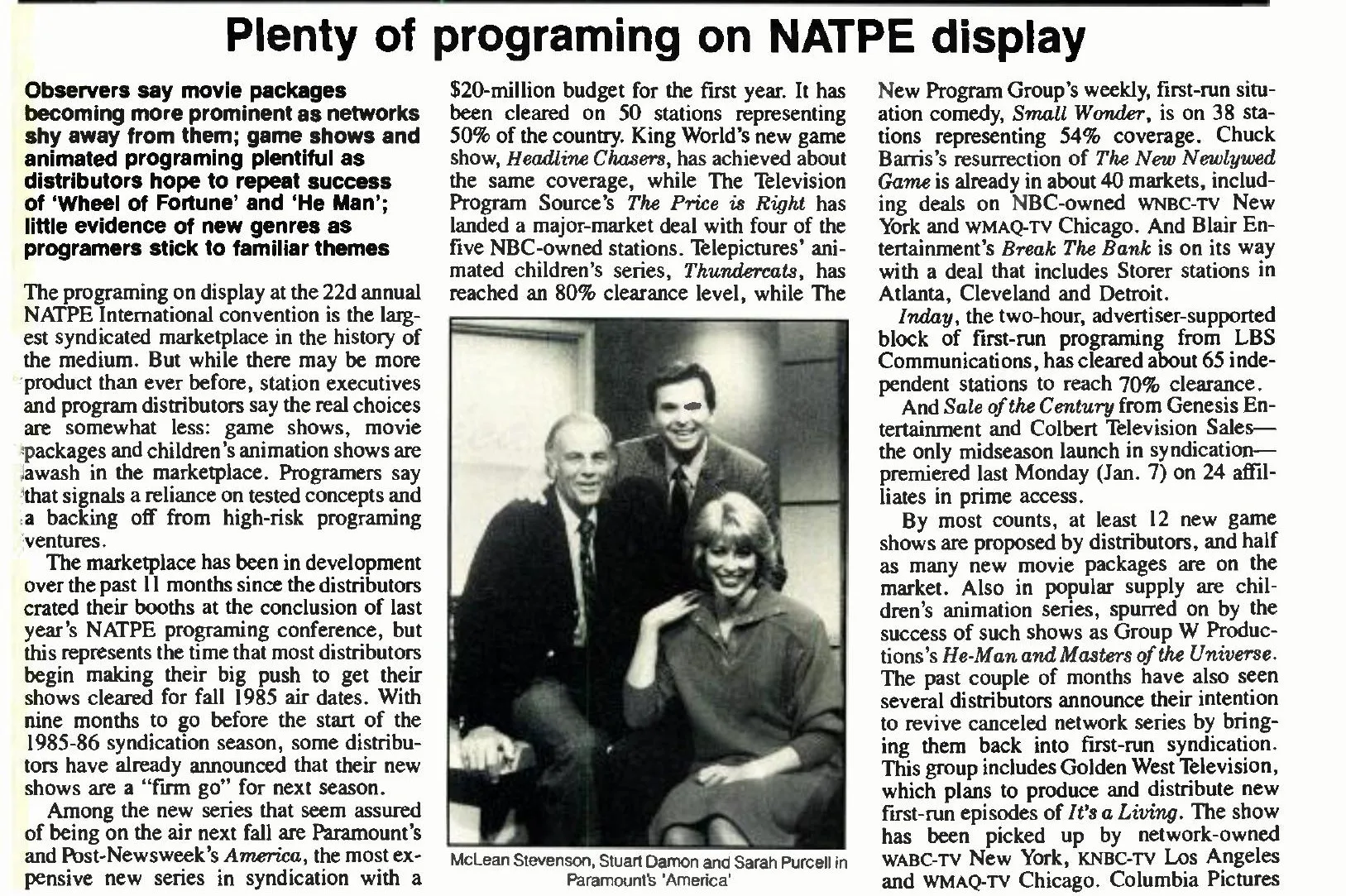
Magazine page headed ‘Plenty of programing on NATPE display’, three text columns around a photo of three actors from Paramount’s America. Advertisement © 1984 Telepictures Corporation; magazine pages © Broadcasting Publications Inc.; ThunderCats characters © their rights holders. Scans: World Radio History full-issue PDFs. Rendered at 200 dpi, cropped and downscaled; not retouched. · Broadcasting 14 Jan 1985, PDF p.84.
The same article says children’s animation was in strong supply, “spurred on by the success of such shows as Group W Productions’s He-Man and Masters of the Universe.” That is the paper’s own framing of the market, and it puts ThunderCats into a crowded field of weekday cartoons pitched to the same stations.
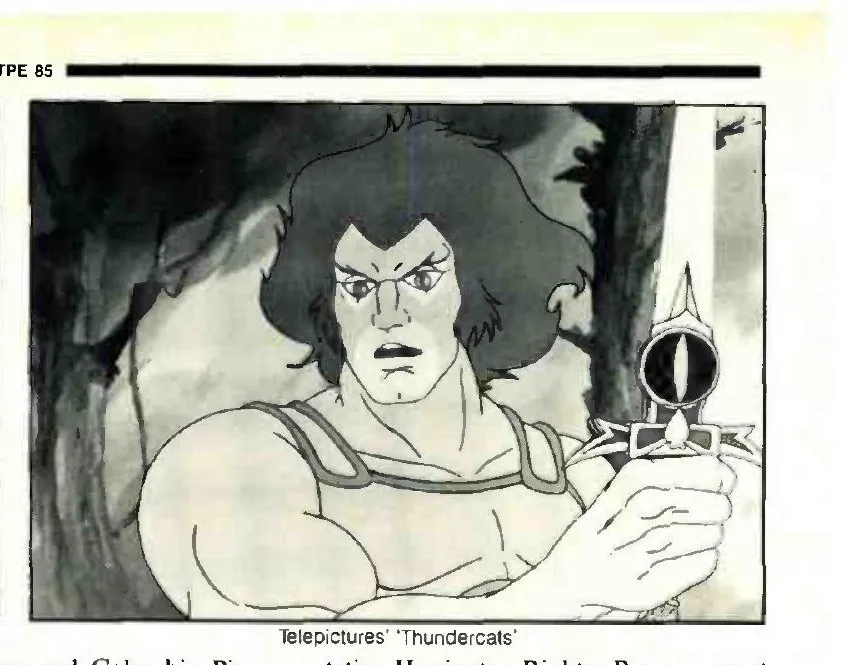
Black-and-white frame of Lion-O with long hair holding a sword with an eye emblem on the hilt, captioned ‘Telepictures’ Thundercats’. Advertisement © 1984 Telepictures Corporation; magazine pages © Broadcasting Publications Inc.; ThunderCats characters © their rights holders. Scans: World Radio History full-issue PDFs. Rendered at 200 dpi, cropped and downscaled; not retouched. · Broadcasting 14 Jan 1985, PDF p.86.
Two pages later (PDF p. 86) the magazine runs a black-and-white frame of Lion-O, sword raised, with the eye-shaped emblem on the hilt, captioned simply “Telepictures’ ‘Thundercats’.”
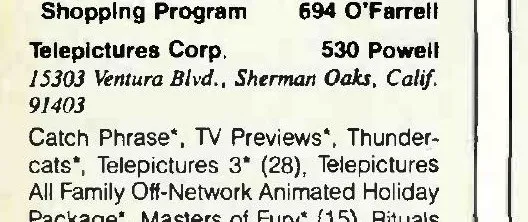
Directory entry: ‘Telepictures Corp. 530 Powell’, a Sherman Oaks address, and a title list including Thundercats. Advertisement © 1984 Telepictures Corporation; magazine pages © Broadcasting Publications Inc.; ThunderCats characters © their rights holders. Scans: World Radio History full-issue PDFs. Rendered at 200 dpi, cropped and downscaled; not retouched. · Broadcasting 14 Jan 1985, PDF p.120.
The convention directory in the same issue (PDF p. 120) lists the company as “Telepictures Corp. 530 Powell, 15303 Ventura Blvd., Sherman Oaks, Calif. 91403,” followed by its titles, with “Thundercats*” between TV Previews and Telepictures 3. The directory’s key to the asterisk is not reproduced in our crop, so we do not interpret it here.
The terms: Syndication Marketplace, June 1985
Clearance reports describe where a distributor has secured station carriage. The June 10, 1985 “Syndication Marketplace” column (PDF p. 99) tells you on what terms. It opens with a separate Telepictures deal, the off-network syndication rights to Alvin and the Chipmunks, and spells out the barter split for that package: “Telepictures getting two-and-a-half minutes and stations getting three-and-a-half minutes in the first three quarters of the year. In the fourth quarter, Telepictures will get two minutes and stations will get four minutes.”
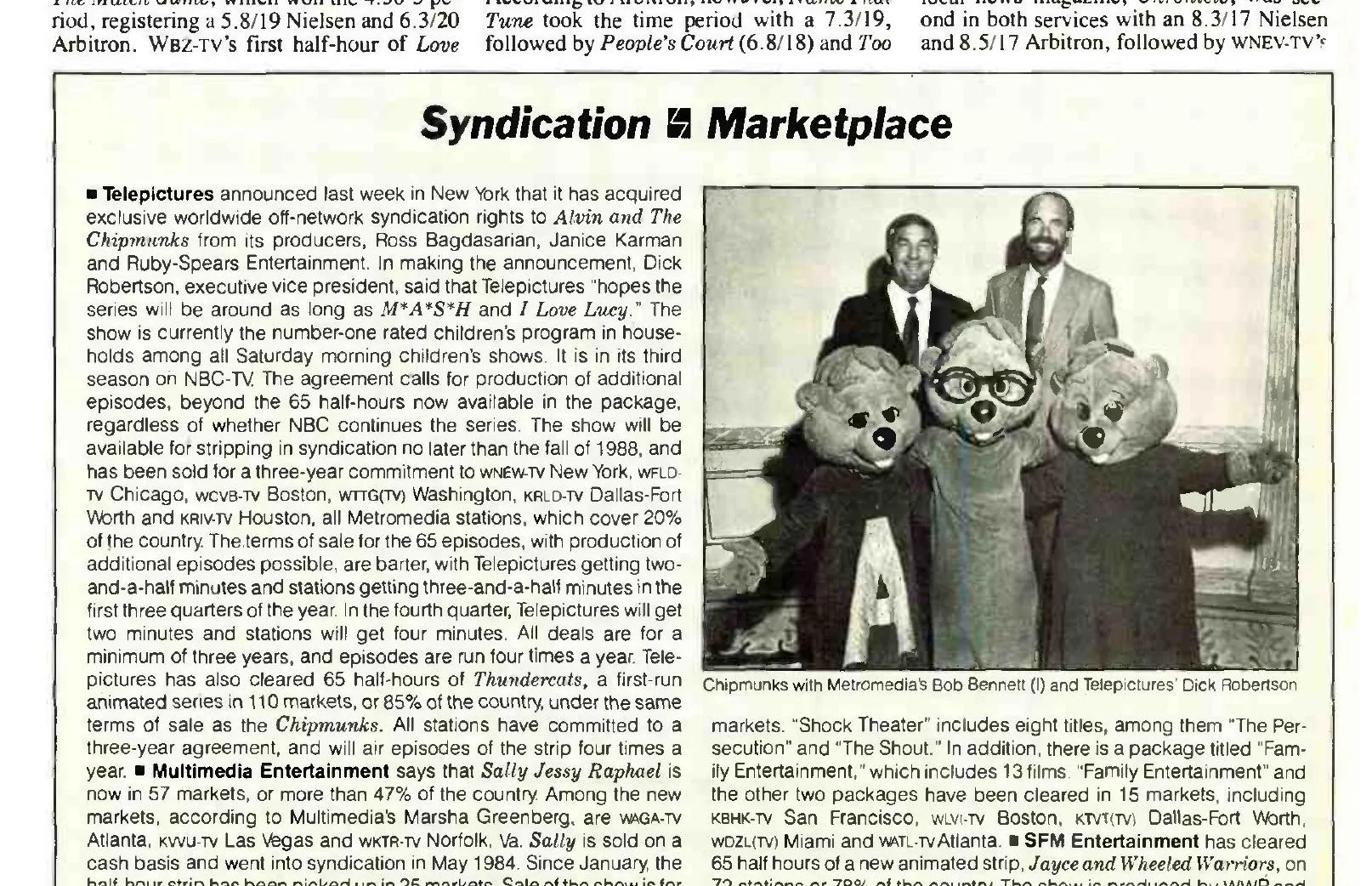
‘Syndication Marketplace’ column with a photo of three people in Chipmunk costumes beside two executives in suits. Advertisement © 1984 Telepictures Corporation; magazine pages © Broadcasting Publications Inc.; ThunderCats characters © their rights holders. Scans: World Radio History full-issue PDFs. Rendered at 200 dpi, cropped and downscaled; not retouched. · Broadcasting 10 Jun 1985, PDF p.99.
Then comes ThunderCats:
“Telepictures has also cleared 65 half-hours of Thundercats, a first-run animated series in 110 markets, or 85% of the country, under the same terms of sale as the Chipmunks. All stations have committed to a three-year agreement, and will air episodes of the strip four times a year.”
This is the clearest description of the business model in the run. Under barter a station paid no cash licence fee. It received the episodes and gave the distributor a share of the commercial minutes in each half-hour; the distributor sold those minutes to national advertisers, and the station sold the rest locally. Read literally, the column says that in the first three quarters Telepictures kept two and a half minutes per episode and the station three and a half, and that the split shifted toward the station in the fourth quarter. “Four times a year” means each episode was expected to repeat, so 65 episodes could fill a weekday slot for years. Sixty-five half-hours is thirteen weeks of weekdays.
The same column shows the competition. A few paragraphs down, SFM Entertainment reports that it has cleared “65 half hours of a new animated strip, Jayce and Wheeled Warriors, on 72 stations or 78% of the country,” on a barter basis, premiering September 16. Read together, the two items show distributors comparing coverage percentages from the same page.
The first numbers: November 1985
By the November 18, 1985 issue the show was on the air and the trade press had moved from coverage to audience. A boxed item headlined “Syndicated numbers” on the “In Brief” page (PDF p. 126) reports Nielsen averages for barter programs, using data gathered from October 7 through November 3. Its animation paragraph reads in part:
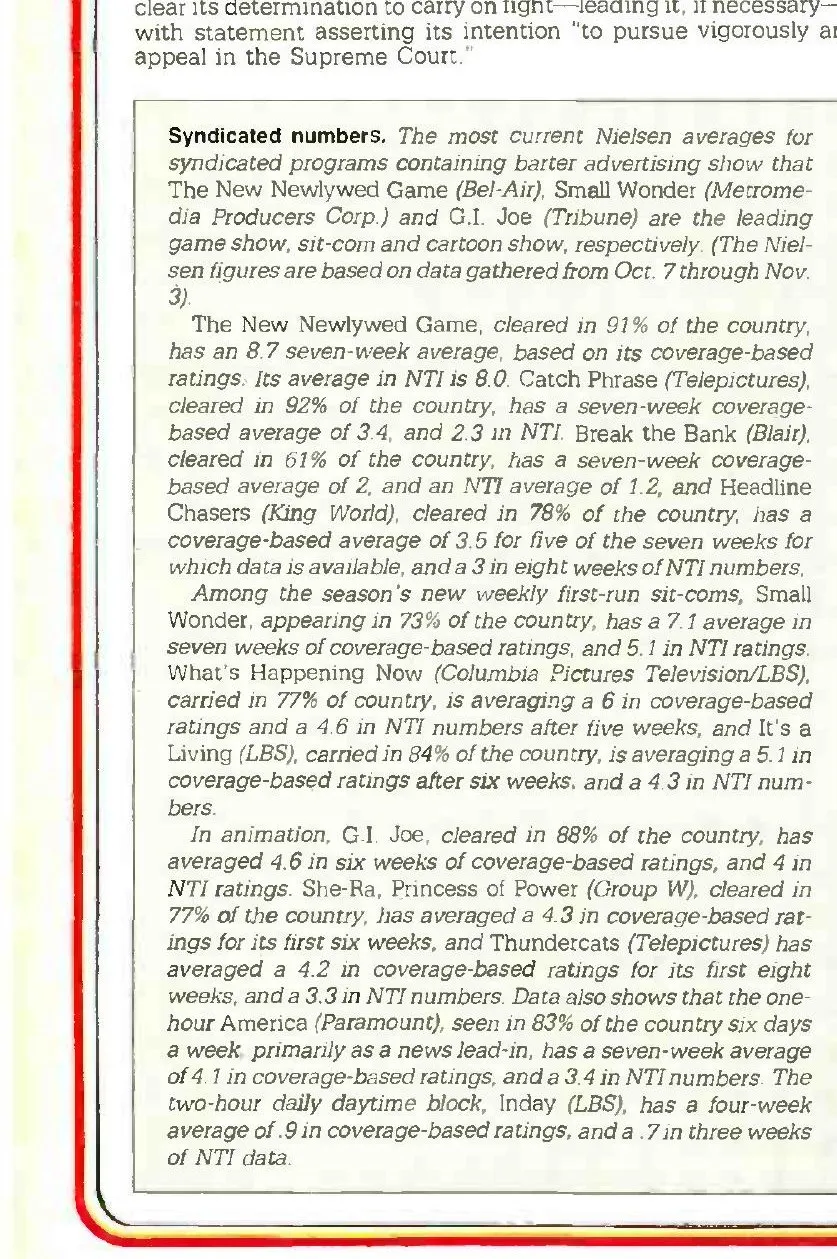
Boxed italic item headed ‘Syndicated numbers’ listing Nielsen averages, with a paragraph on G.I. Joe, She-Ra and Thundercats. Advertisement © 1984 Telepictures Corporation; magazine pages © Broadcasting Publications Inc.; ThunderCats characters © their rights holders. Scans: World Radio History full-issue PDFs. Rendered at 200 dpi, cropped and downscaled; not retouched. · Broadcasting 18 Nov 1985, PDF p.126.
“Thundercats (Telepictures) has averaged a 4.2 in coverage-based ratings for its first eight weeks, and a 3.3 in NTI numbers.”
In the same paragraph, G.I. Joe, “cleared in 88% of the country,” has averaged 4.6 in six weeks of coverage-based ratings, and She-Ra, Princess of Power, “cleared in 77%,” a 4.3 in its first six weeks. Two kinds of number appear side by side. A coverage-based rating measures audience only in the markets that carried the show; NTI, Nielsen’s national index, spreads it across the whole country. That is why the ThunderCats NTI figure is lower than its coverage-based one. The item is a snapshot from the first weeks of the run, and we draw no wider conclusion about the show’s performance from it.
What the trade pages leave out
Broadcasting covered the sale, not the making. None of these pages mentions where the animation was drawn. Wikipedia’s article on the series says the animation came from Japan: its infobox credits Topcraft for season 1 and Pacific Animation Corporation for seasons 2 to 4, while its main text credits Pacific Animation Corporation, with Masaki Iizuka as production manager, and notes that the studio was acquired in 1989 to form Walt Disney Animation Japan. The two statements in the same article do not fully agree, and we record the conflict rather than settle it. The article also names Leisure Concepts as the licensing agent and LJN as the maker of the 1980s action figures, the merchandising side the trade ads only hint at with their enamel-pin artwork.
Wikipedia lists later home releases as well, including Warner’s Season 1, Volume 1 DVD on August 9, 2005 and a complete-series DVD set in 2019. Those dates come from the encyclopedia’s citations and were not checked against retail listings for this Story.
For a collector, the value of these four issues is the sequence. Over fourteen months, one show’s trade presence runs from “over 70%” in an ad, to “80%” at NATPE, to “110 markets, or 85%” with the barter split spelled out, to a 4.2 rating in its first eight weeks. Each figure is attributed to the distributor or the magazine and is reproduced here as printed.
Sources
- Broadcasting, September 3, 1984 · Broadcasting Publications Inc. · scan page 2
- Broadcasting, January 14, 1985 · Broadcasting Publications Inc.
- Broadcasting, June 10, 1985 · Broadcasting Publications Inc. · scan page 99
- Broadcasting, November 18, 1985 · Broadcasting Publications Inc. · scan page 126
- ThunderCats (1985 TV series) · Wikipedia
Artwork and toy photographs are credited reproductions from published sources.