From the archive Rockman
Wily's Castle, Redrawn Every Time
Near the back of a 1997 Rockman collector's book, four pages of black-and-white setting art show Dr. Light's lab as a domed house behind a picket fence, and a villain's castle whose design, the book says, "changes every time."
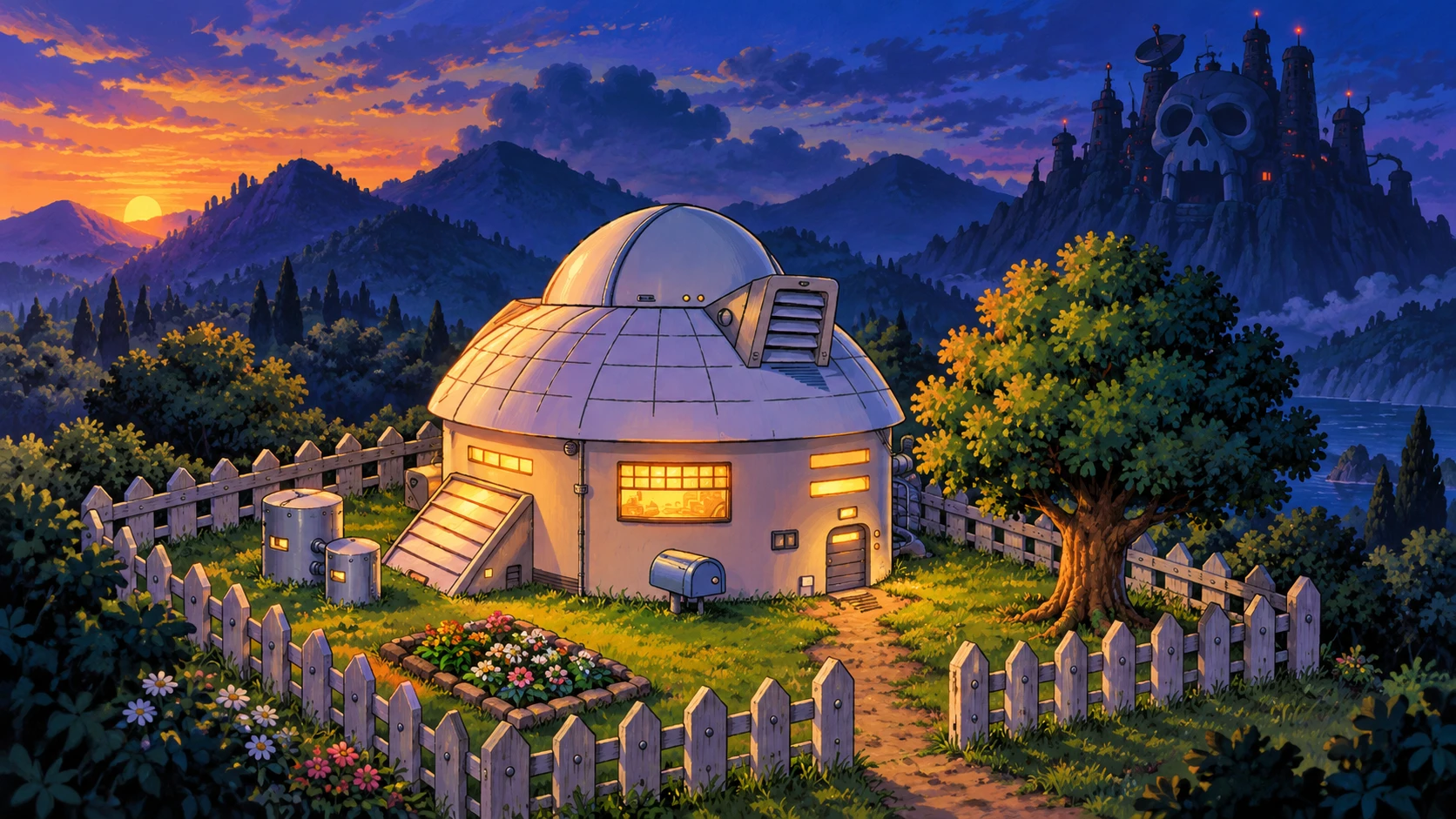
Original editorial illustration inspired by the setting drawings in Rockman Memories. The historical drawings appear below.
AI editorial illustration · Rewind: Northwest RetroDesign reference ↗01 Historical source
Kodansha · p. 110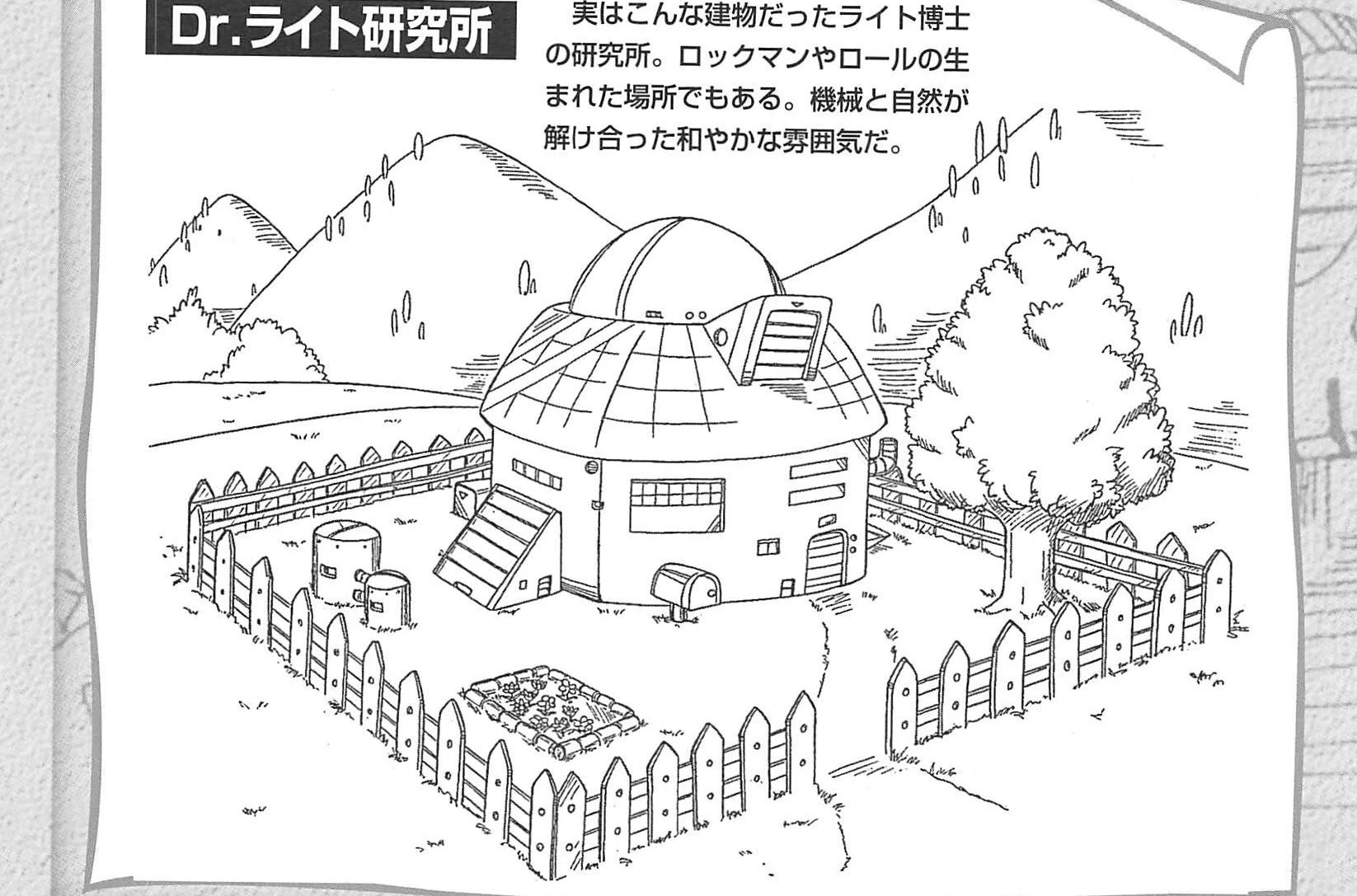
Dr. Light's laboratory, "the place where Rockman and Roll were born," with "a gentle atmosphere in which machinery and nature blend together" (working translation).
Rockman Memories · Kodansha, 1997 · printed p. 110 · scan p. 110The book is Rockman Memories, a Kodansha MOOK. Its full title on the colophon reads 愛蔵版 ロックマンメモリーズ 1987〜1997全作品集, a “collector’s edition” covering every Rockman title from 1987 to 1997. The first printing is dated November 7, 1997 (Heisei 9). The colophon credits the book’s composition to M&U Bros. and lists Capcom as a cooperating company. Rockman Memories, colophon (scan page 114). (All Japanese quotations in this Story are working translations.)
Most of the book is game-by-game pages. On p. 110, a heading in heavy block lettering reads ロックマンシリーズ 舞台設定画集, “Rockman series: stage-setting art collection.” The introduction is short: “Each title in the Rockman series comes with stages full of variety. Here, let’s look at the original drawings those stages were based on, and at unpublished original drawings that were used as setting material. I think the gentle worldview of the series, where humans and robots live side by side, comes through in every illustration.” Rockman Memories, p. 110.
The book never names who drew these pages, and it doesn’t date any of them. It calls them 原画 (original drawings) and 設定資料 (setting material), and that’s as specific as it gets.
The house where Rockman was born
The first drawing is presented as a reveal. Under the label Dr.ライト研究所 (Dr. Light’s laboratory) sits a round, two-level building with a domed roof, set inside a wooden picket fence. A full, leafy tree stands at one side of the yard, there’s a small fenced garden bed out front, and rounded hills rise behind. A sloping, slatted panel leans against the wall by the door.
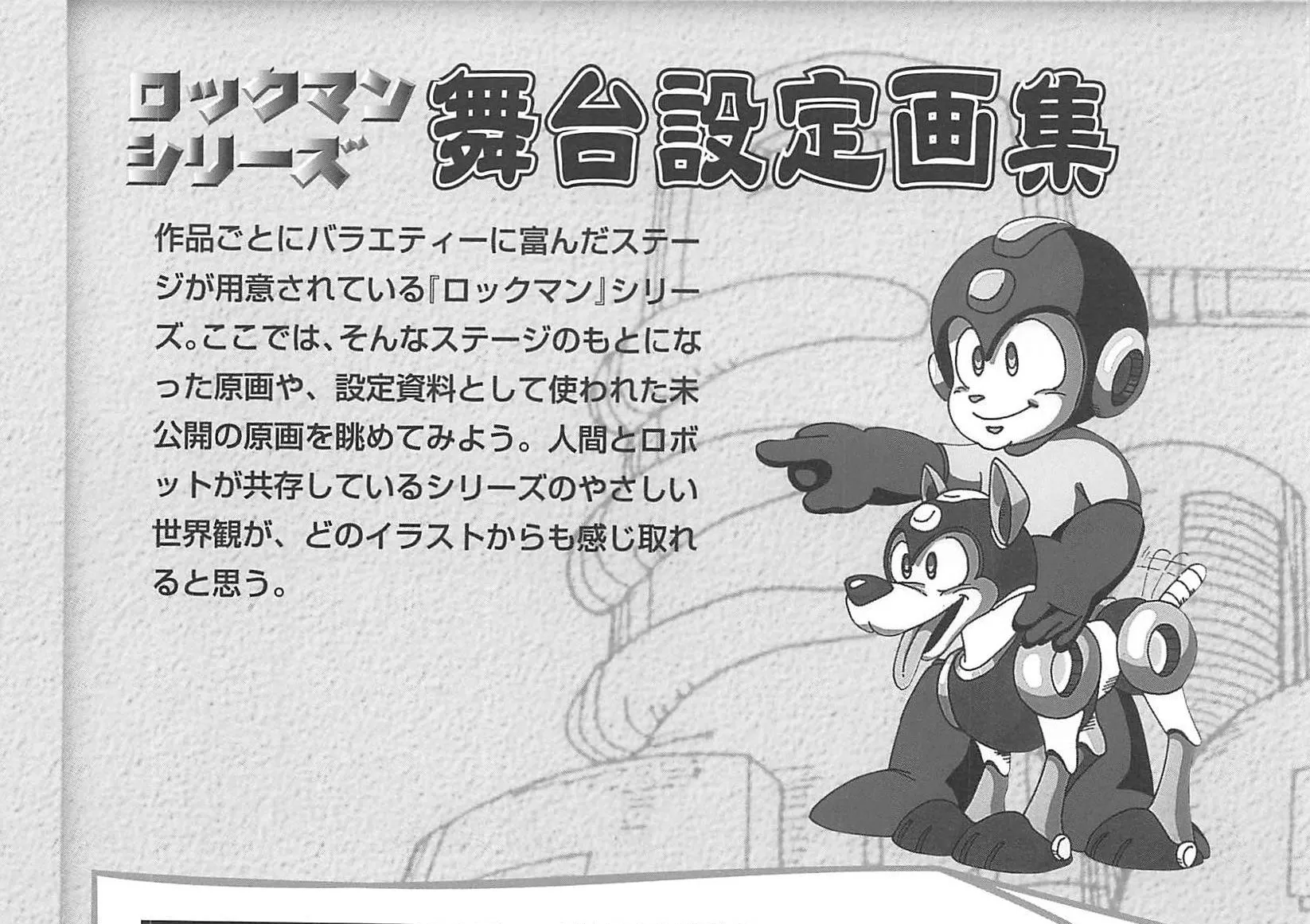
The opening of the “stage-setting art collection” section, beside a drawing of Rockman and a robot dog. Rockman Memories · Kodansha, 1997 · printed p. 110 · scan p. 110.
The caption reads: “So this is the kind of building Dr. Light’s laboratory actually was. It’s also the place where Rockman and Roll were born. It has a gentle atmosphere in which machinery and nature blend together.” Rockman Memories, p. 110.
“Actually was” (実はこんな建物だった) is the caption’s own framing: the drawing is presented as a reveal. The caption doesn’t say which game, if any, the building was drawn for.
Machine and nature
Turn the page and the stage drawings begin, under the heading ステージ編, the “stages” section. Its introduction states a rule: “The stages, each built around its own ingenious theme from game to game, were also made under the concept of ‘a fusion of machine and nature.’ Come to think of it, many of the regular stages are based on natural environments. Rockman is surprisingly nature-minded (?).” Rockman Memories, p. 111. The question mark in parentheses is the book’s own.
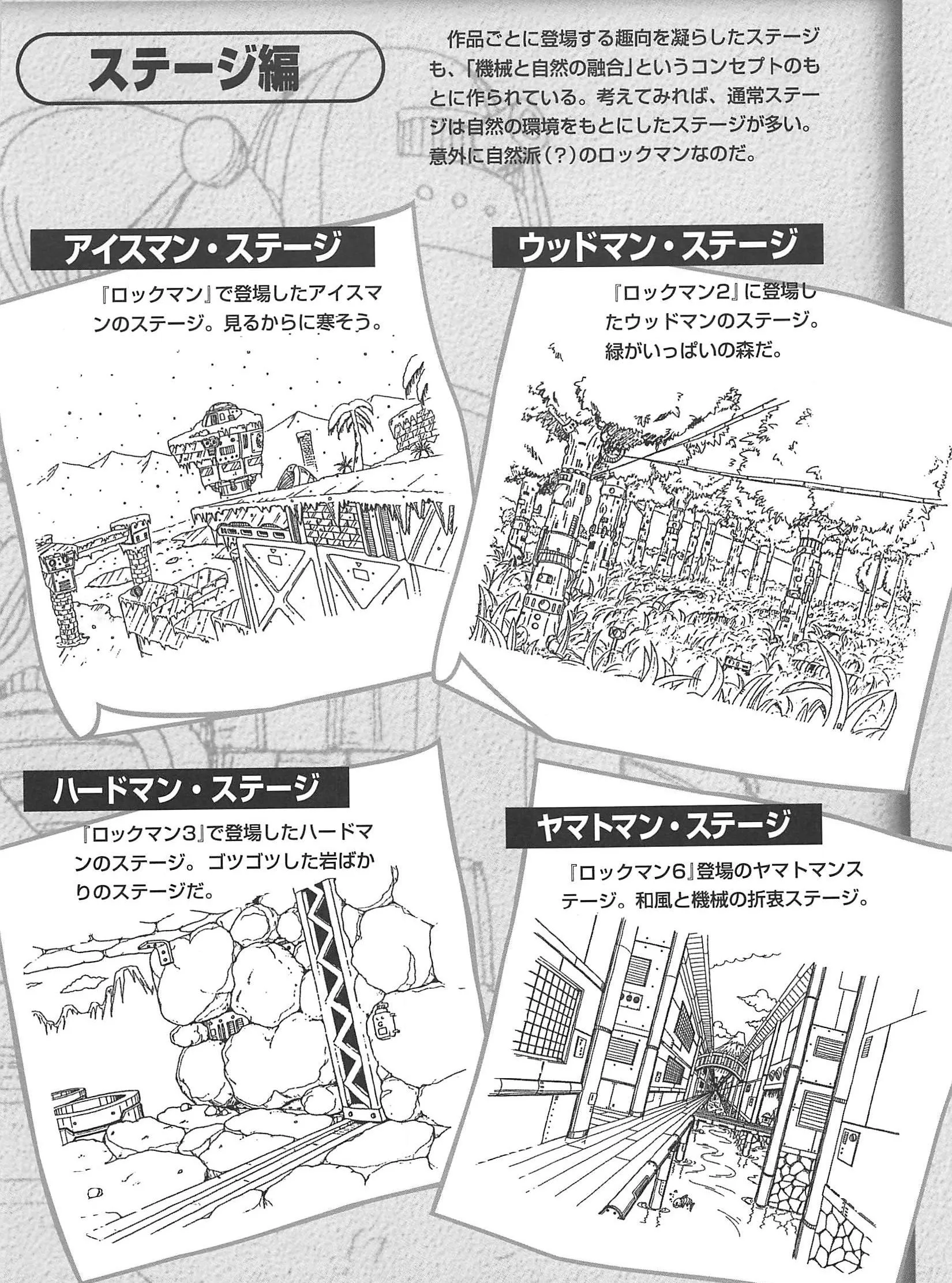
Stage drawings for Ice Man, Wood Man, Hard Man and Yamato Man, made under the concept of “a fusion of machine and nature” (working translation). Rockman Memories · Kodansha, 1997 · printed p. 111 · scan p. 111.
Four stages illustrate the point, one drawing each:
- Ice Man stage, from the first Rockman. Snow falls on a frozen landscape strewn with machine blocks, tilted towers and a hatch-marked gate, with palm-like trees and mountains behind. The caption: “It looks cold just to look at it.” Rockman Memories, p. 111.
- Wood Man stage, from Rockman 2. Tall cylindrical machine columns stand in dense jungle, with ferns crowding the foreground and a cable or rail running overhead. The caption: “A forest full of green.” Rockman Memories, p. 111.
- Hard Man stage, from Rockman 3. A wall of big, rounded boulders is braced by a riveted steel girder with a zigzag pattern, with parallel lines running along the ground in front. The caption: “A stage made of nothing but rugged rock.” Rockman Memories, p. 111.
- Yamato Man stage, from Rockman 6. A one-point perspective view runs down a narrow street between tall paneled buildings with pipes and vents, with a stone embankment at the lower right. The caption: “A stage that mixes Japanese style and machinery.” Rockman Memories, p. 111.
Each caption names its game, and that’s all. None says how closely the drawing matches what appears on screen, and the book offers no screenshots alongside to compare.
A castle that keeps changing
Then comes the villain. The ワイリー編 (Wily section) opens on p. 112 with a shaded drawing of Dr. Wily in a white coat and dark cape, arms thrown wide. The introduction treats him almost fondly: “Dr. Wily may wear the crown of ‘evil,’ but he’s a genius scientist. Every time, he invents all kinds of robots and keeps us entertained. Here we’ve gathered original drawings of Dr. Wily’s works.” Rockman Memories, p. 112.
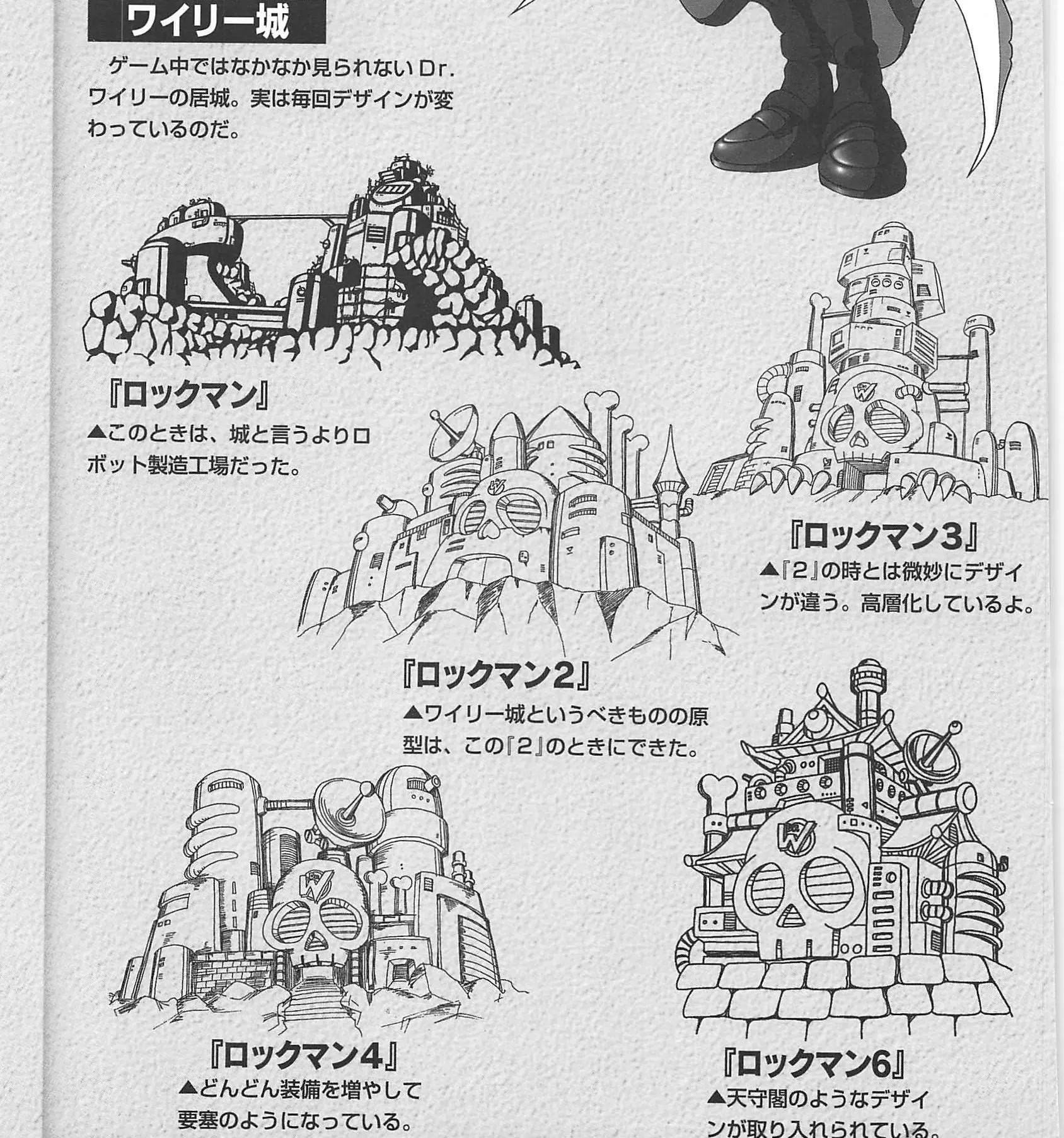
Five Wily Castles, from Rockman to Rockman 6. “In fact, its design changes every time” (working translation). Rockman Memories · Kodansha, 1997 · printed p. 112 · scan p. 112.
The first of those works is his home. Under ワイリー城 (Wily Castle), the caption reads: “Dr. Wily’s castle, which you rarely get a good look at in the games. In fact, its design changes every time.” Rockman Memories, p. 112.
The page proves it with five drawings, each captioned by game:
- Rockman: a low cluster of buildings joined by a looping pipe, on a rocky outcrop. “At this point it was less a castle than a robot-manufacturing factory.”
- Rockman 2: a dense, many-towered mass on a rocky peak, with a satellite dish on top and a skull face with grilled eyes built into its walls. “The prototype of what you’d properly call Wily Castle was born with 2.”
- Rockman 3: a skull-faced complex with a row of fang-like spikes along its base. “Its design is subtly different from 2. It’s gotten taller.”
- Rockman 4: coiled tanks, a satellite dish and a big skull face with grilled eyes over a stairway. “It keeps adding equipment and has turned into something like a fortress.”
- Rockman 6: a skull-faced block on a stone base, crowned by tiered, curved roofs. “A design like a castle keep (天守閣) has been worked in.”
All five captions are on Rockman Memories, p. 112. The page shows no castle for Rockman 5, and the book doesn’t say why.
Read in order, the captions tell a short design story: a factory, then the first true castle, then a taller one, then a fortress, then a Japanese-style keep. The book doesn’t say who decided on each change or whether the drawings came before or after the games’ graphics. It also uses “every time” (毎回) loosely, given that one game is missing from the sequence.
Up in the air
The last page moves Wily off the ground. Rockman World, the Game Boy series, gets its own entry on p. 100. That page says the first Rockman World came out about half a year after the Famicom’s Rockman 3, at a time when many popular series were being ported to the Game Boy, and that it answered fans calling for “the Rockman series on Game Boy!” Up to the fourth game, it says, the series reused the Famicom games’ bosses, “truly in the style of a Rockman side story”; the fifth had a fully original story and bosses, “but since then, no new game in this series has come out. A little lonely.” Rockman Memories, p. 100.
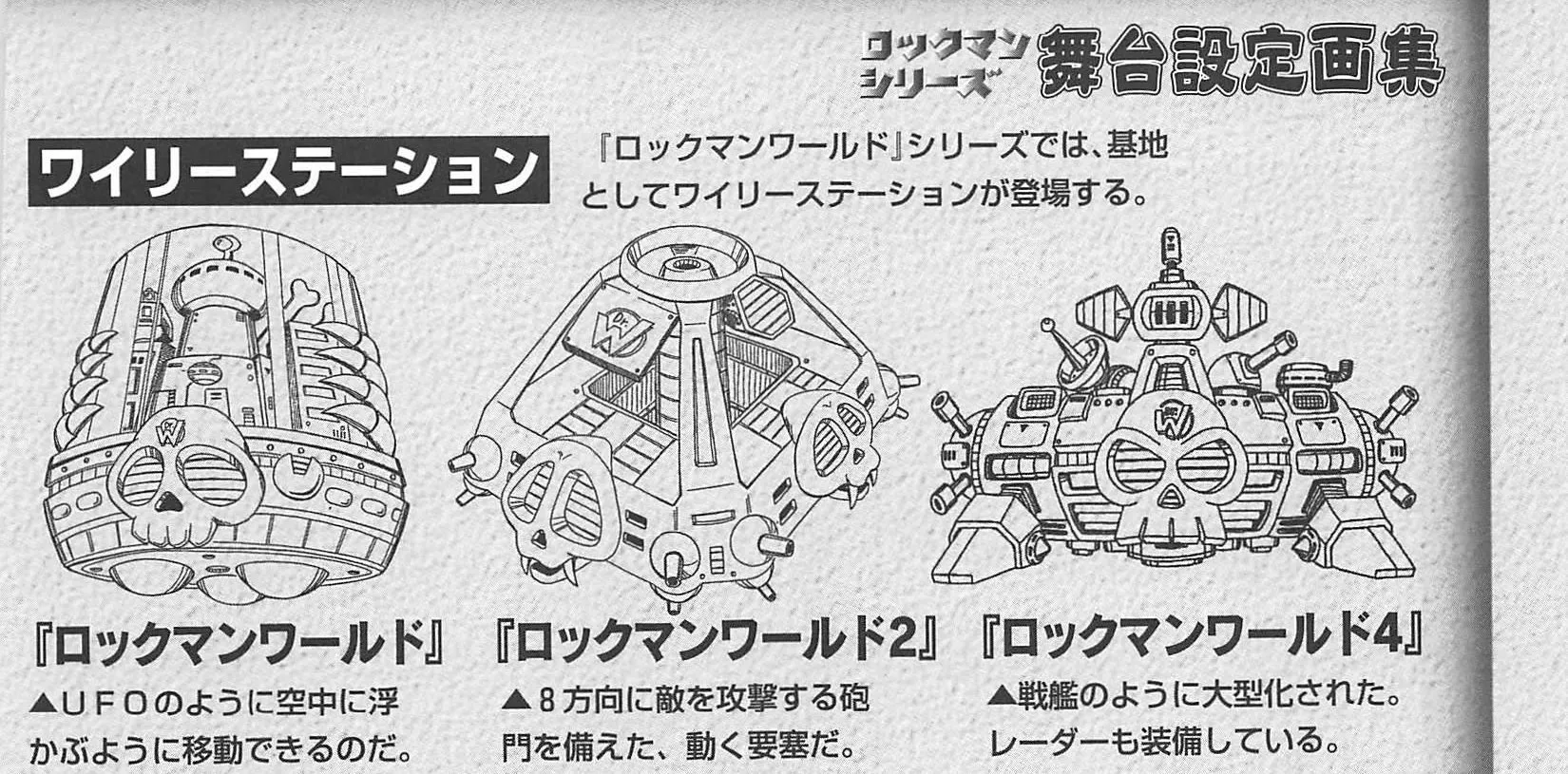
Three Wily Stations from the Game Boy Rockman World series, from UFO to battleship (working translation). Rockman Memories · Kodansha, 1997 · printed p. 113 · scan p. 113.
In those games, the setting pages explain, Wily doesn’t need a castle: “In the Rockman World series, Wily Station appears as his base.” Rockman Memories, p. 113. Three stations follow, all skull-faced:
- Rockman World: “It can move as if floating in the air, like a UFO.”
- Rockman World 2: “A moving fortress, equipped with gun ports that attack enemies in eight directions.”
- Rockman World 4: “Scaled up like a battleship. It’s also equipped with radar.”
Below them come the machines Wily pilots himself. “What you always fight last in the Rockman series is the Wily Machine. They come in all kinds of designs.” The captions add a few specifics. A Rockman World version shows that “Wily Machines appear in Rockman World too.” Wily Machine No. 2, from Rockman 2, is “proud of being armed with anti-gravity energy shells.” No. 3 is “the first Wily Machine type with a walking system.” No. 4 hides “a powerful spreading beam inside its skull-shaped front cover.” Rockman Memories, p. 113.
The final drawing has nothing to do with Wily. A tall stone castle under onion domes and pointed spires, with cannons poking out of its walls, sits among pine trees. The caption: “The laboratory where Dr. Cossack and Kalinka live. It’s Russian-style.” Rockman Memories, p. 113. The book doesn’t name the game it comes from.
What the pages can prove
These are captions written for young readers in 1997, often playful. “Surprisingly nature-minded (?),” says one; “a little lonely,” says another. They aren’t designers’ notes. The book identifies each drawing by game, explains what it shows, and gives a single stated design concept, “a fusion of machine and nature.” It doesn’t name any artist, date any drawing, or describe how setting art was used inside Capcom.
What survives is the pattern. Dr. Light lives in a domed house with a tree and a garden bed. Dr. Wily keeps building upward, then outward, then into the sky. As the book puts it, the castle’s design “changes every time.”
Sources
- Rockman Memories — Rockman World series · Kodansha · 1997 · page 100 · scan page 100
- Rockman Memories — stage-setting art collection: introduction and Dr. Light's laboratory · Kodansha · 1997 · page 110 · scan page 110
- Rockman Memories — stage-setting art collection: stages · Kodansha · 1997 · page 111 · scan page 111
- Rockman Memories — stage-setting art collection: Dr. Wily and Wily Castle · Kodansha · 1997 · page 112 · scan page 112
- Rockman Memories — stage-setting art collection: Wily Station, Wily Machines, Cossack Castle · Kodansha · 1997 · page 113 · scan page 113
- Rockman Memories — colophon (1st printing) · Kodansha · 1997 · scan page 114
Artwork and toy photographs are credited reproductions from published sources.