From design to toy · 1990s
Ninjaman: A Transformation with a Temper
A rounded blue ninja becomes an armored samurai when his temper breaks. Compare Ninjaman’s two character designs with Bandai’s DX transforming toy.
- From the world of
- Ninja Sentai Kakuranger
- Toy maker
- Bandai
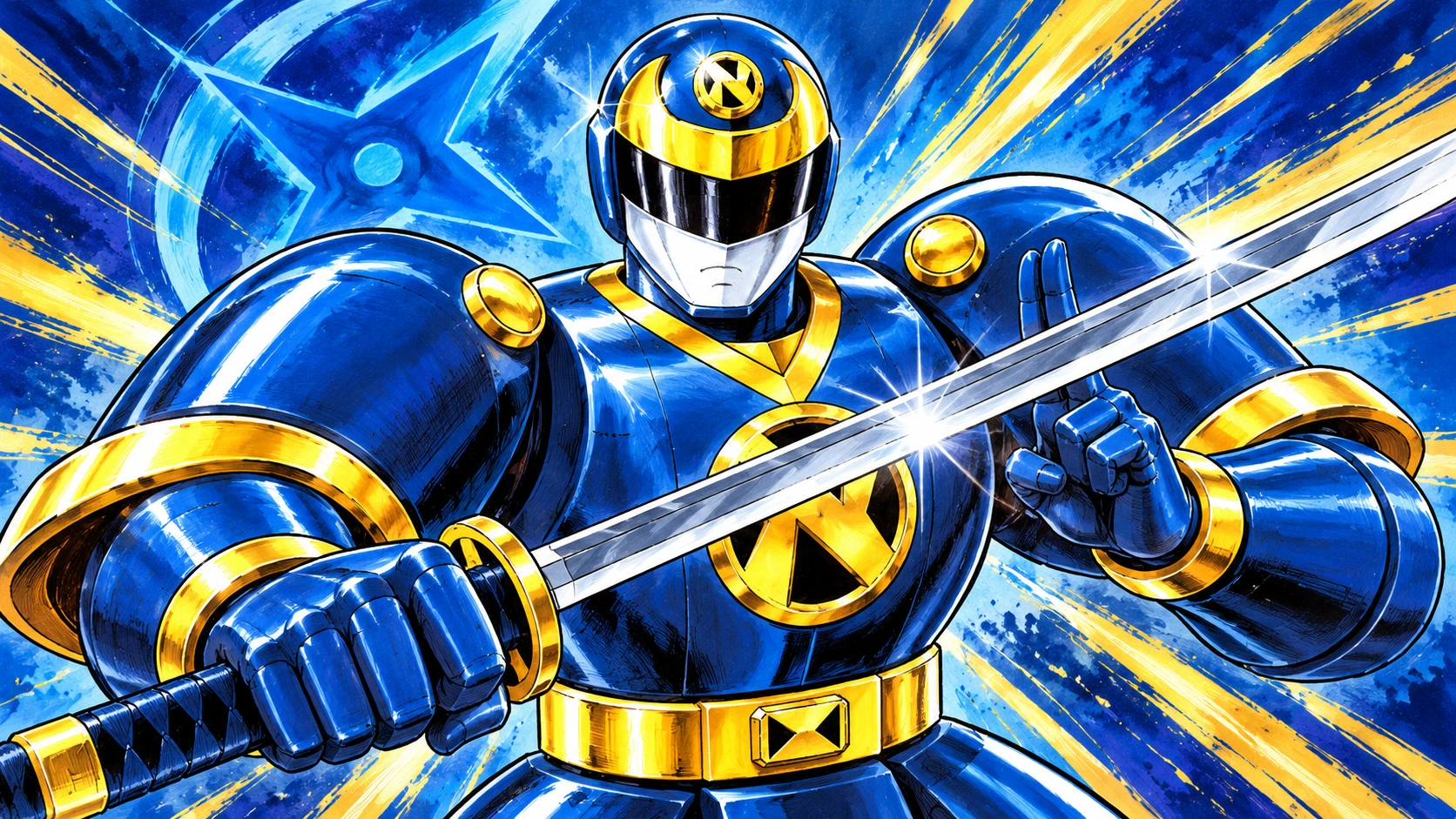
Original AI cover illustration inspired by the character design; historical artwork and toy photographs appear inside the article.
AI cover illustration · Rewind: Northwest RetroDesign reference ↗01 / The design
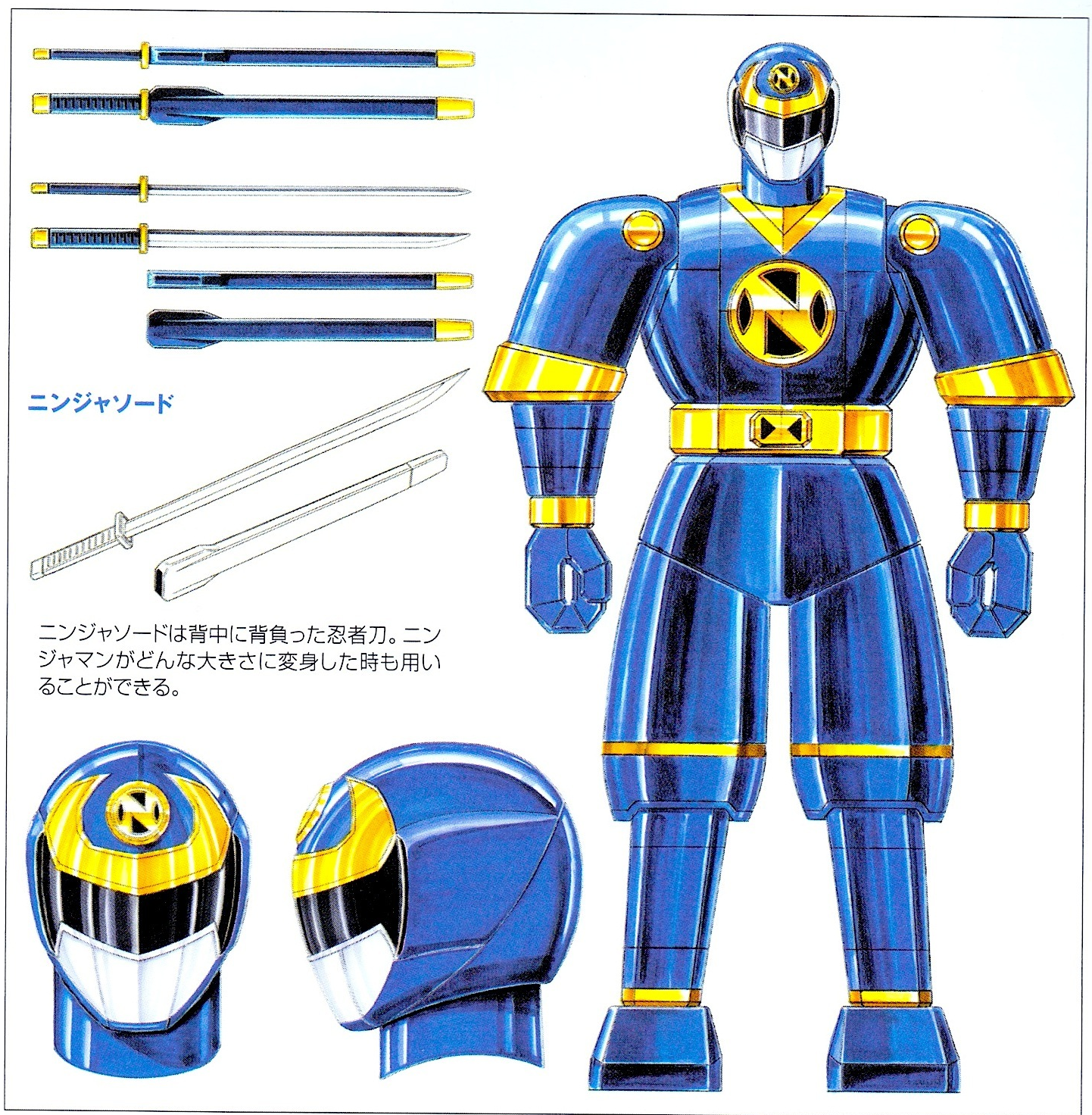
Ninjaman’s everyday form, with sword and helmet studies. The source presents finished character artwork, rather than development sketches.
Super Sentai Art Collection · MediaWorks, 2002 · printed p. 078 · PDF p. 86
02 / The toy
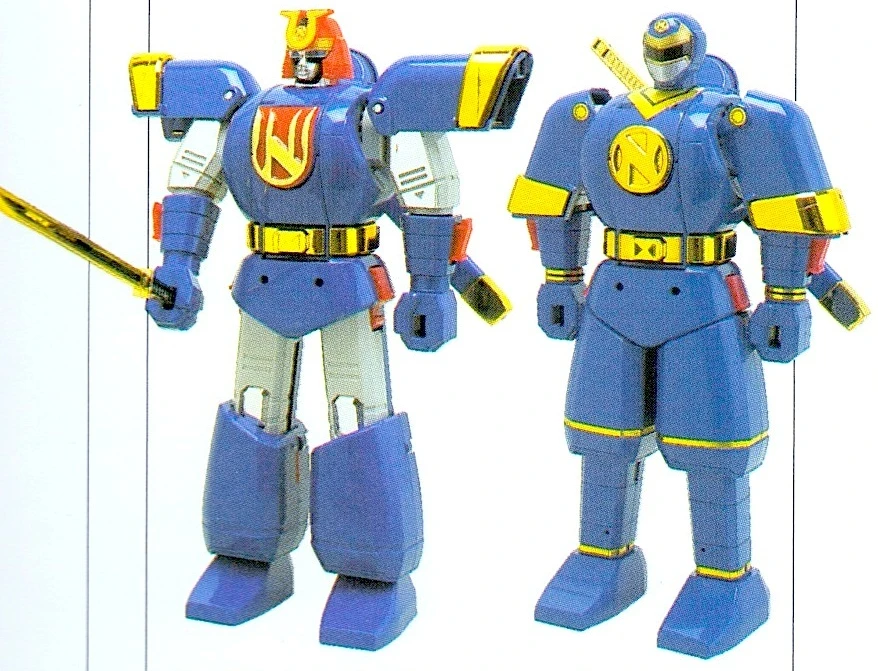
The same DX product shown in its Samuraiman and Ninjaman forms. This is a photograph of the manufactured toy, reproduced from the artbook.
Super Sentai Art Collection · MediaWorks, 2002 · printed p. 078 · PDF p. 86
In the story
Some giant guardians arrive as a combination of five creatures. Ninjaman arrives with a temper.
In Ninja Sentai Kakuranger, he stands apart from the towering Muteki Shogun and Kakure Daishogun. The artbook describes him as normally human-sized, making him another warrior alongside the team. He first appears in episode 36, after an exile in space brought about by the Great Demon King’s trickery.
His everyday appearance is almost disarmingly simple: blue armor, gold trim, a dark visor, and a white face covering. A round emblem sits at the center of his chest. The finished drawing’s curved shoulders and broad thighs give him a compact, rounded outline.
Then someone calls him “aonisai”—an insult aimed at his immaturity—and the mood changes. The book says anger powers his transformation into Samuraiman, his true form. His finishing attack is Samurai Gekido Bomber. The story gives the transformation a character trigger: the same warrior, pushed into a very different appearance. Artbook, printed p. 078 / PDF p. 86.
On the drawing board
Compare the two finished designs. Samuraiman keeps the blue-and-gold color identity, but the rounded ninja silhouette opens into something taller-looking and more angular. The shoulders extend sideways, pale upper arms and thighs become prominent, and a red-and-gold helmet replaces the smooth blue head. The chest emblem also changes from a circular badge to a much longer shield-like shape.
These are differences visible in the artwork. The page does not show a sequence of early prototypes or explain every joint in the toy. What it does provide is a concise design note: the transforming DX robot was made with morphing as its motif. Read beside the two character drawings, that note connects a dramatic change of appearance with the central idea of the product.
The weapon carries the same theme. Ninjaman’s Ninja Sword is a ninja blade carried on his back. The book explains that the sword and its scabbard combine into the naginata-shaped Samurai Javelin. The page draws both weapon configurations beside the two bodies, letting the change of equipment reinforce the change of character. These descriptions concern the fictional equipment; the source does not supply a complete inventory of the DX toy’s accessories. Artbook, p. 078.
Look closer
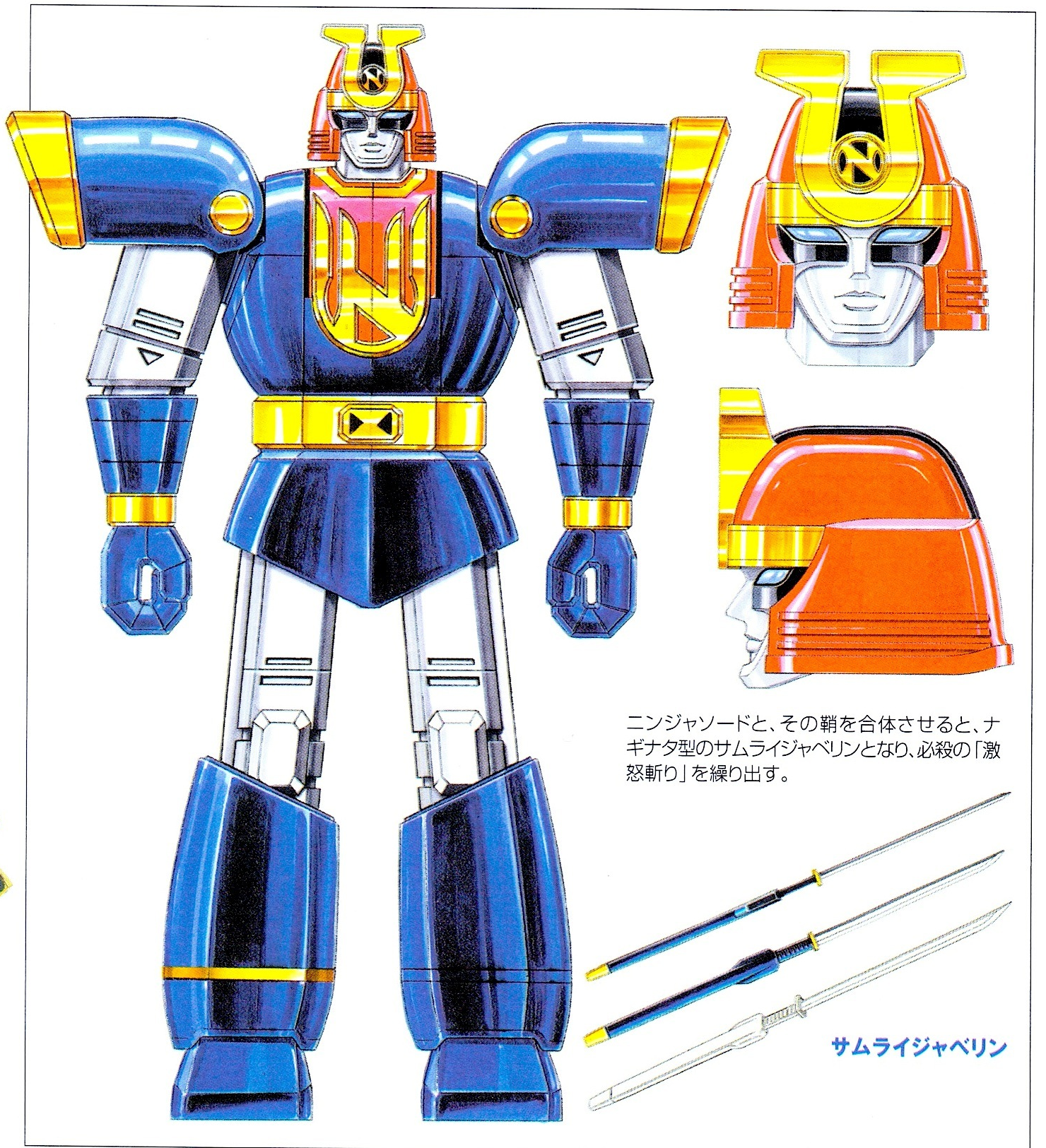
Samuraiman’s finished artwork and equipment studies. Compare the extended shoulders and exposed pale limb sections with the rounded blue Ninjaman in the opening comparison.
Super Sentai Art Collection · MediaWorks, 2002 · printed p. 078 · PDF p. 86
On the toy shelf
The same page names the manufactured product Instant Transformation DX Ninjaman (瞬間変化 DXニンジャマン). Its photograph presents the toy in both configurations: Samuraiman on the left and Ninjaman on the right. This is a direct design-to-toy match within the artbook, rather than a photograph borrowed from a superficially similar robot.
Follow the identifying features across the images. The toy’s Ninjaman form has the smooth blue helmet, rounded shoulders, circular chest emblem, and broad blue legs. Its Samuraiman form has the red-and-gold head, extended shoulder panels, elongated chest detail, and pale limb sections shown in the finished artwork. The photograph lets us see how the two silhouettes were realized as a physical transforming figure.
The retrospective note calls the product a hit and connects its appeal with Ninjaman’s lively character. That is the book’s assessment; it provides no sales figures. The photograph documents the two toy forms, while the accompanying account explains why the transformation belongs to this particular character. DX toy note, artbook p. 078.
Ninjaman makes a change of shape feel like a change of mood. The familiar blue remains, but the helmet, shoulders, chest, and limbs announce that his patience has run out. The toy gives that character beat a form you can hold in your hands.
In the advertisement
The Japanese DX Ninjaman commercial excerpt presents the blue ninja toy and its Samuraiman transformation. Compare the changing head and armor with the two photographed forms in this exhibit.
See the change between Ninjaman’s two toy modes.
Sources
- Super Sentai Art Collection: Sentai Robo Edition 1975–2002 — Ninjaman, Samuraiman, and Instant Transformation DX Ninjaman · MediaWorks · 2002 · page 078 · scan page 86
- DX Ninjaman advertisement excerpt · G RAISER(ジーライザー) / YouTube
Artwork and toy photographs are credited reproductions from published sources. This is a virtual exhibit.