From the archive Goof Troop
Poopsie, A.K.A. Chainsaw: Reading the 1991 Goof Troop Model Sheets
An 88-page scan of Goof Troop model sheets carries Walt Disney Television Animation archive stamps from March 1991, a year and a half before the series reached syndication. The notes show how the studio rebuilt Goofy and Pete for television, and one rough sheet gives Pete's dog the names Poopsie and Chainsaw.

New editorial illustration of an imagined animation workbench. The historical character and production sheets appear below.
AI editorial illustration · Rewind: Northwest RetroDesign reference ↗01 Historical source
Internet Archive · scan p. 1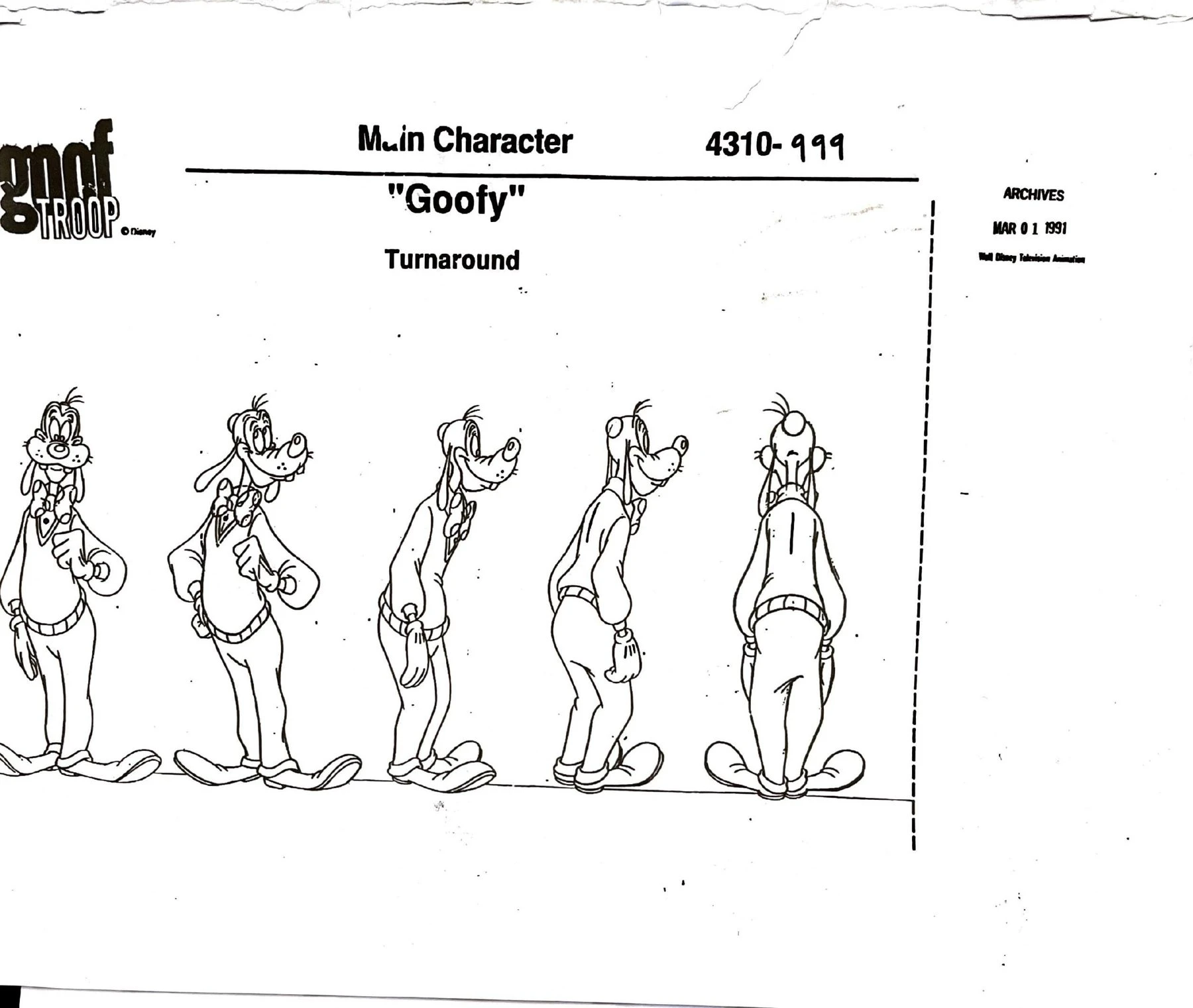
Model sheet with five standing views of Goofy in sweater vest and bow tie on one ground line, headed 'Main Character', 'Goofy', 'Turnaround', with an archive date stamp in the margin.
Goof Troop model sheets © Disney. Scan: Internet Archive item goof-troop-modelsheets (uploader-supplied). Rendered at 250 dpi from the original PDF, rotated upright, downscaled; not retouched. · IA PDF p.1An 88-page scan of Goof Troop model sheets carries Walt Disney Television Animation archive stamps from March 1991, a year and a half before the series reached syndication. The notes show how the studio rebuilt Goofy and Pete for television, and one rough sheet gives Pete’s dog the names Poopsie and Chainsaw.
The Internet Archive item is titled “Disney’s Goof Troop: Production Model Sheets (1991)” and described only as “Model sheets of the main cast from Disney’s Goof Troop.” The PDF holds 88 scanned pages, photographed at a slight angle on a desk, some with curling edges. The uploader does not say where the sheets came from or whether they are originals or copies, and this Story makes no claim either way. What the pages do show is a television studio setting down rules for its central cast: Goofy, Max, Pete, Pistol and Chainsaw. A team of animators at other companies would later have to follow those rules.
The sheet format
Almost every finished sheet uses the same printed template. A “Goof Troop” logo with a small “© Disney” sits at the upper left. Across the top runs “Main Character” (the first letters are faint on most scans), then a number, “4310-999” on the Goofy turnaround (PDF p. 1). Below the rule is the character’s name in quotation marks and a heading such as “Turnaround,” “Full Body Detail” or “Head Detail.” A dashed vertical line marks off a right-hand margin, and in that margin many sheets carry a three-line stamp: “ARCHIVES,” a date, and in tiny type what appears to read “Walt Disney Television Animation.”
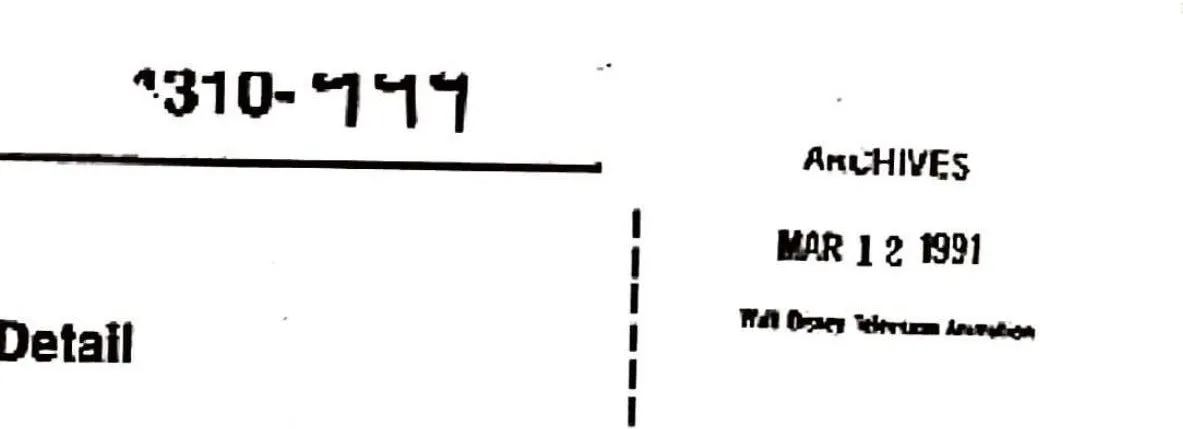
Close-up of the sheet number and a margin stamp reading ‘ARCHIVES’ and ‘MAR 12 1991’ above tiny type. Goof Troop model sheets © Disney. Scan: Internet Archive item goof-troop-modelsheets (uploader-supplied). Rendered at 250 dpi from the original PDF, rotated upright, downscaled; not retouched. · detail of PDF p.2.
The stamp dates make a short timeline. The Goofy turnaround reads “MAR 01 1991.” A Max sheet with a guitar (PDF p. 24) reads “MAR 05 1991.” The Goofy “Full Body Detail” (PDF p. 2) reads “MAR 12 1991.” On the Chainsaw sheets near the end of the file, the stamps are partly cut off at the scan edge: “MAR 19 19” on the head detail (PDF p. 74) and “MAR 20 199” on the full-body construction (PDF p. 72). We read these as receiving or filing dates for the archive. The sheets do not say when each drawing was made.
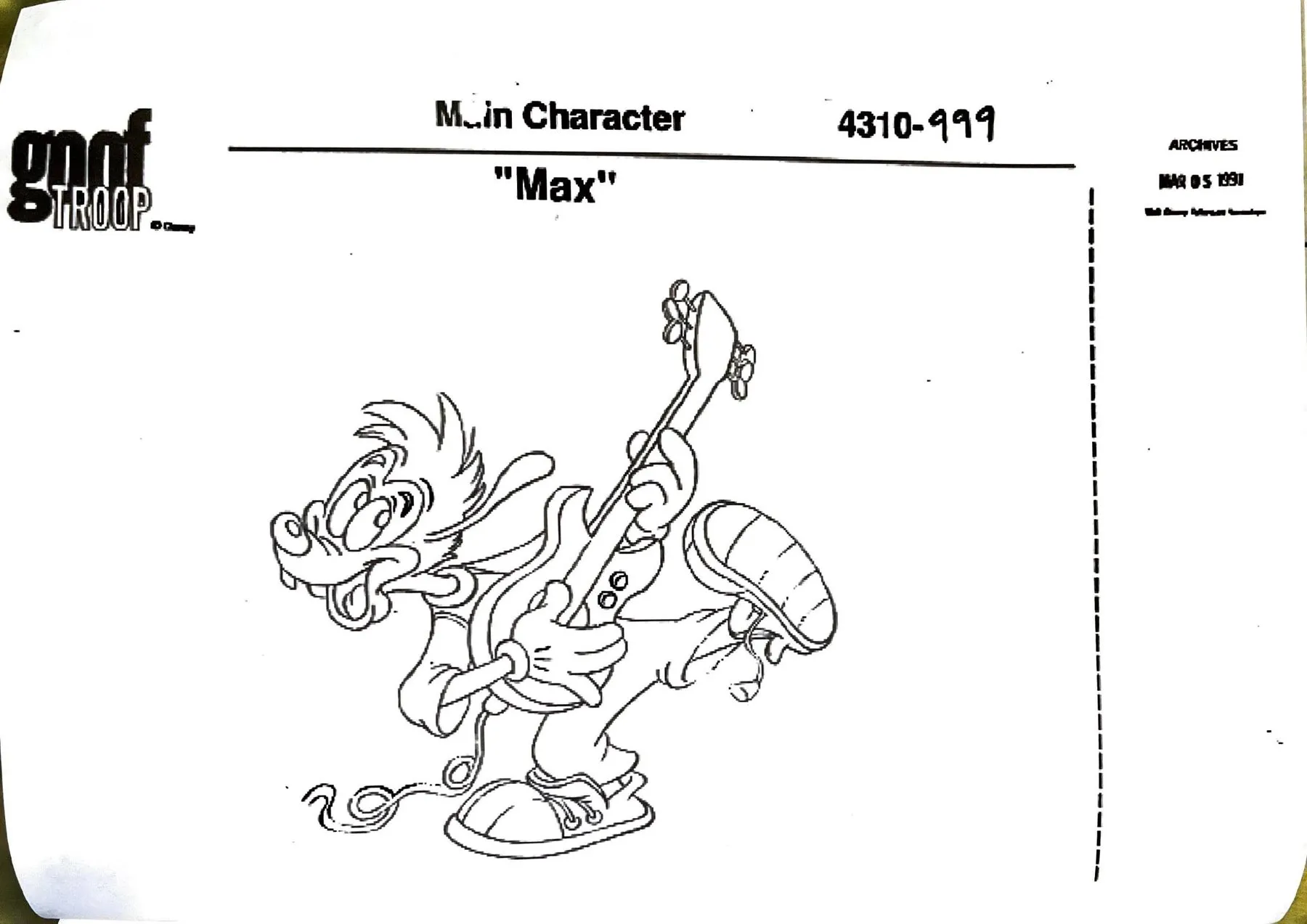
Max with spiky hair playing an electric guitar mid-kick, on the standard template stamped in March 1991. Goof Troop model sheets © Disney. Scan: Internet Archive item goof-troop-modelsheets (uploader-supplied). Rendered at 250 dpi from the original PDF, rotated upright, downscaled; not retouched. · IA PDF p.24.
For scale: Disney’s D23 archive dates the syndicated debut on The Disney Afternoon to September 7, 1992, after an April debut on The Disney Channel. If the stamps are filing dates, the main designs were already being logged about eighteen months before the show reached stations.
Goofy, with instructions
The Goofy “Full Body Detail” sheet is the most heavily annotated page in the set. Every note is a design rule, written in capitals with arrows to the drawing:
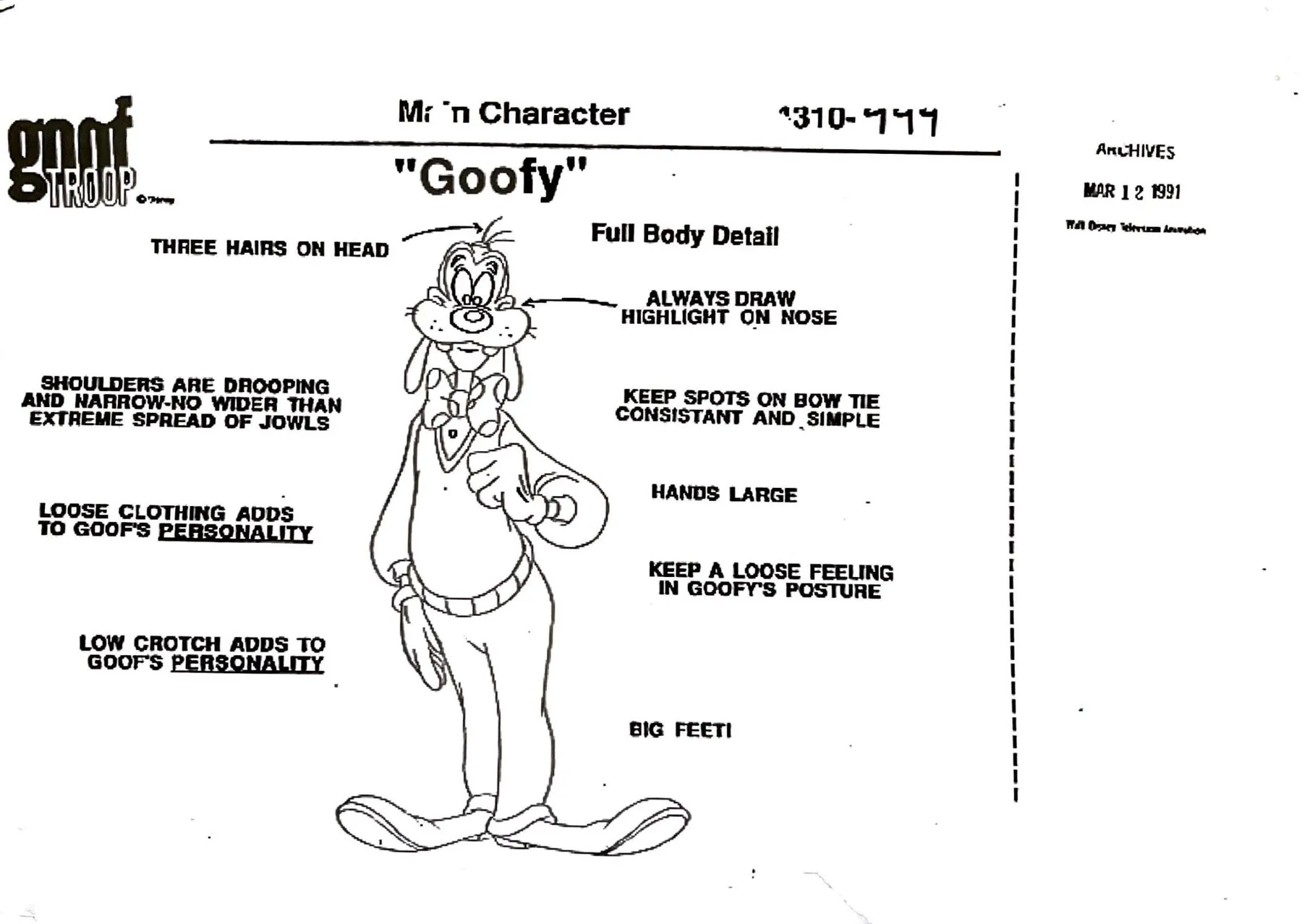
Goofy standing front-on surrounded by capital-letter notes with arrows, such as ‘THREE HAIRS ON HEAD’ and ‘BIG FEET!’. Goof Troop model sheets © Disney. Scan: Internet Archive item goof-troop-modelsheets (uploader-supplied). Rendered at 250 dpi from the original PDF, rotated upright, downscaled; not retouched. · IA PDF p.2.
- “THREE HAIRS ON HEAD”
- “ALWAYS DRAW HIGHLIGHT ON NOSE”
- “SHOULDERS ARE DROOPING AND NARROW-NO WIDER THAN EXTREME SPREAD OF JOWLS”
- “KEEP SPOTS ON BOW TIE CONSISTANT AND SIMPLE”
- “LOOSE CLOTHING ADDS TO GOOF’S PERSONALITY”
- “HANDS LARGE”
- “KEEP A LOOSE FEELING IN GOOFY’S POSTURE”
- “LOW CROTCH ADDS TO GOOF’S PERSONALITY”
- “BIG FEET!”
“Consistant” is spelled that way on the sheet, and “PERSONALITY” is underlined both times. The notes mix fixed counts (three hairs, spots kept simple) with attitude (“loose feeling”), which is what a model sheet is for: drawings made by many hands should still read as one character. The same Goofy appears on the turnaround as five standing views on one ground line, front to back.
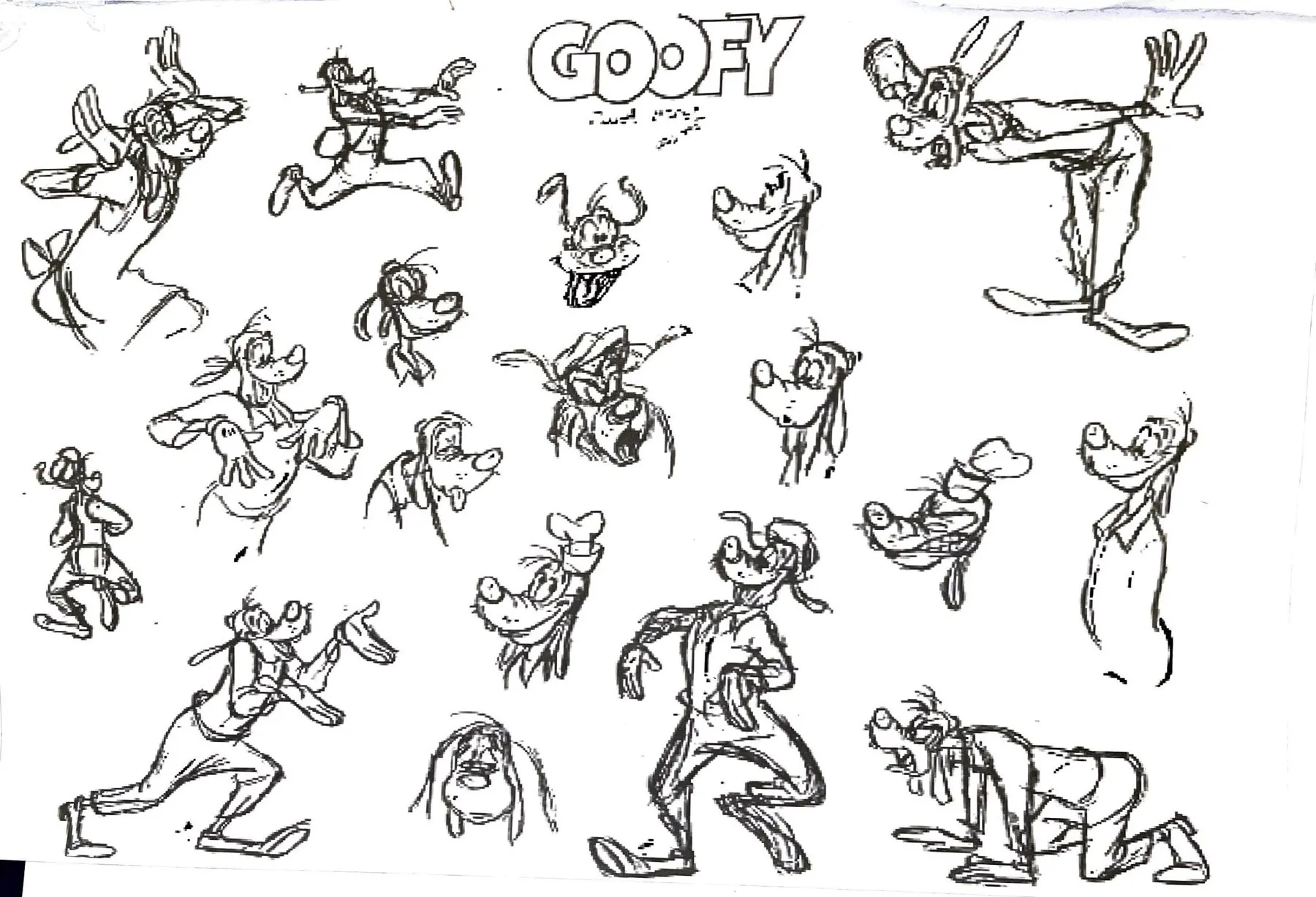
Loose pencil sheet of about two dozen Goofy poses around an outlined ‘GOOFY’ logo. Goof Troop model sheets © Disney. Scan: Internet Archive item goof-troop-modelsheets (uploader-supplied). Rendered at 250 dpi from the original PDF, rotated upright, downscaled; not retouched. · IA PDF p.3.
The file also holds rougher pages. PDF p. 3 is an expression and pose sheet headed by an outlined “GOOFY” logo, with about two dozen loose pencil studies: running, bowing, crawling, laughing. It carries no template, number or stamp, so it may be an earlier stage than the clean sheets. The scan alone cannot settle that.
Pete’s construction
Pete gets a two-page “PETE’S BASIC CONSTRUCTION” sequence (PDF pp. 57–58, the second marked “B”). These sheets explain how to build the figure rather than just showing it. The first shows a pointing Pete drawn over rough masses, with the notes “BUILD PETE’S HEAD INTO NECK,” “SHOULDERS HIGH AND ROUNDED,” “START WITH A LARGE MASS FOR PETE’S BODY,” “LARGE HANDS,” “SMALL FEET,” and “NOTE: PETE OFTEN STANDS W/ HIS LEGS APART GIVING HIM A STRONG POWER BASE.” Underlined at the bottom: “KEEP HIS CENTER OF GRAVITY LOW.”
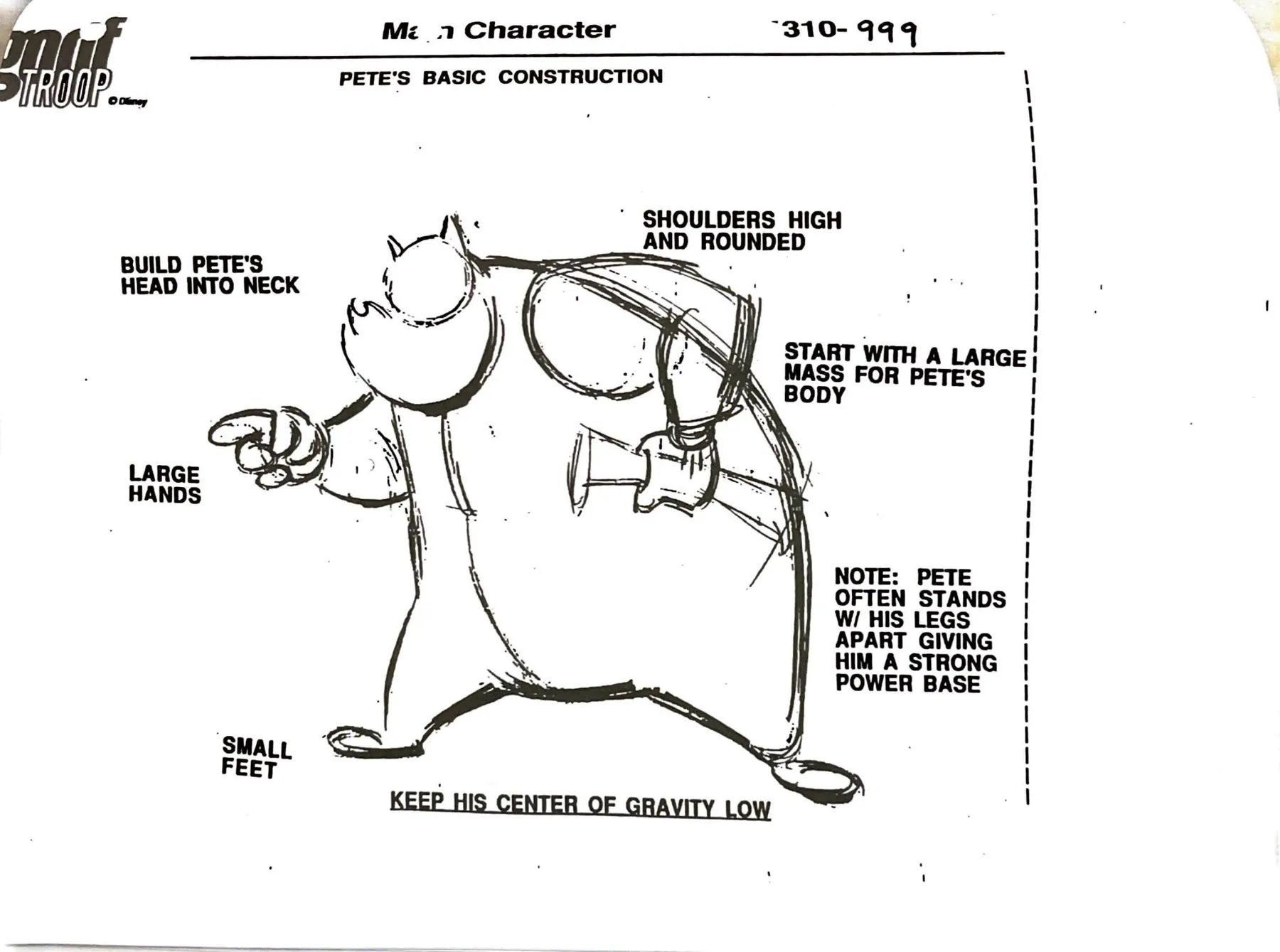
Rough drawing of Pete pointing, built from large round masses, with notes such as ‘KEEP HIS CENTER OF GRAVITY LOW’. Goof Troop model sheets © Disney. Scan: Internet Archive item goof-troop-modelsheets (uploader-supplied). Rendered at 250 dpi from the original PDF, rotated upright, downscaled; not retouched. · IA PDF p.57.
Sheet B dresses that same mass in a suit and tie: “WATCH PERSPECTIVE ON EYES & PUPILS,” “CLOTHES FIT LOOSE ON PETE,” “HANDS LARGE.” Put side by side, the Goofy and Pete pages set up a contrast: Goofy’s drooping, narrow shoulders against Pete’s high, rounded ones, and Goofy’s big feet against Pete’s small ones. Both characters already existed in Disney shorts. These sheets show them being restated as a pair of neighbours for a weekly sitcom.
Poopsie, a.k.a. Chainsaw
The final third of the scan covers Pistol, Pete’s daughter, and the family dog Chainsaw. The two Chainsaw construction sheets are as specific as the Goofy one. “Full Body Construction” (PDF p. 72) asks the artist to “KEEP BOW LARGE AND FLOPPY!”, to “USE CHAINSAW’S TAIL FOR SELECTING EMOTIONS,” and to “KEEP ANIMAL ANATOMY SIMPLE.” The “Head Detail” (PDF p. 74) notes “BOW CAN BOUNCE AROUND ON HER HEAD FOR COMIC EFFECT,” “THREE HAIRS TIED THROUGH BOW,” “THREE EYE LASHES” with “THREE” underlined, and a colour note: “COLOR SEP LINE: MASK AND EARS WILL MAINTAIN DESIGN THEME WITH GOOFY AND PETE.” At the foot of the page: “ANIMATORS—USE EARS AND HAIR FOR OVERLAP AND FOLLOW THROUGH.”
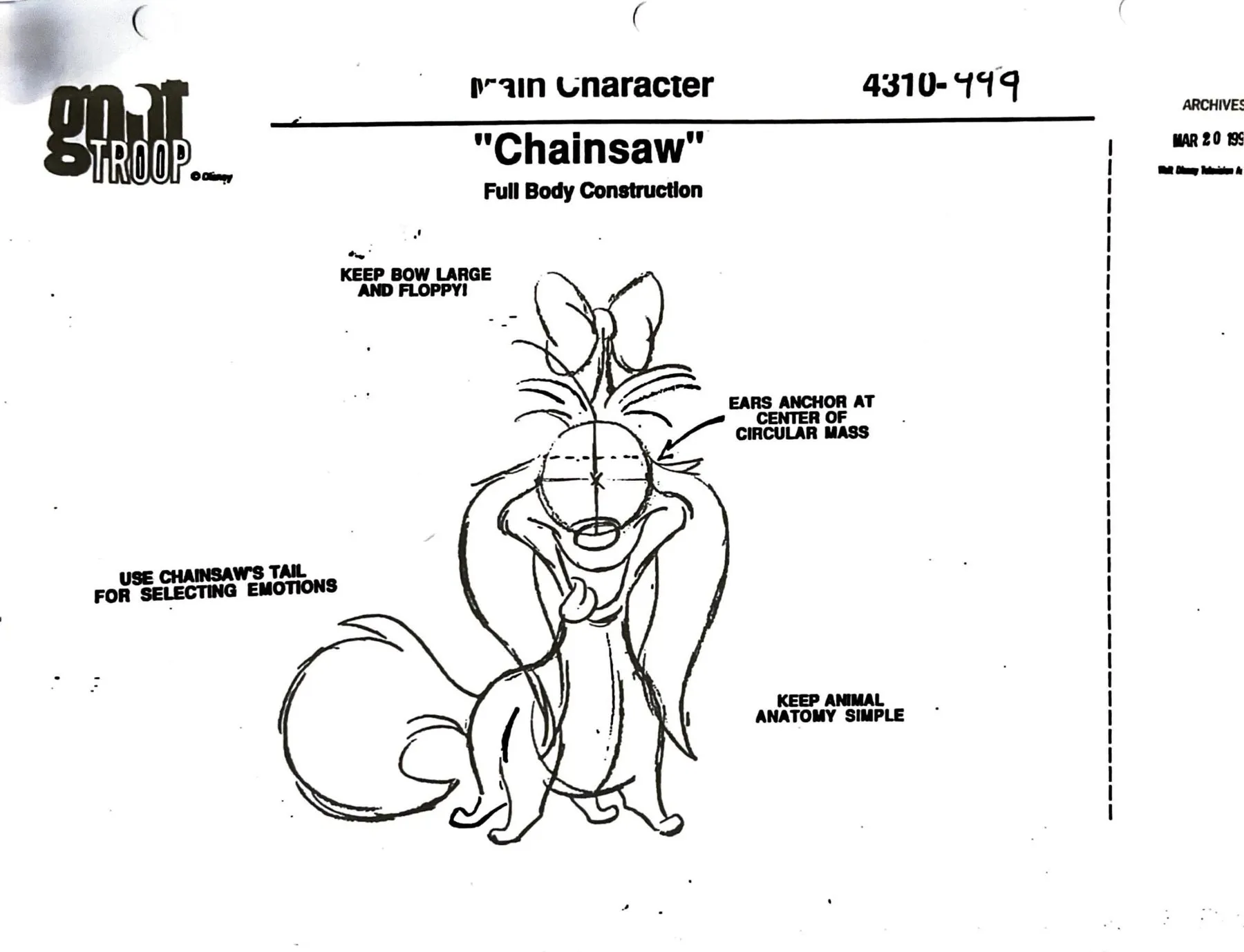
Small long-eared dog with a big bow sitting up, construction lines on the head, notes about the bow, tail and anatomy. Goof Troop model sheets © Disney. Scan: Internet Archive item goof-troop-modelsheets (uploader-supplied). Rendered at 250 dpi from the original PDF, rotated upright, downscaled; not retouched. · IA PDF p.72.
The page collectors will look for first is PDF p. 75. It is a sheet of about twenty loose ink sketches of the dog sitting, snarling, sleeping and scratching. In the middle, hand-lettered: “‘POOPSIE’ AKA CHAINSAW.” Next to it are a circled mark we cannot read with confidence, a pair of circled initials, the number “4310-999” written by hand, and a small stamp, “ROUGH.” A second small date stamp below is not legible on the scan.
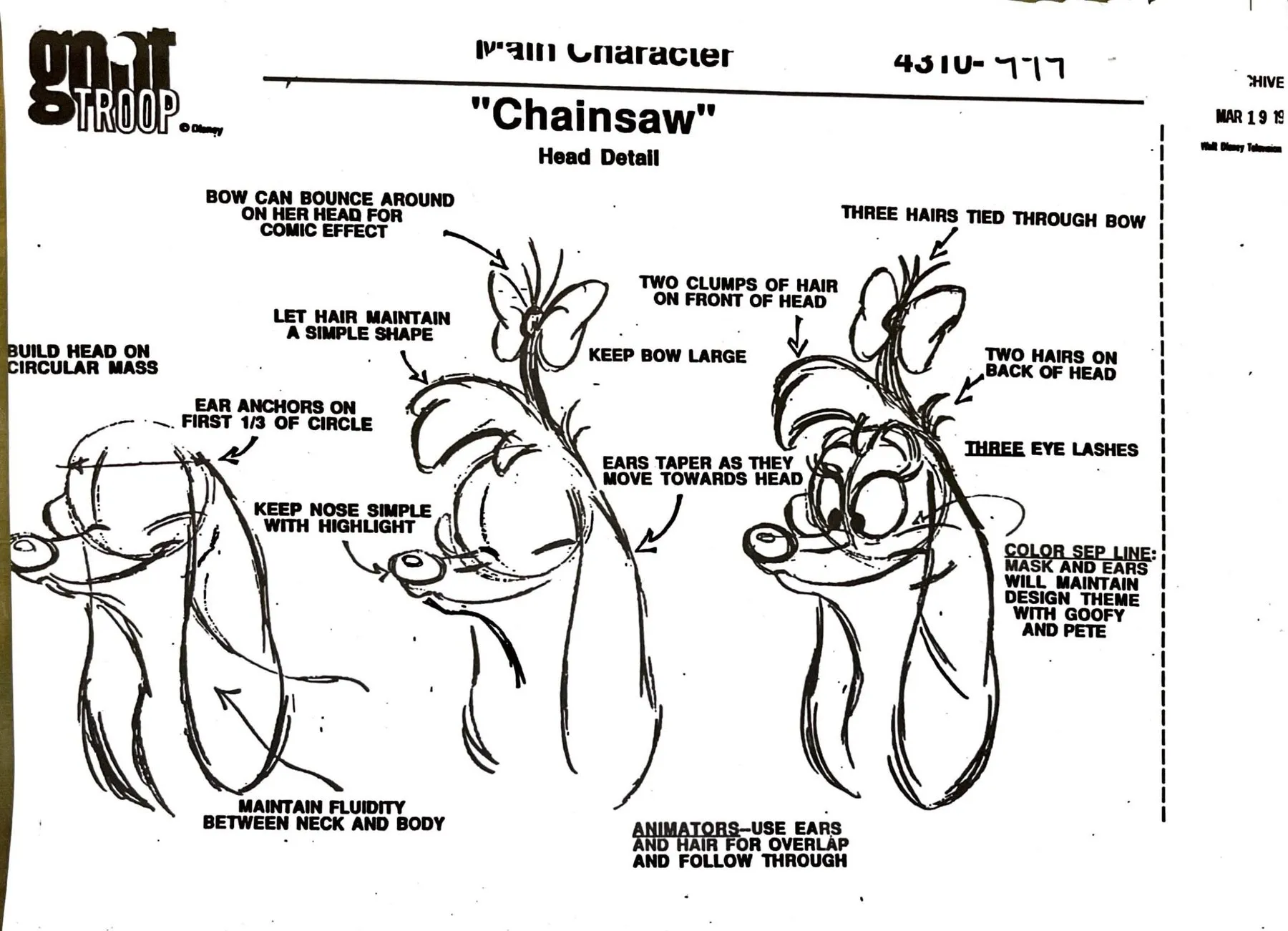
Three views of the dog’s head, from circle construction to finished face, with notes on bow, hair, ears and eyelashes. Goof Troop model sheets © Disney. Scan: Internet Archive item goof-troop-modelsheets (uploader-supplied). Rendered at 250 dpi from the original PDF, rotated upright, downscaled; not retouched. · IA PDF p.74.
The lettering supports one narrow reading: at the time of this rough, the dog was being called both “Poopsie” and “Chainsaw.” The page does not say which name came first, who chose it, or when the change was made, and we do not guess. Wikipedia’s cast list credits Frank Welker as the voice of Chainsaw, which is the name that reached the screen.
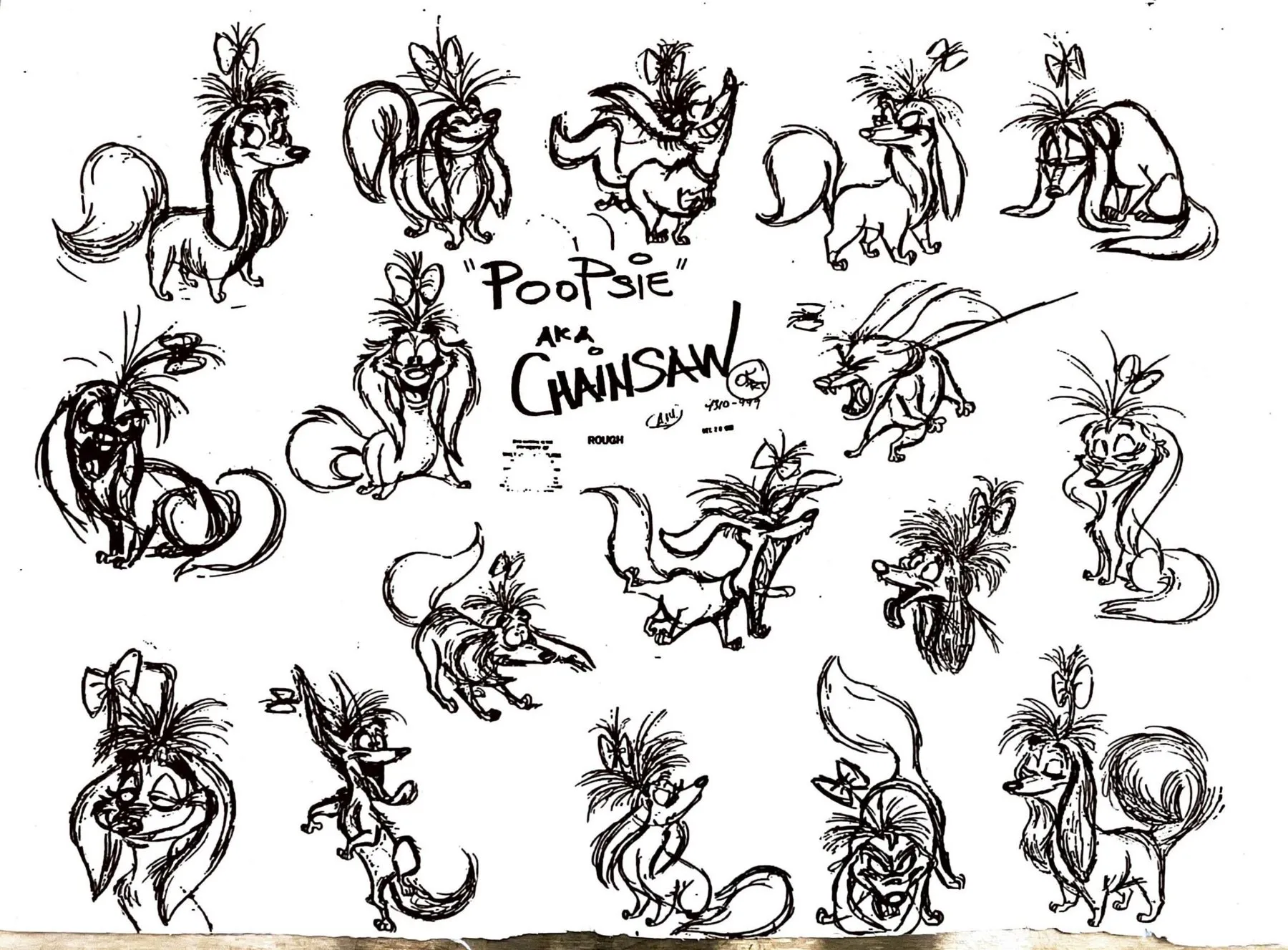
Ink rough of about twenty dog poses around hand-lettered ‘“POOPSIE” AKA CHAINSAW’ with a small ‘ROUGH’ stamp. Goof Troop model sheets © Disney. Scan: Internet Archive item goof-troop-modelsheets (uploader-supplied). Rendered at 250 dpi from the original PDF, rotated upright, downscaled; not retouched. · IA PDF p.75.
Who drew from these
The sheets name no overseas studio. Wikipedia credits Walt Disney Television Animation as the producer and lists outsourced animation by Guimaraes Productions, Kennedy Cartoons, Moving Images International, Sunwoo Animation, Walt Disney Animation Australia, Walt Disney Animation France, Walt Disney Animation Japan and Wang Film Productions. That list explains the tone of the notes. Lines like “ALWAYS DRAW,” “KEEP” and “ANIMATORS—USE” read as instructions written to travel. We cannot show which of these studios received this particular set.
The same article gives the business frame: 65 episodes in first-run syndication on The Disney Afternoon, 13 more for ABC on Saturday mornings, and a June 1992 promotion with Kellogg’s, Burger King and others valued at $100 million, citing a 1992 trade report. The model sheets come before all of that. The March 1991 archive stamps preserve design instructions about hair counts and centres of gravity before the television launch.
Disney’s D23 archive confirms the September 7, 1992 syndicated debut after the April Disney Channel debut: Goof Troop Debuts in Syndication.
Sources
- Disney's Goof Troop: Production Model Sheets (1991) · Internet Archive
- Same item, "Poopsie aka Chainsaw" rough · PDF p. 75 · scan page 75
- Goof Troop · Wikipedia
Artwork and toy photographs are credited reproductions from published sources.