From the archive Langrisser
Out of Order on Purpose: Satoshi Urushihara's Notes on Five Langrisser Games
A 1998 Gakken art book runs the Langrisser games in story order, III first, and opens each chapter with a short first-person note on designing its characters: what anime had taught him, what he changed, and what he had wanted to try for years.
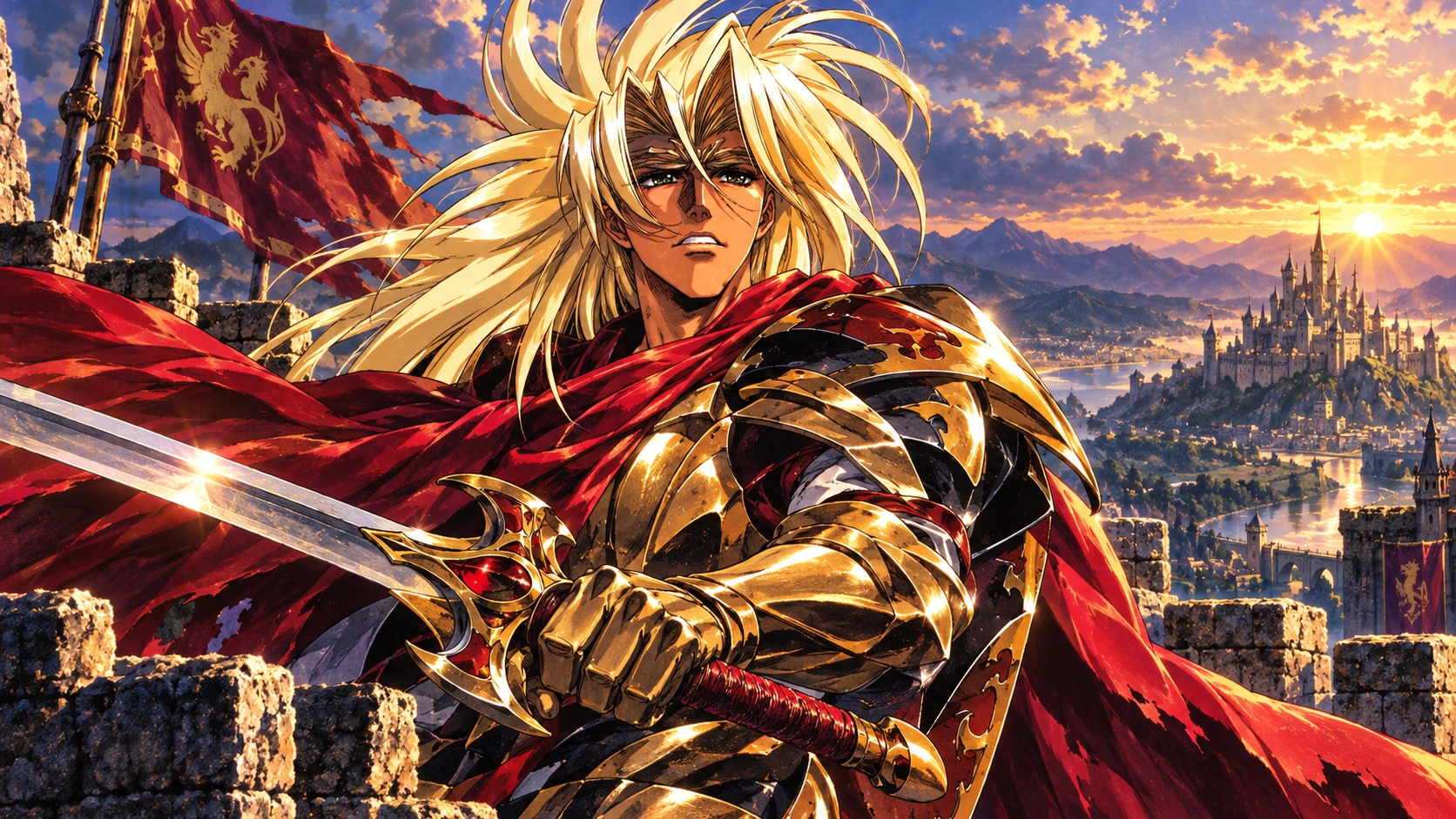
Original editorial illustration inspired by Dihalt’s Langrisser III package-art design. It is not artwork by Satoshi Urushihara.
AI editorial illustration · Rewind: Northwest RetroDesign reference ↗01 Historical source
Gakken · p. 5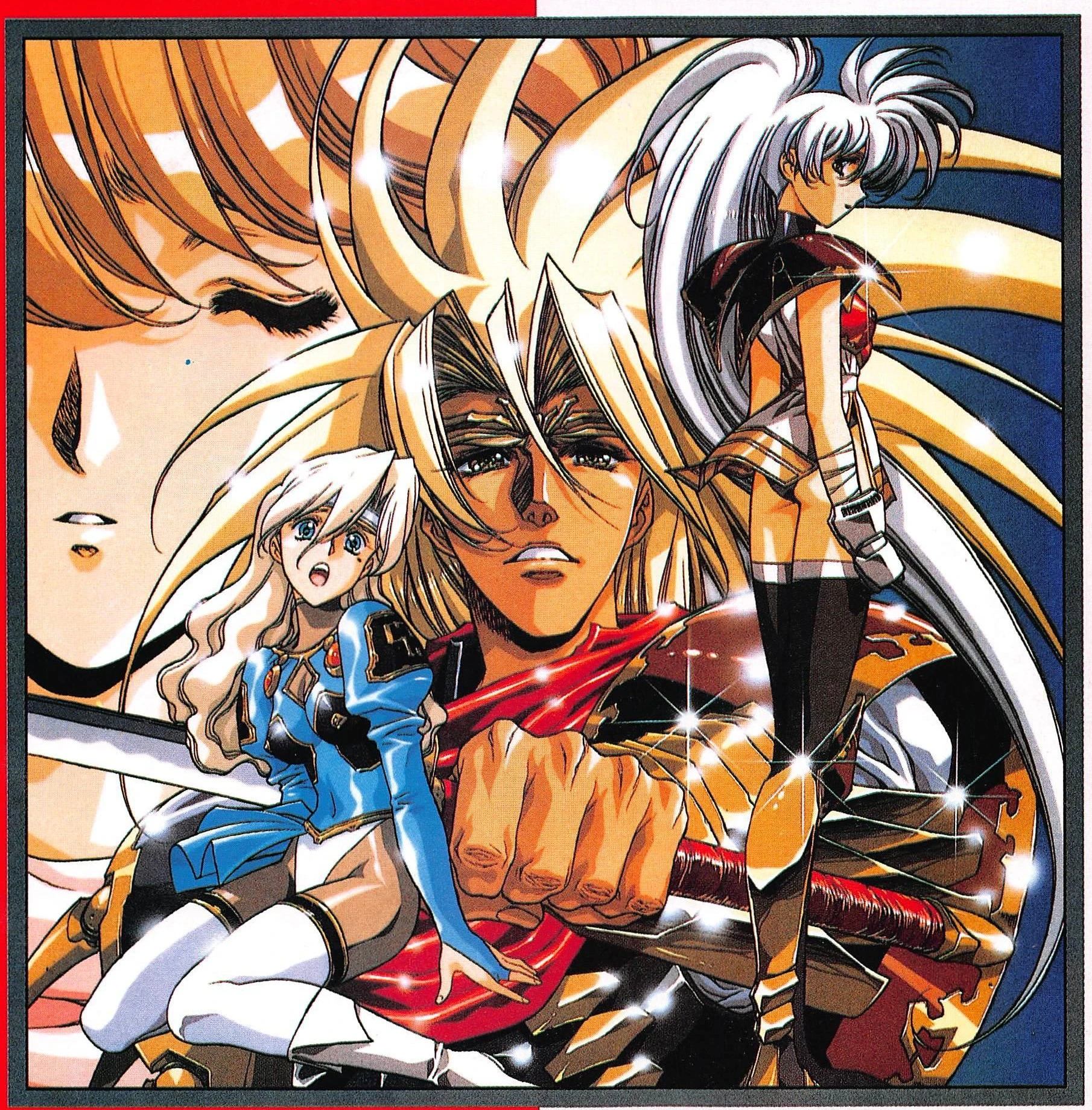
Satoshi Urushihara's Langrisser III package illustration: Dihalt holding a sword, with the heroines around him.
うるし原智志イラスト集 LEGEND OF LANGRISSER, Gakken (学習研究社), first printing August 14, 1998 · p. 5 (PDF 5; IA n4), plate · © Satoshi Urushihara 1998, © NCS, © Career Soft, © 1998 GAKKEN.The book is うるし原智志イラスト集 LEGEND OF LANGRISSER. Its colophon gives the first printing as August 14, 1998 (1998年8月14日 第1刷発行), with Gakken (株式会社学習研究社) as publisher and うるし原智志 (Satoshi Urushihara) as author. The copyright lines read “©Satoshi Urushihara 1998 ©NCS ©キャリアソフト.” Editorial cooperation is credited to メサイヤ (Masaya), キャリアソフト (Career Soft), Broccoli and others. Legend of Langrisser, p. 106 (PDF p. 106). (Japanese text is quoted in working translations. Character names are working transliterations, with the katakana at first mention; these spellings are not all official English localizations. This scan’s printed page numbers match its PDF pages.)
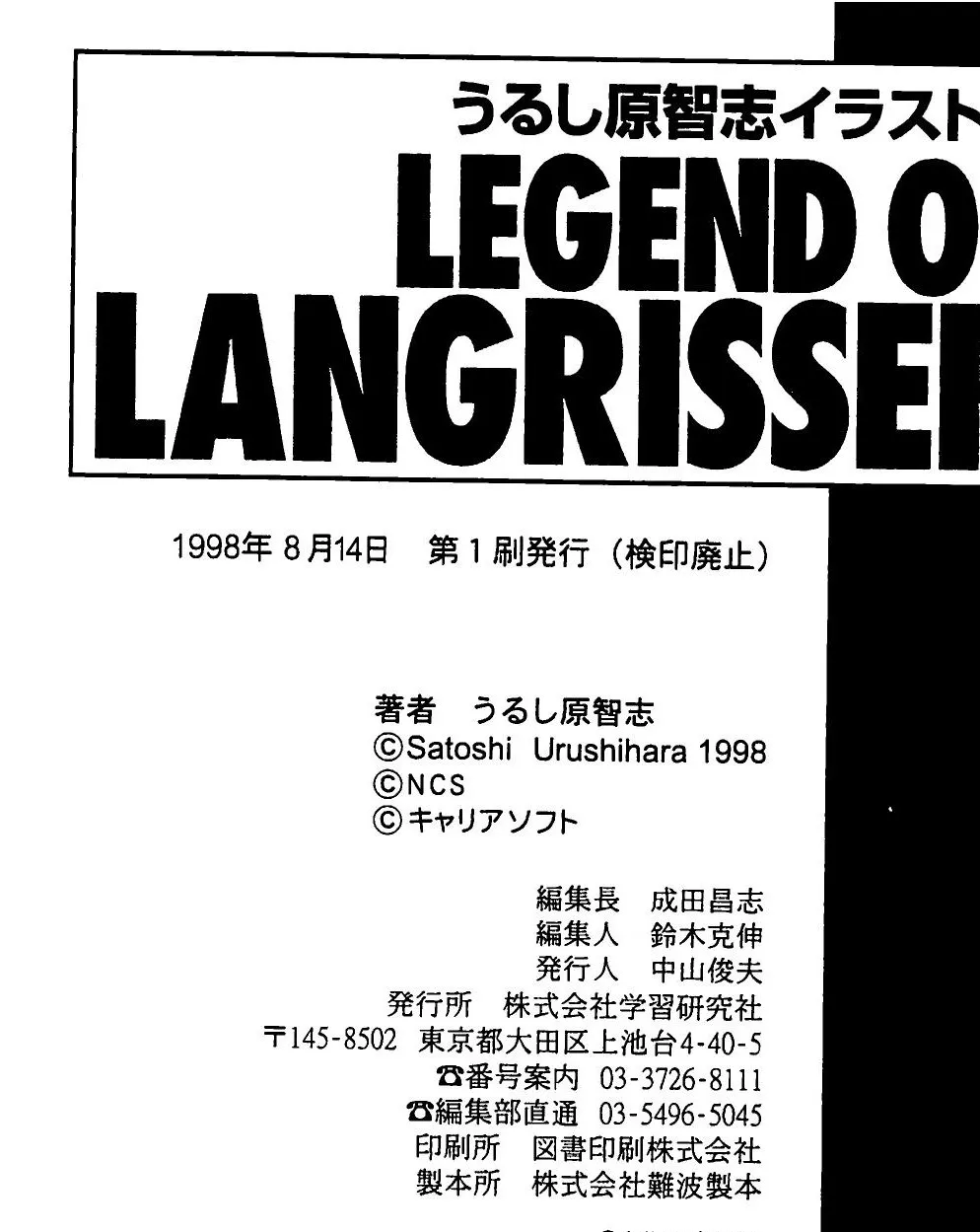
Colophon of Legend of Langrisser: first printing August 14, 1998, Gakken. うるし原智志イラスト集 LEGEND OF LANGRISSER, Gakken (学習研究社), first printing August 14, 1998 · p. 106 (PDF 106), top · © Satoshi Urushihara 1998, © NCS, © Career Soft, © 1998 GAKKEN..
Why III comes first
The contents page lists LANGRISSER III at page 5, then I (29), II (41), IV (57) and V (70), followed by “Opening Animation” (86), “Trading Cards” (90) and “History of Langrisser” (99). Legend of Langrisser, p. 4 (PDF p. 4).
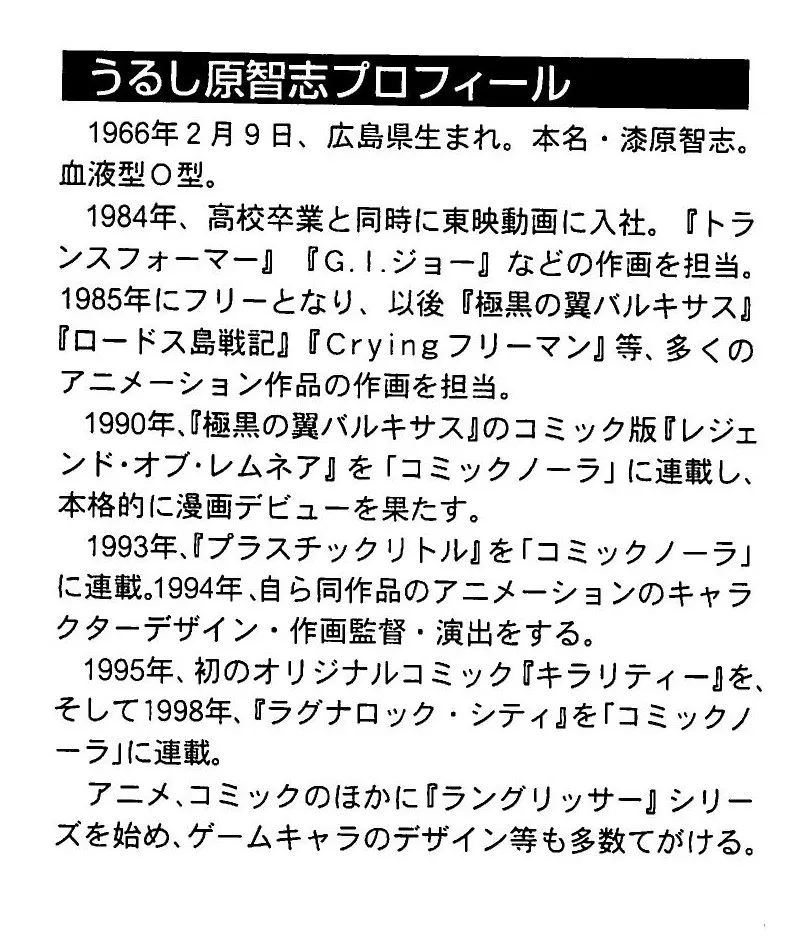
Urushihara’s profile: born 1966 in Hiroshima, joined Toei Doga in 1984, animation work on Transformers and G.I. Joe. うるし原智志イラスト集 LEGEND OF LANGRISSER, Gakken (学習研究社), first printing August 14, 1998 · p. 106 (PDF 106), lower left · © Satoshi Urushihara 1998, © NCS, © Career Soft, © 1998 GAKKEN..
The note opening the III chapter, signed (うるし原智志), explains the order. Arranged by their history inside the game world, the episodes run III, I, II, IV, V, “so this art book is also arranged to be seen in that order.” He calls III one he is “especially attached to,” because it has the most characters he designed in the series and because he got to work on the opening animation, “which I had wanted to do for a long time.” Legend of Langrisser, p. 5 (PDF p. 5).
His profile on the colophon page explains the anime background. He was born February 9, 1966, in Hiroshima, and joined Toei Dōga (東映動画) in 1984, the year he finished high school, where he did animation drawing on Transformers and G.I. Joe among other work. He went freelance in 1985 and drew animation for 極黒の翼バルキサス (Dark Wing Barkisus), Record of Lodoss War and Crying Freeman, among others. In 1990 he serialized Legend of Lemnear, the comic version of Barkisus, in Comic Nora and made his full manga debut. Plastic Little followed there in 1993, and in 1994 he did the character design, animation direction and direction on its anime. Legend of Langrisser, p. 106 (PDF p. 106).
Only the III chapter note is explicitly signed on the reproduced pages. The other first-person chapter notes are attributed to Urushihara from their context in his authored art book.
I: no rule against detail
The note for the first game begins: “I, who had been an animator until then, was slowly starting to take work outside anime, such as manga, around when I received this I.” Game character design was a first for him, and he says he was “quite confused.” Anime and game design look alike but differ a great deal: anime assumes other people will draw the characters, so they must be built from simple lines that are easy to grasp in three dimensions. A game has no such limit. “Anything goes, which turned around into the question: how far can I go?” After many rounds of trial and error, he writes, the present form emerged. Legend of Langrisser, p. 29 (PDF p. 29).
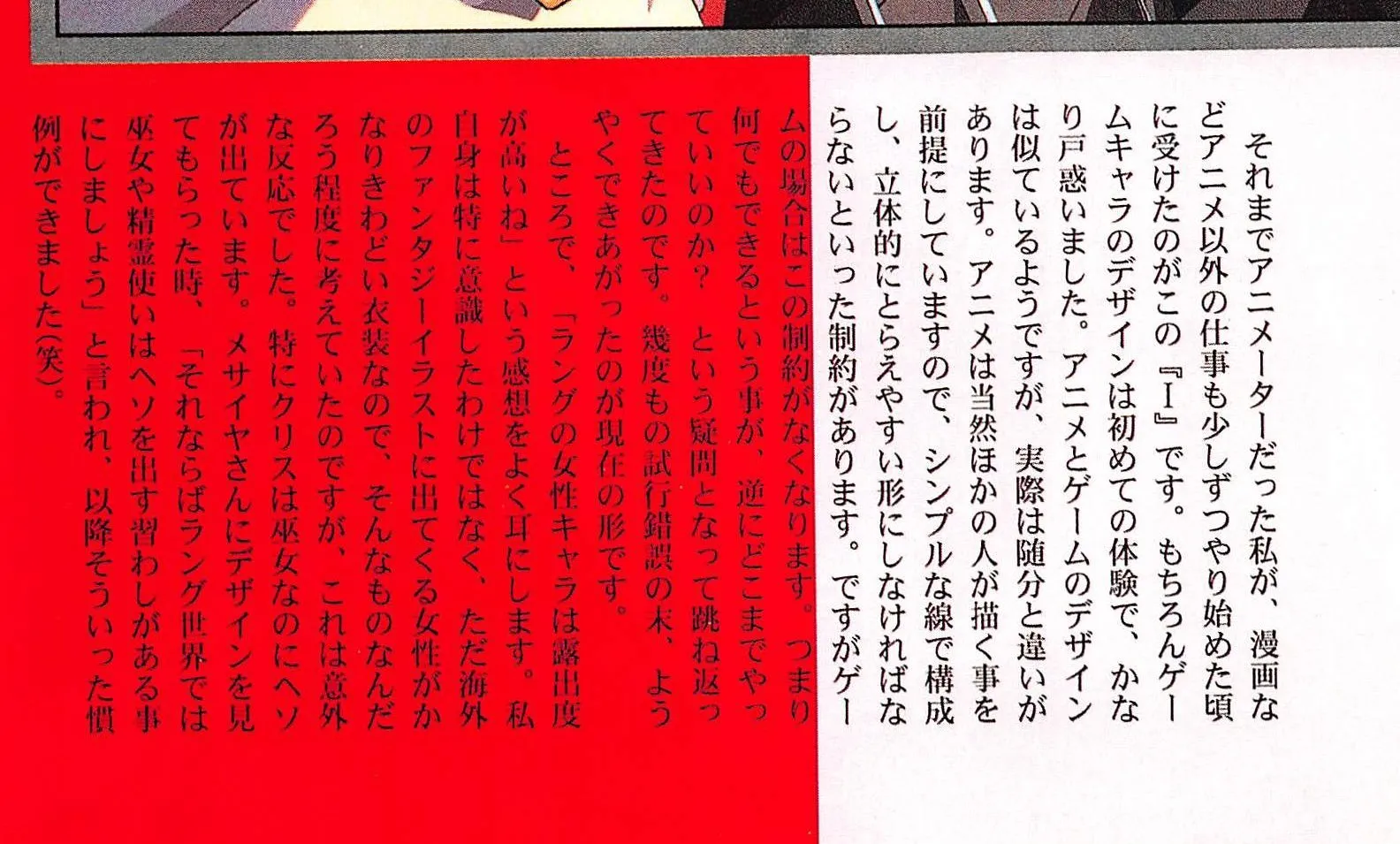
Urushihara’s note opening the Langrisser I chapter, on moving from anime to game character design. うるし原智志イラスト集 LEGEND OF LANGRISSER, Gakken (学習研究社), first printing August 14, 1998 · p. 29 (PDF 29), note · © Satoshi Urushihara 1998, © NCS, © Career Soft, © 1998 GAKKEN..
He takes on a comment he hears often, that “Lang’s female characters show a lot of skin.” He says he wasn’t consciously aiming for that and thought of the costumes as ordinary for women in overseas fantasy illustration. The reaction surprised him. When Masaya saw that クリス (Chris), a shrine maiden, had a bare midriff, the answer was “then in the Lang world, shrine maidens and spirit users have a custom of showing the navel,” and that became the rule from then on, he adds with a “(laughs).” Legend of Langrisser, p. 29 (PDF p. 29).
II: a princess rewritten
Masaya ordered designs by sending character settings along with image roughs, he explains, and he built his own image from there, sometimes far from the original setting. シェリー (Sherry) was one case. She began as a quiet daughter of a good family, but his “selfish assumption that princess = tomboy” produced the tomboy princess of the finished game. “Fortunately this was accepted,” and the story was hastily revised. Legend of Langrisser, p. 41 (PDF p. 41).
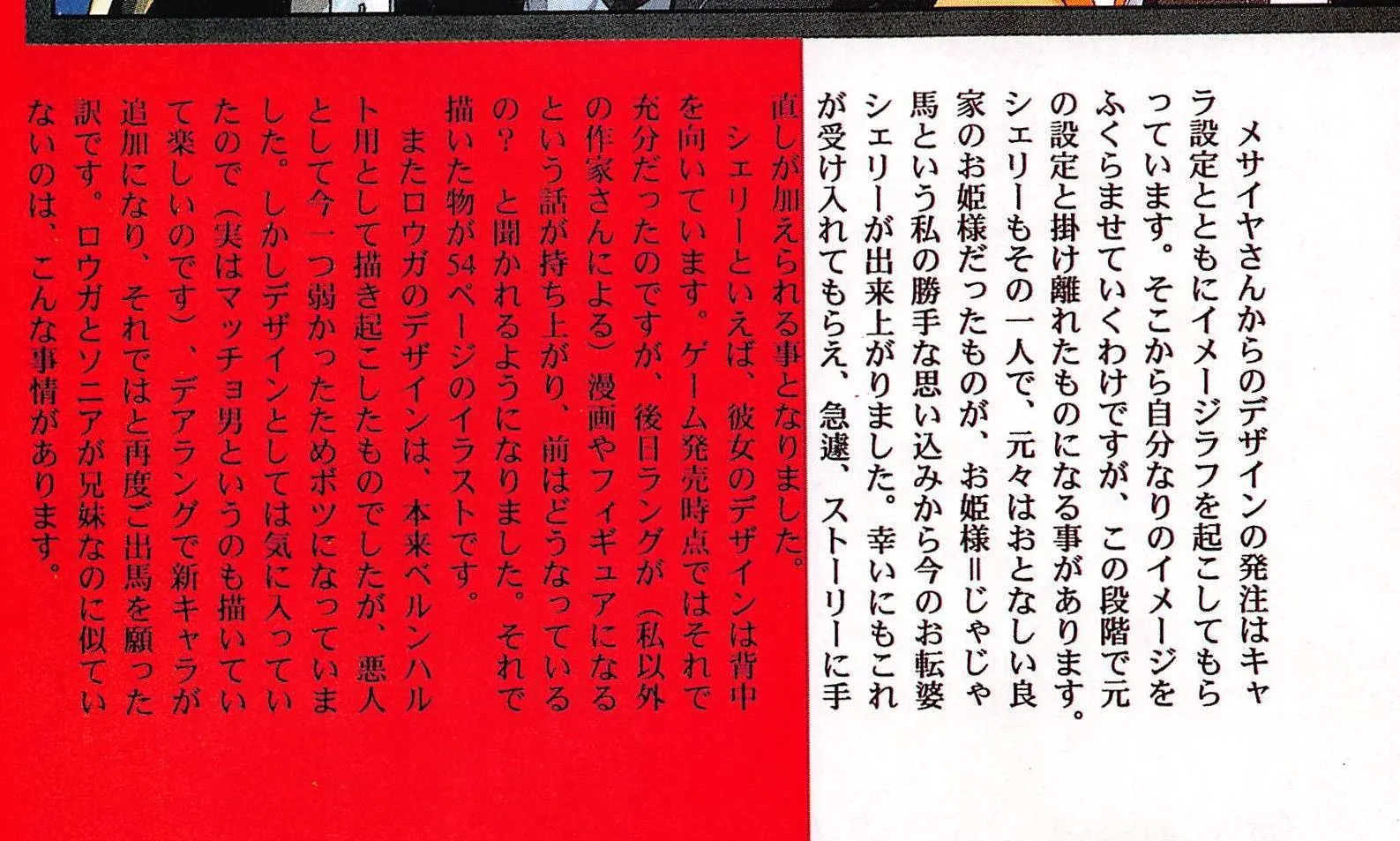
Urushihara’s note opening the Langrisser II chapter, on Sherry and on Rouga’s design. うるし原智志イラスト集 LEGEND OF LANGRISSER, Gakken (学習研究社), first printing August 14, 1998 · p. 41 (PDF 41), note · © Satoshi Urushihara 1998, © NCS, © Career Soft, © 1998 GAKKEN..
Sherry’s design, he writes, showed her from behind (背中を向いています), which was enough when the game came out. Later, when manga and figures by other creators were planned, he was asked what her front looked like, and he says the illustration on page 54 is what he drew. The book’s first-appearance list gives page 54 as a Der Langrisser pack-in bonus (封入特典). He also says ロウガ (Rouga) was first drawn for ベルンハルト (Bernhardt) but set aside as too weak for a villain. He liked the design (“drawing macho men is fun, actually”) and asked for it back when Der Langrisser added new characters, which, he says, is why Rouga and his sister ソニア (Sonia) look nothing alike. Legend of Langrisser, pp. 41, 104 (PDF pp. 41, 104).
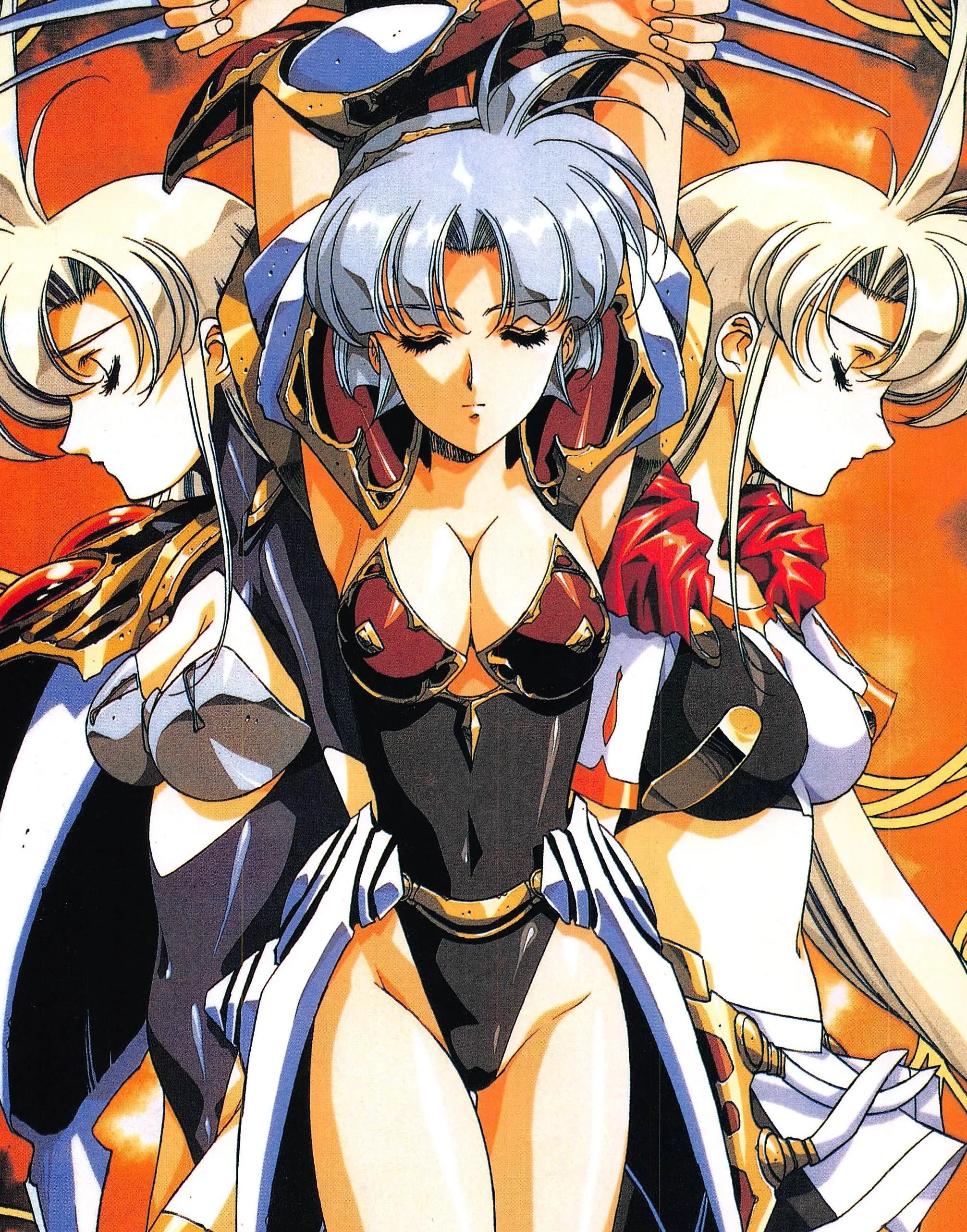
The page-54 illustration, listed as a Der Langrisser pack-in bonus, which the p. 41 note says was drawn to answer what Sherry’s front looked like. うるし原智志イラスト集 LEGEND OF LANGRISSER, Gakken (学習研究社), first printing August 14, 1998 · p. 54 (PDF 54; IA n53), plate · © Satoshi Urushihara 1998, © NCS, © Career Soft, © 1998 GAKKEN..
III: the things he had held back
By III, he writes, the world had “settled in my mind,” so he could try elements he had avoided for fear of breaking it: the Eastern atmosphere of 霧風 (Kirikaze) and シルバーウルフ (Silver Wolf), and ティアリス (Tiaris) wearing a huge ribbon “in shōjo-manga style (laughs).” He gave the hero ディハルト (Dihalt) a roughness unlike the heroic leads of earlier games, a quality of the 1970s anime heroes he liked. “So you could say Dihalt’s origin is in Ashita no Joe (laughs).” Legend of Langrisser, p. 5 (PDF p. 5).
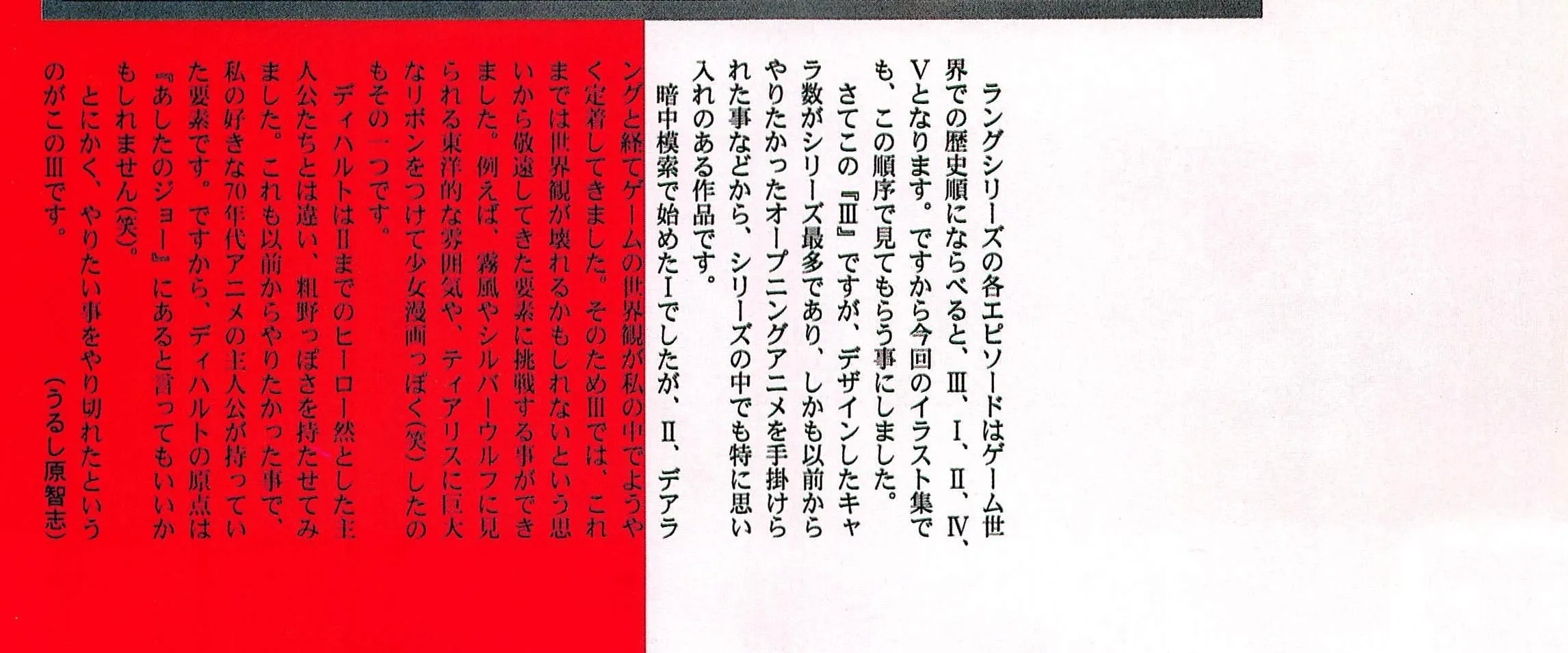
Urushihara’s signed note opening the Langrisser III chapter, explaining the book’s story order. うるし原智志イラスト集 LEGEND OF LANGRISSER, Gakken (学習研究社), first printing August 14, 1998 · p. 5 (PDF 5), note · © Satoshi Urushihara 1998, © NCS, © Career Soft, © 1998 GAKKEN..
IV and V: a different Lang
IV and V, he notes, take place on a different continent from I–III, and having done everything he wanted through III, he treated them as “a different Lang.” He swapped heavy armor for simpler, easier-to-move armor, which gave an SF look that he thought suited IV’s world with its machines. He designed the women’s costumes “with less exposure.” Where he had used colors such as brown to make things look showy, IV is built on calmer white, black and red. He had avoided cool colors, but the blue he tried on リファニー (Liffany) in III worked, so he used it fully on the green-haired sisters シェルファニール (Sherfanir) and アンジェリナ (Angelina). His aside about Admiral Willer’s model ends: “I wish Kei Tomiyama had voiced him.” Legend of Langrisser, p. 57 (PDF p. 57).
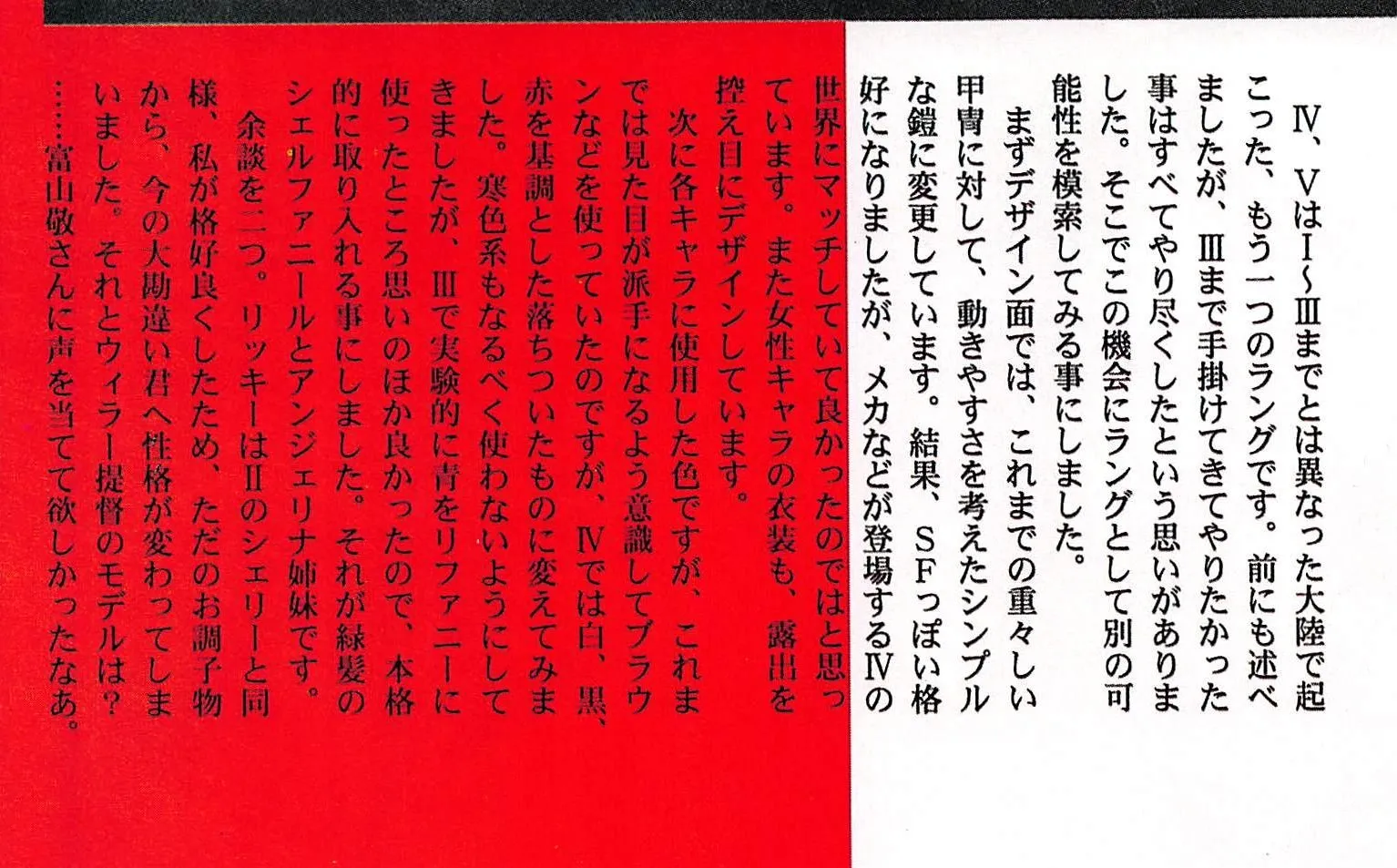
Urushihara’s note opening the Langrisser IV chapter, on lighter armor and a white, black and red palette. うるし原智志イラスト集 LEGEND OF LANGRISSER, Gakken (学習研究社), first printing August 14, 1998 · p. 57 (PDF 57), note · © Satoshi Urushihara 1998, © NCS, © Career Soft, © 1998 GAKKEN..
For V, whose lead is an artificial soldier, the problem was expression. シグマ (Sigma) and ラムダ (Lambda) lack memory and feeling, so they can’t make big faces, yet blank faces have no impact. He kept expressions to a minimum and put bright colors in hair and costume instead. He removed the armor from レインフォルス (Rainforce), reasoning that “a truly strong man has no need to block an opponent’s sword.” He ends by saying he got to make an opening animation again and is proud that he gave the series’ last game everything he had, so as to leave no regrets. Legend of Langrisser, p. 70 (PDF p. 70).
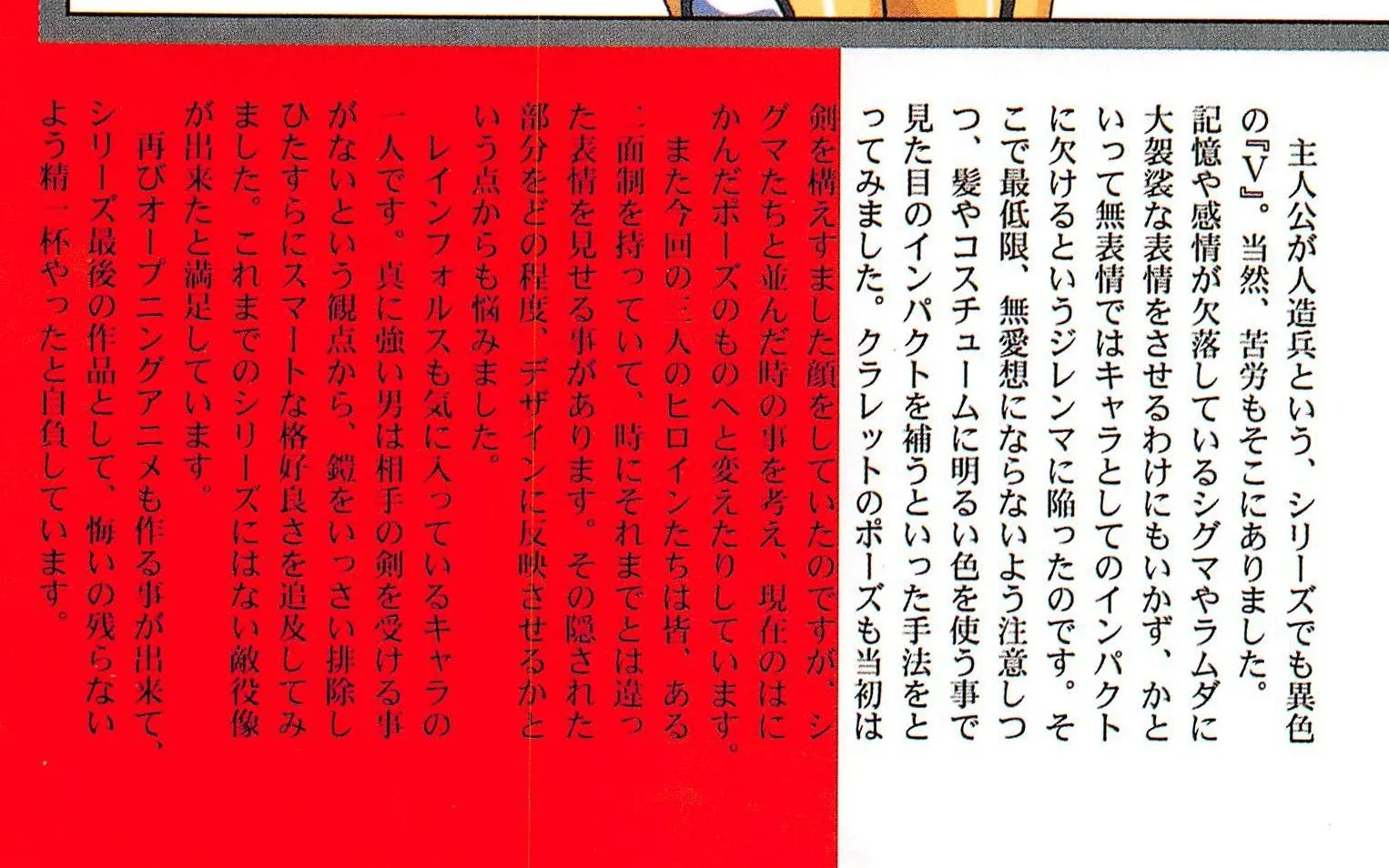
Urushihara’s note opening the Langrisser V chapter, on drawing expressionless artificial soldiers. うるし原智志イラスト集 LEGEND OF LANGRISSER, Gakken (学習研究社), first printing August 14, 1998 · p. 70 (PDF 70), note · © Satoshi Urushihara 1998, © NCS, © Career Soft, © 1998 GAKKEN..
Where the art first ran
A first-appearance list (初出リスト) dates many plates: the III package (September 1996) on page 5, posters, Card Getter nine-panel puzzles, and covers for Sega Saturn Magazine, Dengeki Sega Saturn, Saturn FAN and Great Saturn Z, plus a V flyer dated May 1998. Legend of Langrisser, p. 104 (PDF p. 104).
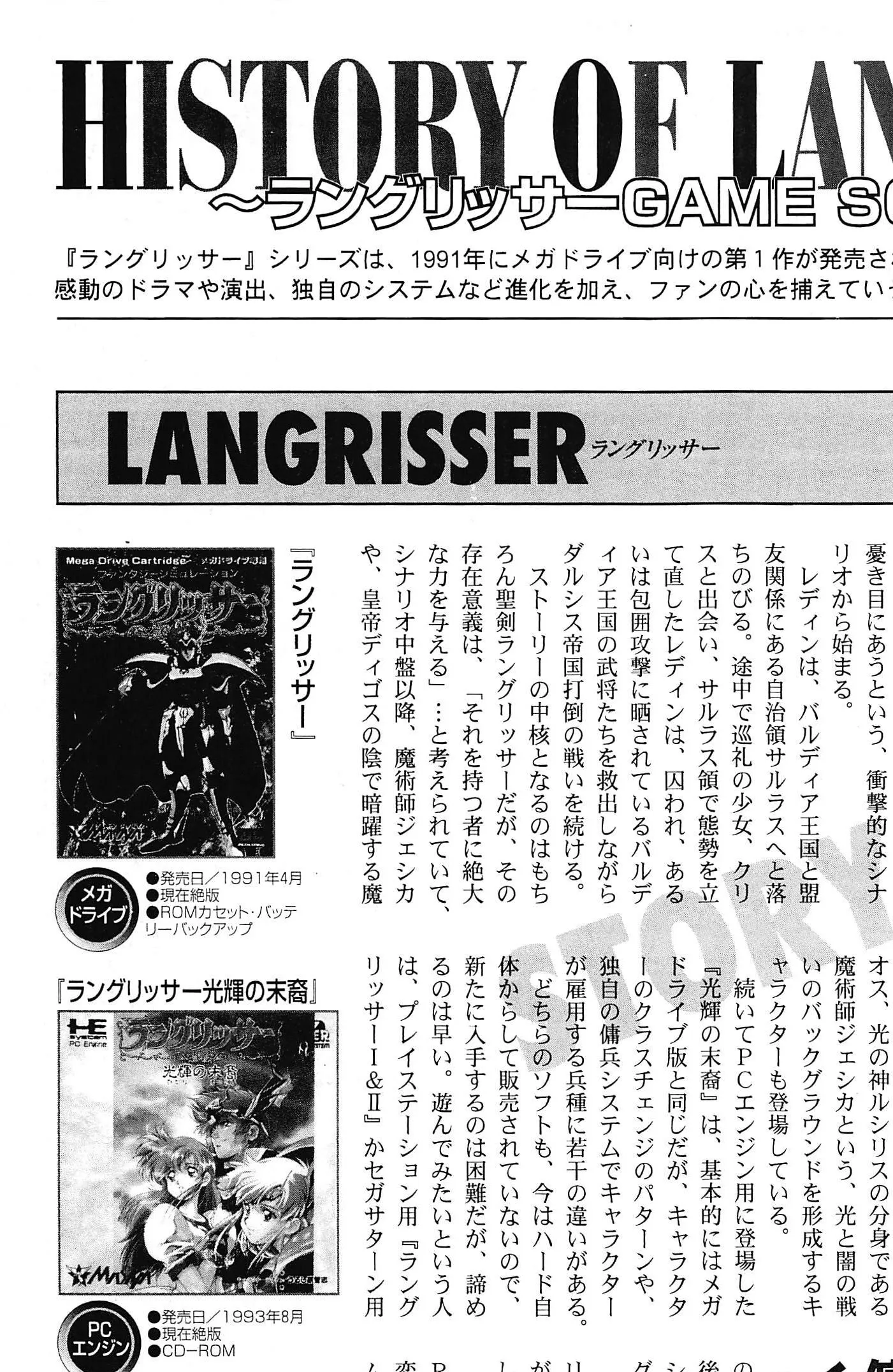
History of Langrisser page: entries for the April 1991 Mega Drive Langrisser and the August 1993 PC Engine version. うるし原智志イラスト集 LEGEND OF LANGRISSER, Gakken (学習研究社), first printing August 14, 1998 · p. 99 (PDF 99), upper left · © Satoshi Urushihara 1998, © NCS, © Career Soft, © 1998 GAKKEN..
A trading-card checklist covers two Broccoli “Hybrid Card Collection” sets: Langrisser I & II & III and III & IV, ten cards a pack at ¥343 before tax, numbered 001–263 between them. Legend of Langrisser, p. 103 (PDF p. 103).
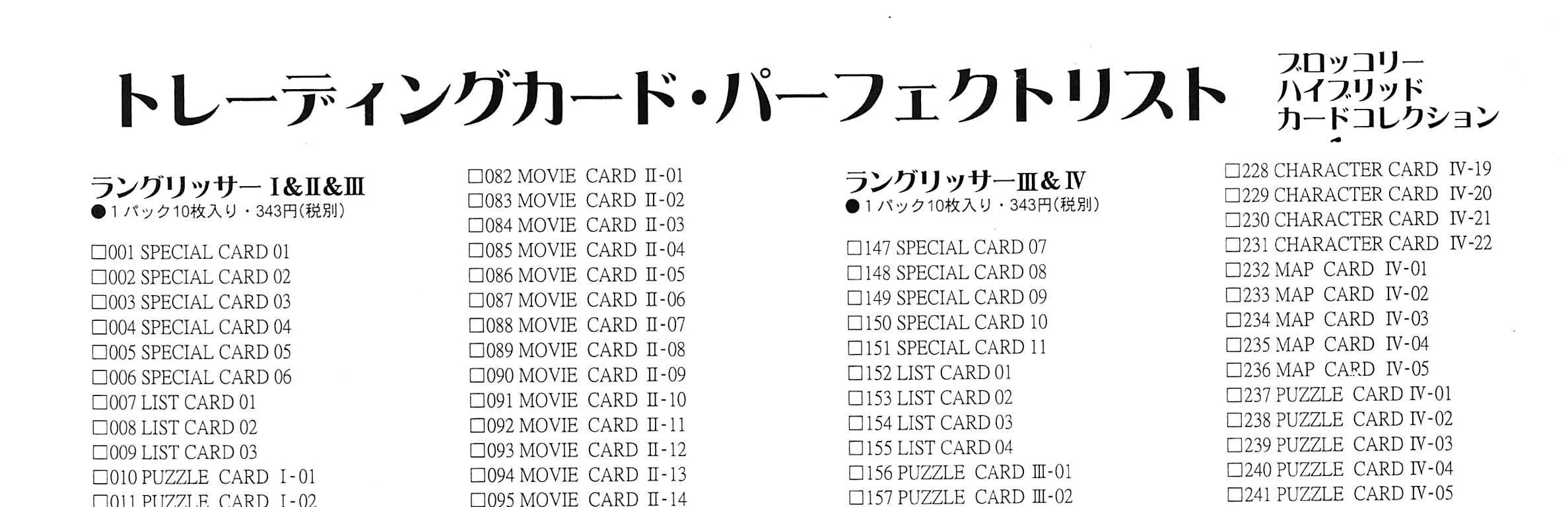
Header of the trading-card checklist for Broccoli’s Langrisser Hybrid Card Collection, ten cards a pack at ¥343. うるし原智志イラスト集 LEGEND OF LANGRISSER, Gakken (学習研究社), first printing August 14, 1998 · p. 103 (PDF 103), header · © Satoshi Urushihara 1998, © NCS, © Career Soft, © 1998 GAKKEN..
The history pages list Japanese releases with dates as printed: Langrisser for Mega Drive (April 1991), Langrisser: Kōki no Matsuei for PC Engine CD-ROM (August 1993), Langrisser II for Mega Drive (August 1994), Der Langrisser for Super Famicom (June 1995), Der Langrisser FX for PC-FX (April 1996), and III (October 1996), IV (August 1997) and V (June 1998) for Saturn. They say neither of the first game’s original versions is on sale any more, the hardware included, and point players to the PlayStation Langrisser I & II or the Saturn Dramatic Edition. Legend of Langrisser, pp. 99–102 (PDF pp. 99–102).
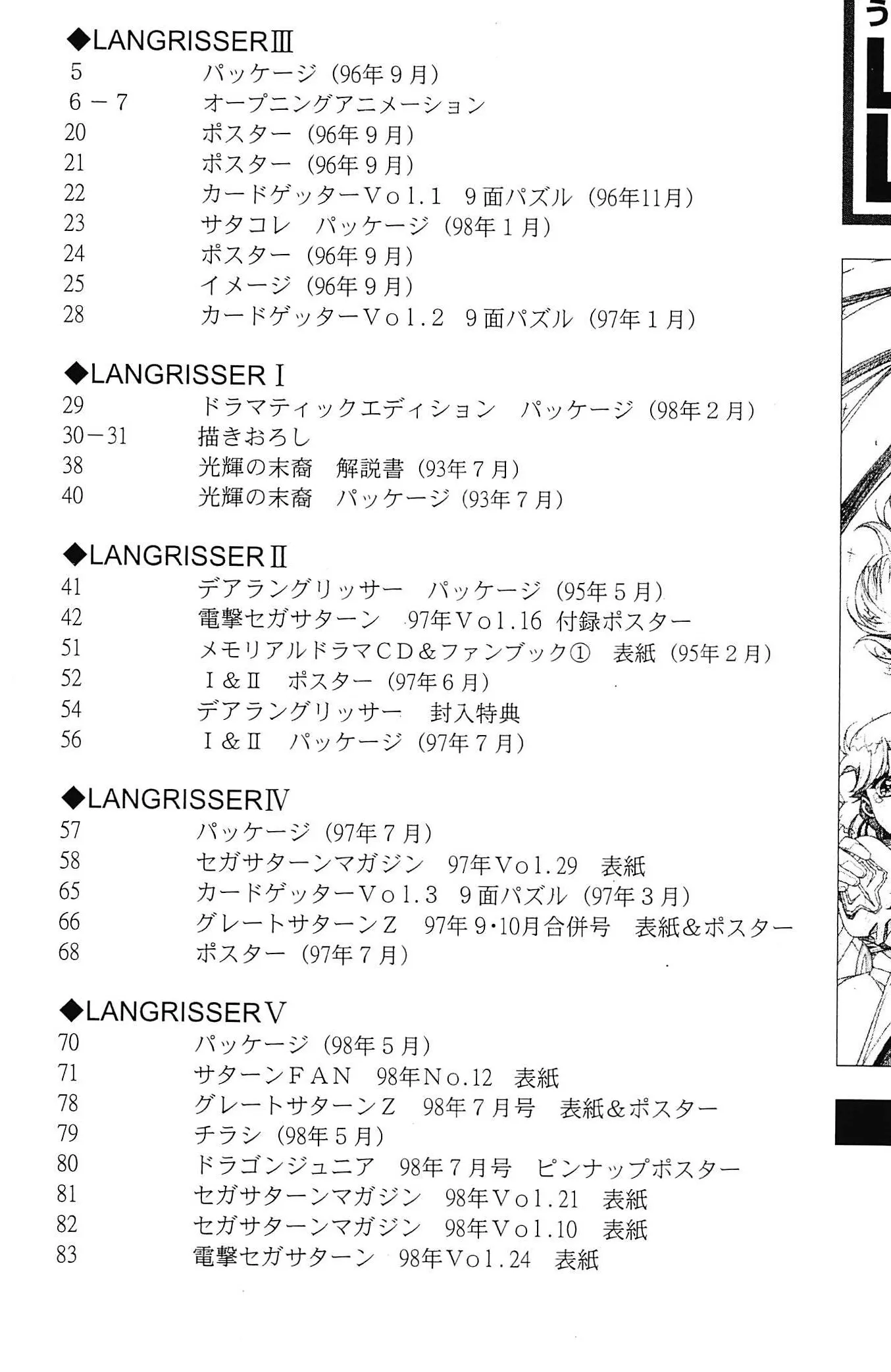
First-appearance list giving where each plate first ran: packages, posters and magazine covers. うるし原智志イラスト集 LEGEND OF LANGRISSER, Gakken (学習研究社), first printing August 14, 1998 · p. 104 (PDF 104), list · © Satoshi Urushihara 1998, © NCS, © Career Soft, © 1998 GAKKEN..
A handwritten afterword dated ’98.7 says the series reached its end with V and thanks producer and director Takada, Masaya, Career Soft’s staff and the editors. Legend of Langrisser, p. 105 (PDF p. 105).
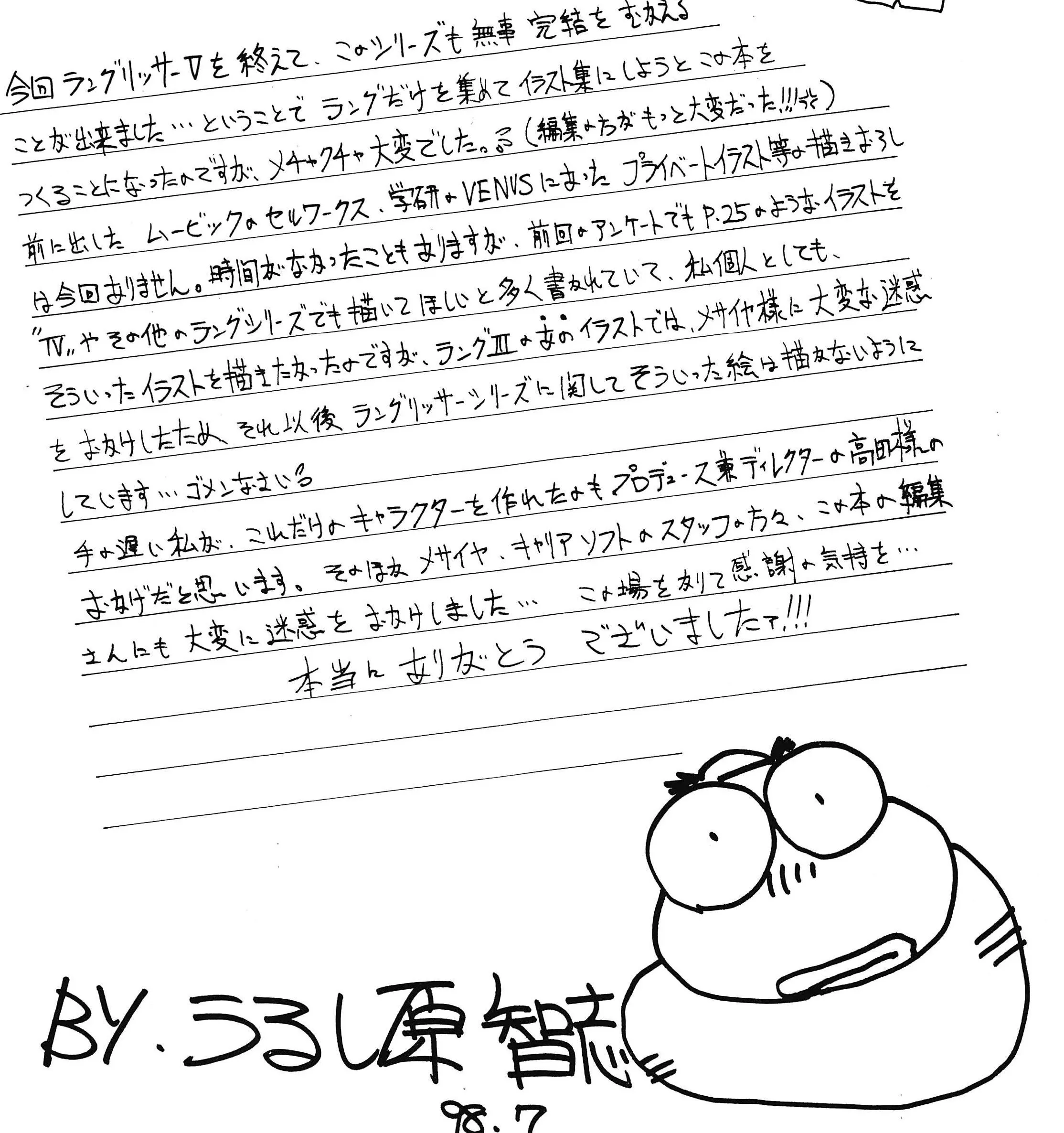
Urushihara’s handwritten afterword, signed and dated ’98.7. うるし原智志イラスト集 LEGEND OF LANGRISSER, Gakken (学習研究社), first printing August 14, 1998 · p. 105 (PDF 105) · © Satoshi Urushihara 1998, © NCS, © Career Soft, © 1998 GAKKEN..
What the pages say, and don’t
These pages record what Urushihara said about designing five Langrisser games, in his own notes, plus the book’s own lists. They give no sales figures for the games or the cards. The history lists Japanese releases only, so nothing here covers releases outside Japan.
Sources
- Legend of Langrisser — contents · Gakken · 1998 · page 4 · scan page 4
- Legend of Langrisser — III chapter note · Gakken · 1998 · page 5 · scan page 5
- Legend of Langrisser — I chapter note · Gakken · 1998 · page 29 · scan page 29
- Legend of Langrisser — II chapter note · Gakken · 1998 · page 41 · scan page 41
- Legend of Langrisser — Der Langrisser pack-in illustration · Gakken · 1998 · page 54 · scan page 54
- Legend of Langrisser — IV chapter note · Gakken · 1998 · page 57 · scan page 57
- Legend of Langrisser — V chapter note · Gakken · 1998 · page 70 · scan page 70
- Legend of Langrisser — History of Langrisser · Gakken · 1998 · page 99–102 · scan page 99
- Legend of Langrisser — trading-card checklist · Gakken · 1998 · page 103 · scan page 103
- Legend of Langrisser — first-appearance list · Gakken · 1998 · page 104 · scan page 104
- Legend of Langrisser — afterword · Gakken · 1998 · page 105 · scan page 105
- Legend of Langrisser — colophon and profile · Gakken · 1998 · page 106 · scan page 106
Artwork and toy photographs are credited reproductions from published sources.