From the archive Power Rangers
The Megazord That Never Was
In a 2002 Japanese art book, a page of robots drawn for Power Rangers' 1994 rollout carries one blunt caption: they went unused, and Dairenoh arrived as Thunder Megazord instead.
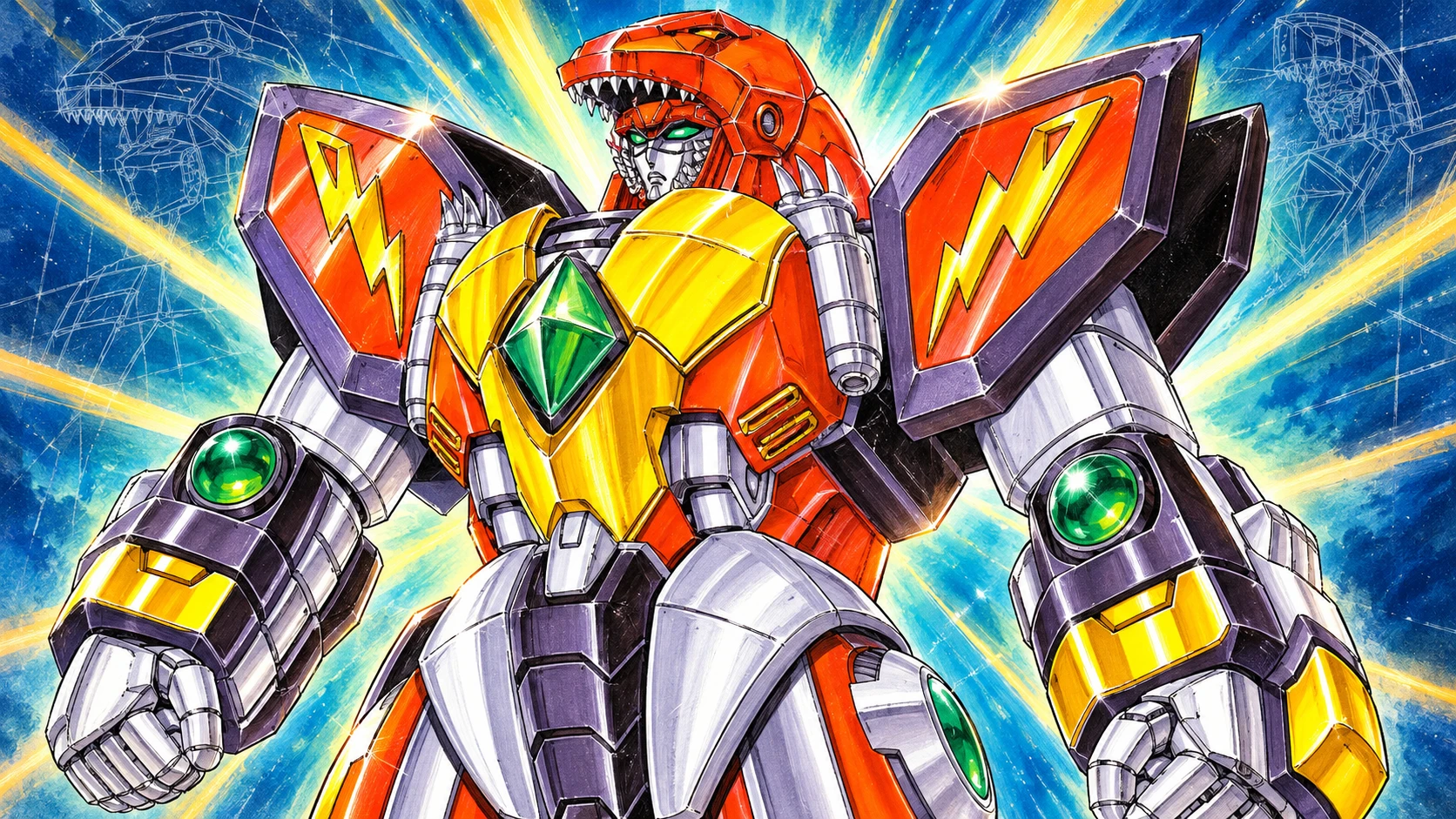
Original AI editorial cover inspired by the unused design. The credited historical drawing appears below.
AI cover illustration · Rewind: Northwest RetroDesign reference ↗01 Historical source
MediaWorks · p. 030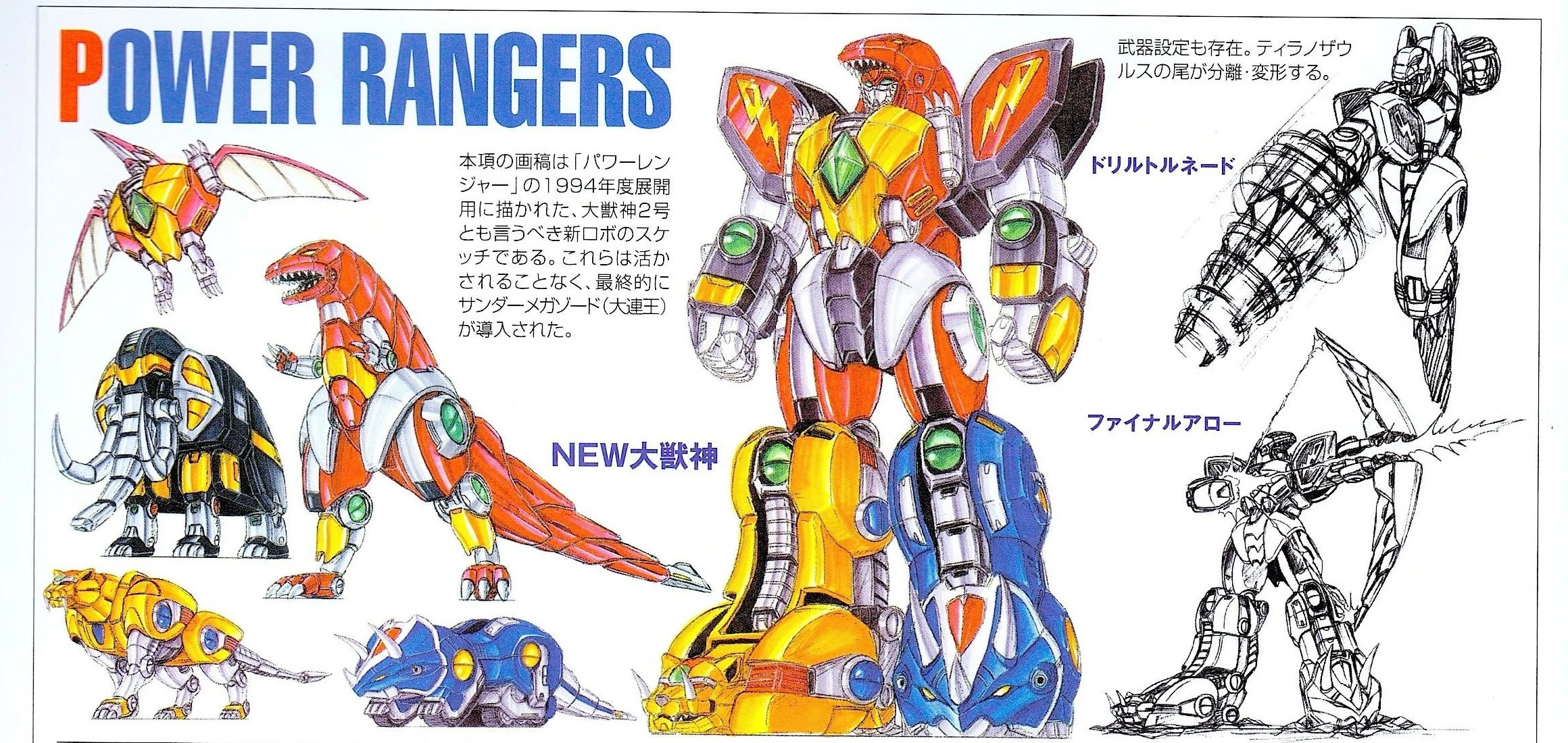
An unused robot design drawn for Power Rangers' 1994 rollout and labeled "NEW Daijuujin." The page caption says these sketches were not used, and that in the end Thunder Megazord (Dairenoh) was introduced (working translation). The book doesn't say these designs were ever prototyped.
Super Sentai Art Collection · MediaWorks, 2002 · printed p. 030 · PDF p. 38Start at the top of the page. A red tyrannosaurus forms a giant robot’s body, its open jaws framing the robot’s face like a helmet. A green jewel sits on a yellow chest. Orange shoulder plates carry lightning bolts, and one leg is yellow, the other blue. Across the top of the sheet, in tall letters, are two words you might not expect in a Japanese retrospective of Super Sentai robots: POWER RANGERS.
This Story follows that drawing, a second Power Rangers page from the same book, and two catalogs printed in 1994, one American and one Japanese. Together they document one link between our Dairanger galleries and the American show, and several resemblances the sources leave unexplained.
On the drawing board
The page is p. 030 of Super Sentai Art Collection: Sentai Robo Edition 1975–2002. Its main caption sits beside the tyrannosaurus: “The artwork in this section consists of sketches of a new robot, one that might be called Daijuujin No. 2, drawn for Power Rangers’ 1994 rollout. These were not put to use, and in the end Thunder Megazord (Dairenoh) was introduced.” Artbook, p. 030. (All Japanese quotations in this Story are working translations.)
Daijuujin is a Zyuranger robot, and the same book connects it to the American show. In its Zyuranger section, a boxed U.S. toy is captioned “Daijuujin, a.k.a. Megazord.” Artbook, p. 095. So the label on the main drawing, NEW 大獣神 (NEW Daijuujin), presents it as a second Daijuujin. By the book’s own equation of Daijuujin with Megazord, that makes it, in effect, a proposed new Megazord, though the page never uses the word.
Around it, a black mammoth, a yellow saber-toothed cat, a blue triceratops and a winged reptile are posed beside a red tyrannosaurus. Those identifications are ours, made from the drawings; the caption names only the Tyrannosaurus. A sketch at upper right shows the robot with a huge drill on one arm, labeled ドリルトルネード (Drill Tornado). Below it, the robot draws a bow labeled ファイナルアロー (Final Arrow). The note above them reads: “Weapon designs also exist. The Tyrannosaurus’s tail separates and transforms.” Another caption records that “three patterns were devised for the Tyrannosaurus alone,” and that TYPE-D “is characterized by an anime-like style.” The page shows TYPE-B, TYPE-C and a pencil TYPE-D beside the main design; it doesn’t spell out which drawings make up the three. Artbook, p. 030.
The lower half of the page changes animals. Under the label NEW 剛龍神 (NEW Goryujin), white robots stand beside a striped white tiger. The caption reads: “In line with Dairanger’s direction, new drawings were again made on the premise that the second robot would have a White Tiger motif. In each, [the tiger] becomes the core of the combination in place of the Tyrannosaurus.” Artbook, p. 030. The white armor and dark stripes may remind you of Won Tiger. The caption, though, ties these drawings only to Dairanger’s direction in general, not to Won Tiger by name.
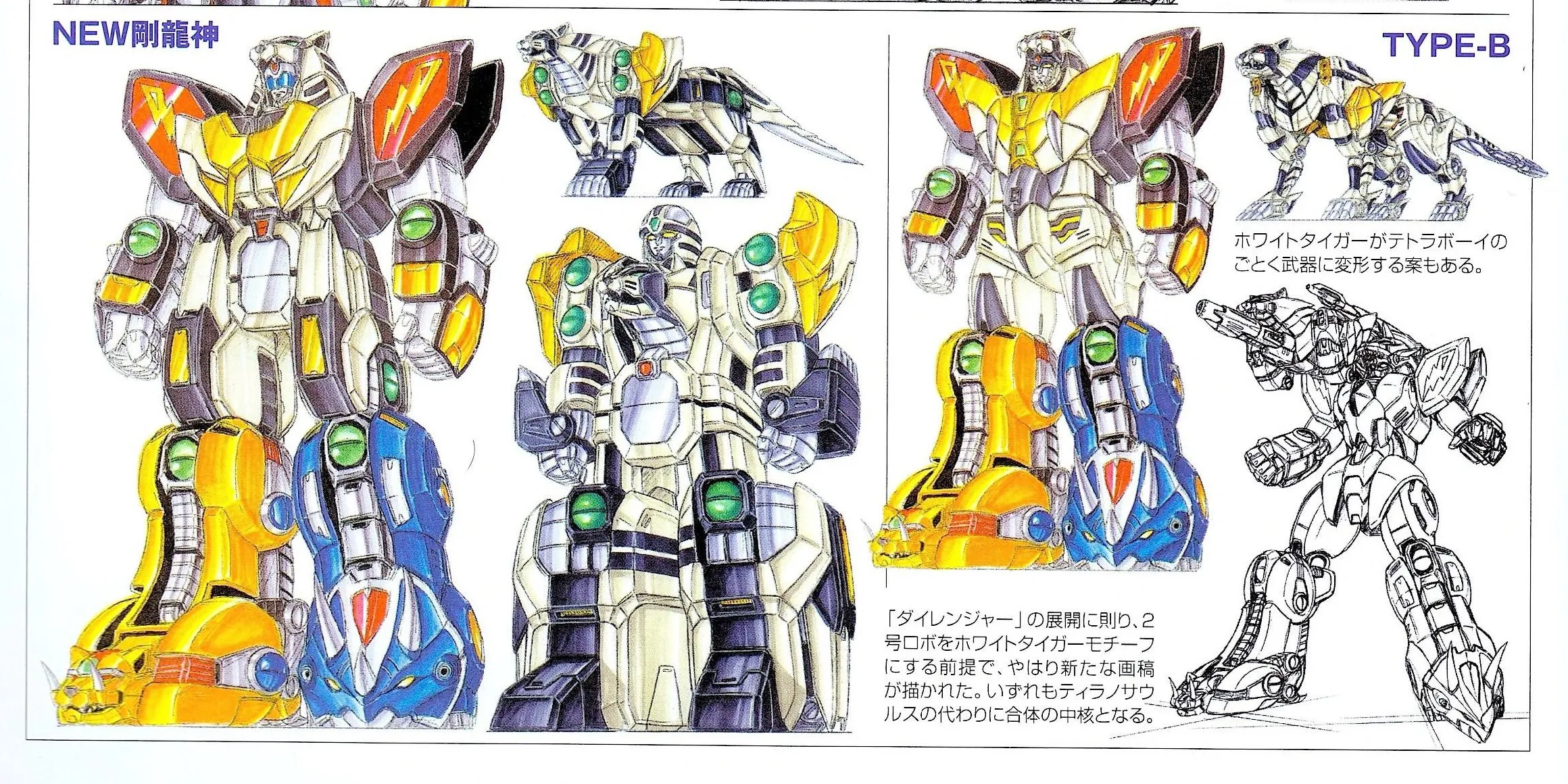
Drawings made, in line with Dairanger’s direction, for a second robot with a White Tiger motif. The caption says that in each version the tiger becomes the core of the combination in place of the Tyrannosaurus (working translation). The page links these drawings to Dairanger’s direction in general, not to Won Tiger by name. Super Sentai Art Collection · MediaWorks, 2002 · printed p. 030 · PDF p. 38.
The page doesn’t name who drew the designs or who asked for them. It doesn’t say why they were set aside, or whether any of them got past paper. Nothing on it indicates a prototype or a toy. The phrase we translate as “1994 rollout” (1994年度展開) uses 年度, which can mean a business or fiscal year. It gives no month.
Forty pages later, the book returns to the subject under the same POWER RANGERS heading. A pencil warrior and a clawed, long-tailed beast are labeled サムライゾード (Samurai Zord). The caption reads: “For Season 2 (corresponding to Dairanger), a character equivalent to Ryuseioh. Never appeared.” Nearby, a “NEW Titanus Variation” panel (the page glosses Titanus as King Brachion) is described as “variation proposals for Season 3 (corresponding to Kakuranger). In the end, it appeared as Titanus unchanged.” Artbook, p. 070. As on p. 030, these captions record designs that went unused. They don’t say why, or whether any went beyond drawings.
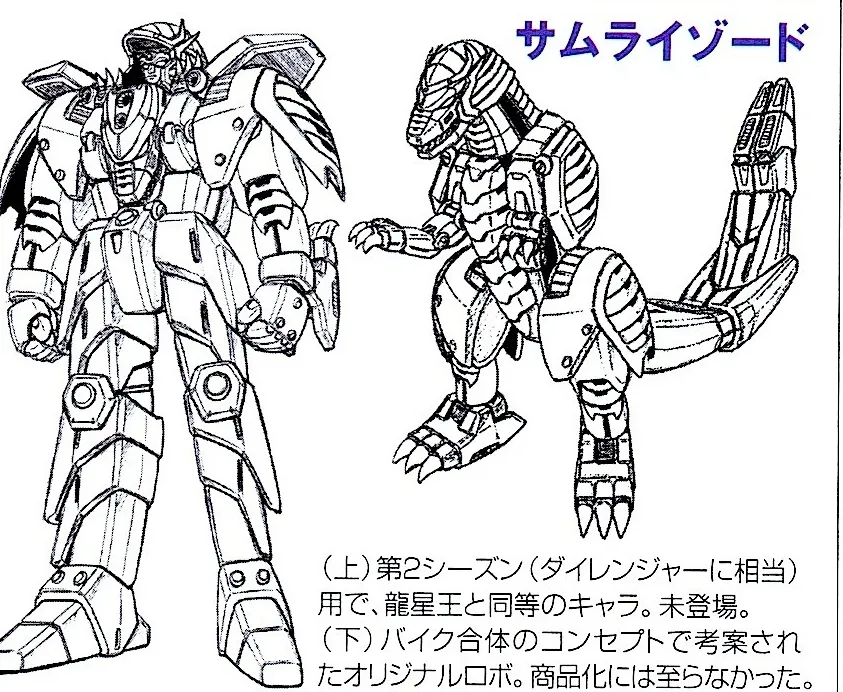
Samurai Zord’s warrior and beast proposals. The caption identifies it as a Season 2 character equivalent to Ryuseioh that never appeared. Super Sentai Art Collection · MediaWorks, 2002 · printed p. 070 / PDF p. 78.
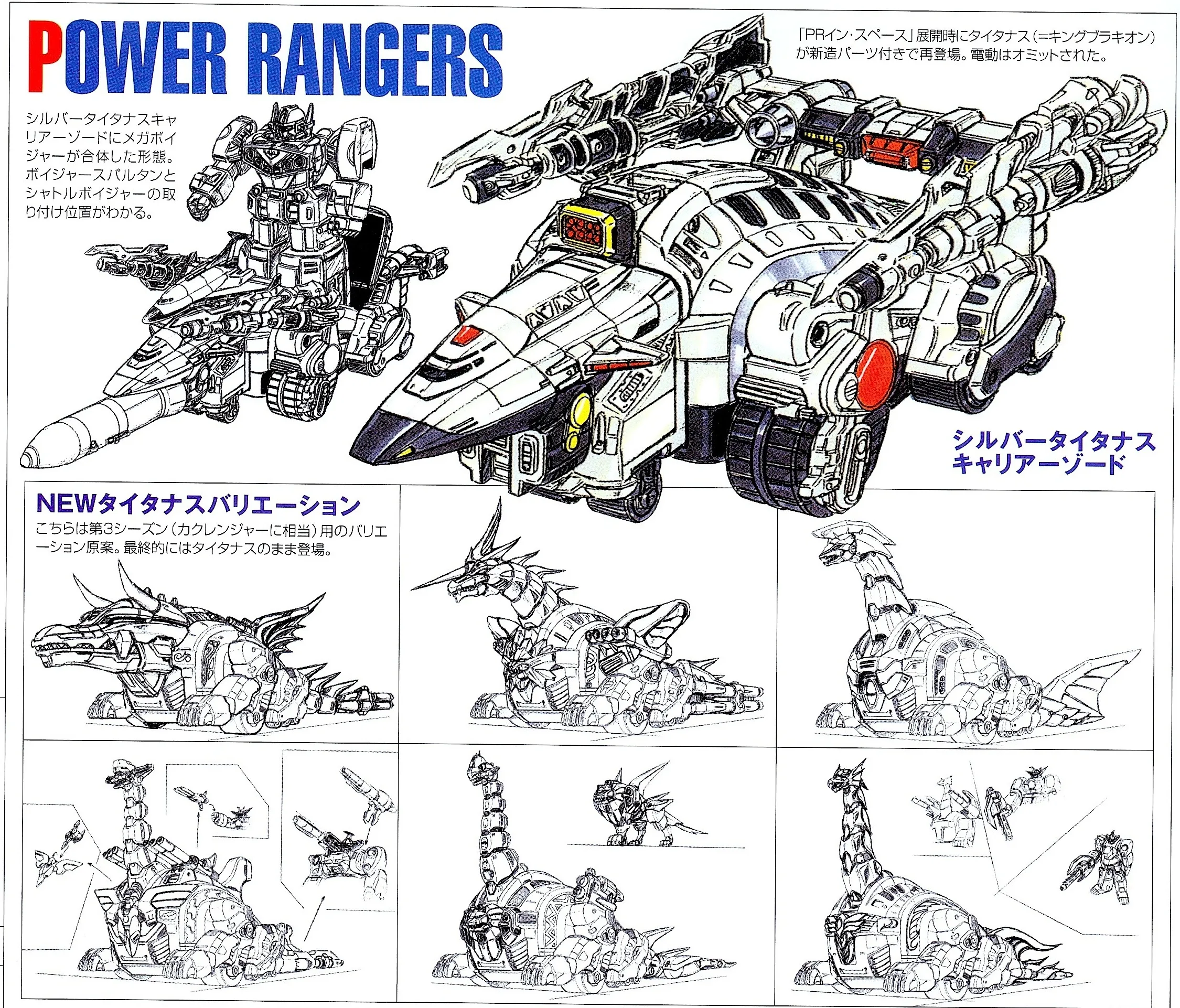
The upper Silver Titanus carrier provides page context; the six-panel NEW Titanus Variation section below it contains the Season 3 proposals discussed here. The caption says Titanus ultimately appeared unchanged. Super Sentai Art Collection · MediaWorks, 2002 · printed p. 070 / PDF p. 78.
In the catalogs
What did reach American shoppers? Page 561 of JCPenney’s 1994 Christmas Catalog opens with a row of four purple photo panels above a bold red “Power Rangers” headline. JCPenney 1994 Christmas Catalog, p. 561.
- Red Dragon Thunderzord, $19.99. It “morphs from sinuous dragon mode to imposing warrior mode” and includes a “power staff, red power crystal and miniature Red Ranger.”
- Thunderzord Assault Team, set $34.99: “Black Ranger’s Black Lion, Pink Ranger’s Firebird, Yellow Ranger’s Griffin and Blue Ranger’s Unicorn,” with a battle transport sled and a golden power sword.
- Tigerzord and White Ranger, $39.99. The White Tigerzord “morphs from ferocious tiger mode to battle-ready warrior with bright electronic light and sound.”
- Tor the Shuttlezord, $44.99, with “room in his cavernous shell to carry other Power Zords,” plus “loud battle cries” and a “glowing red light.”
Plus signs and arrows join the photos into combinations labeled Thunder Megazord, Mega Tigerzord and Thunder Ultrazord. For the Ultrazord the instruction is simply “To create order [H]-[K].” The fine print adds one more detail: Red Dragon and the Assault Team are listed as imported from Thailand, Tigerzord from China, and Tor from Mexico. JCPenney 1994 Christmas Catalog, p. 561.
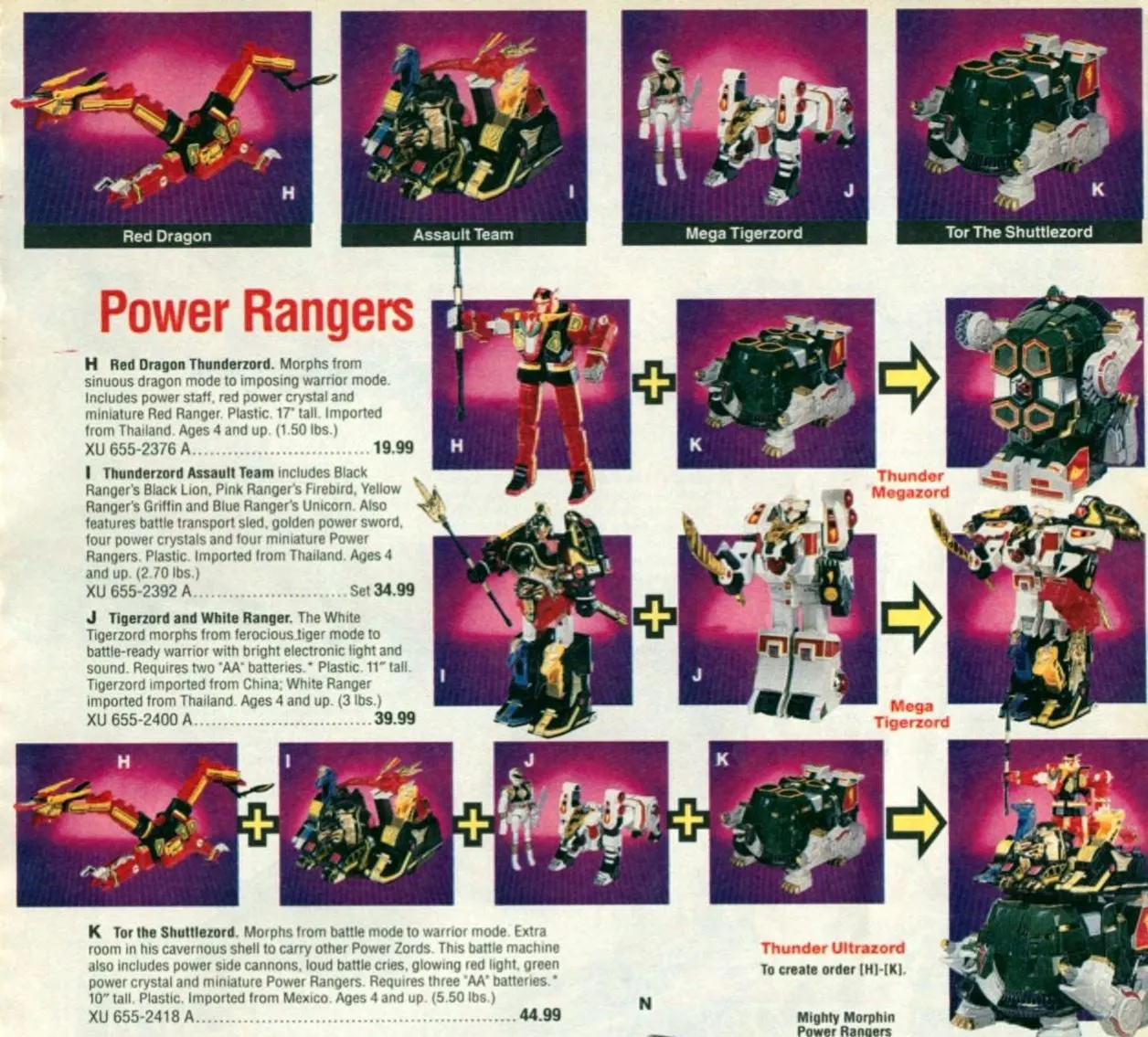
JCPenney’s 1994 Christmas Catalog sold the Thunderzords separately: Red Dragon for $19.99, the four-beast Assault Team for $34.99, Tigerzord with White Ranger for $39.99 and Tor the Shuttlezord for $44.99. Photos joined by plus signs and arrows show the combinations labeled Thunder Megazord, Mega Tigerzord and Thunder Ultrazord. JCPenney 1994 Christmas Catalog · J. C. Penney, 1994; scan via WishbookWeb.com · printed p. 561 · scan p. 558.
Now set the catalog beside the Japanese product notes. The art book says DX Ryuseioh came with a Ryuranger mini figure that can be placed on its head, and the photo shows the toy holding a long staff. Artbook, p. 079. Dairenoh forms when four companion beasts combine around Ryuseioh. They are a lion, a heavenly horse, a kirin and a phoenix. Artbook, pp. 080–081. The book credits DX Won Tiger with an EL unit providing light-and-sound features. Artbook, p. 083. The Seven-Star Combination caption says Won Tiger is held inside Daimugen’s body. Artbook, p. 085.
The parallels are easy to see: a dragon with a staff and a tiny Ranger figure, four creatures, a lit-up tiger, and a turtle-like shell with room inside. The catalog confirms what JCPenney offered and at what price. It doesn’t mention Dairanger or Bandai, and it doesn’t say these are the Japanese toys under new names. Among these Dairanger robots, only the art book makes an explicit link, and only for one: Thunder Megazord is Dairenoh. Artbook, p. 030. The other pairings are visible correspondences, not documented facts. The Seven-Star caption, for its part, describes a formation in the show, not a feature of the toy.
In the advertisement
This U.S. product commercial shows the released Red Dragon toy, its warrior form, and the companion toys assembling as Thunder Megazord. It illustrates the product that reached shelves after the unused proposals discussed above. The unreleased drawings are not presented as manufactured toys.
Across the Pacific
Bandai’s view from Japan appears on printed p. 113 of its 1994 catalogue. A note on the index page says the catalogue is current as of May 20, 1994 (平成6年5月20日). Bandai catalog, printed p. 114 / PDF p. 115. Power Rangers shares its single page with SHOT M78 merchandise and publishing.
The Mighty Morphin Power Rangers panel fills the lower half of p. 113. Five helmeted Rangers, arms crossed, crowd the foreground under the logo. A red vertical banner reads 遊びの楽しさを世界へ!: “Taking the fun of play to the world!” A photo shows a row of Ranger figures. The caption reads: “Our heroes are popular in America too! They’re thriving worldwide.” The credits read “©1993 Saban International Services, Inc.” and “©1992 TOEI COMPANY LTD.” Bandai catalog, printed p. 113 / PDF p. 114. The panel calls the Rangers “our heroes,” but it shows no Zords. It doesn’t mention Dairanger, and it offers no sales figures to back up “popular.”
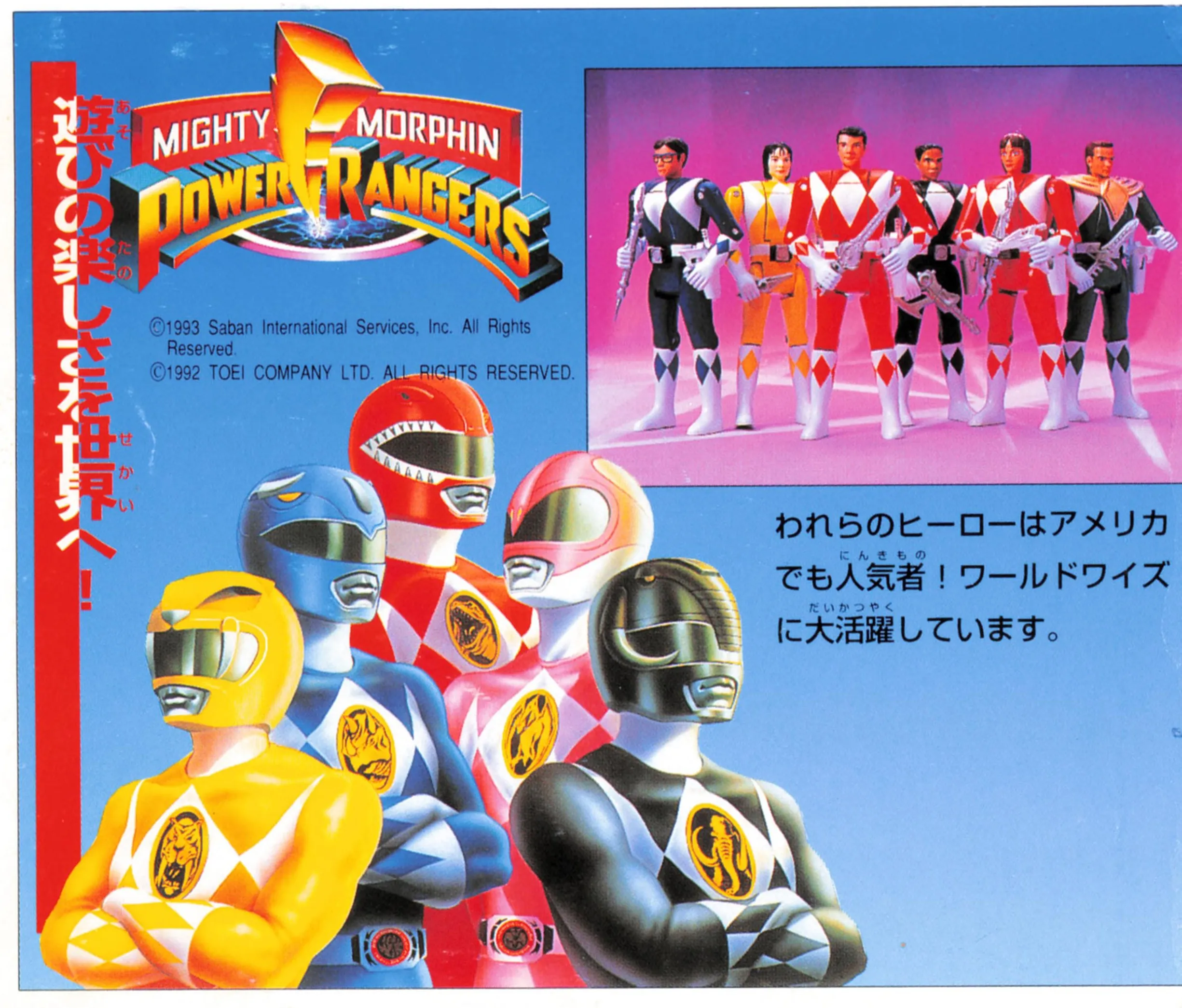
“Our heroes are popular in America too!” Bandai’s own 1994 catalogue gave Mighty Morphin Power Rangers part of a page under the banner “Taking the fun of play to the world!” (working translations). The panel shows the Rangers but no Zords. 1994 Bandai Catalogue · Bandai; scan by Gaming Alexandria · printed p. 113 · PDF p. 114.
The art book supplies a longer history. A box titled 戦隊ロボ海外展開2 in USA (“Sentai Robo Overseas Rollout 2: in USA”) says the U.S. story began separately from the shows, under the name “Godaikin,” with releases running from Daidenjin to Change Robo. It adds that Power Rangers, launched in 1993, was “now in its 10th year” as a popular series that was still running. Beside a boxed MEGAZORD set, the caption says its success as a big-hit product “is still fresh in memory.” Artbook, p. 095.
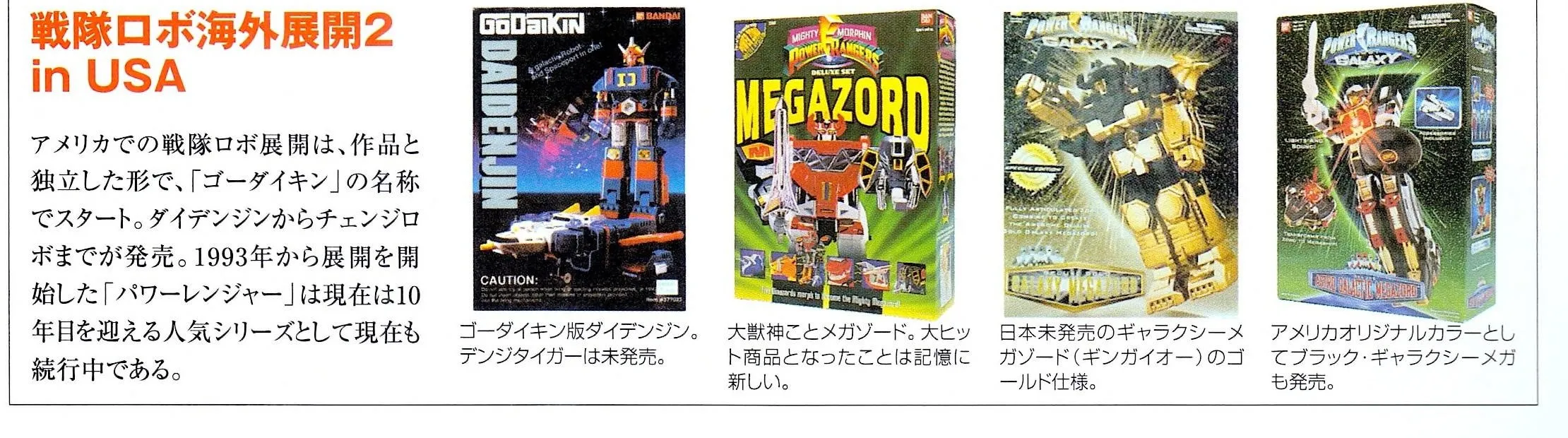
“Sentai Robo Overseas Rollout 2: in USA”: the art book’s short history of Sentai robots in the U.S., from Godaikin to Power Rangers. Beside the boxed MEGAZORD set, the caption calls Daijuujin “a.k.a. Megazord” and recalls its big-hit success (working translation). Super Sentai Art Collection · MediaWorks, 2002 · printed p. 095 · PDF p. 103.
Go back to page 030 one last time. As far as these sources show, the tyrannosaurus robot and the striped white tiger never left the page, and neither did the Samurai Zord on p. 070. The p. 030 caption ends with the robot that did: Dairenoh, the lion-faced warrior with blue-and-yellow legs on p. 080, now under a new name. Artbook, pp. 030, 080.
Related exhibits
- Dairenoh: the combined warrior that, according to the art book, was introduced as Thunder Megazord.
- Ryuseioh: the dragon with a staff and a Ryuranger mini figure, and the robot the unused Samurai Zord was drawn as an equivalent to.
- Won Tiger: the white tiger with light and sound.
- Daimugen: the turtle that carries Won Tiger inside the Seven-Star Combination.
Sources
- Super Sentai Art Collection: Sentai Robo Edition 1975–2002 — "POWER RANGERS ①," unused designs · MediaWorks · 2002 · page 030 · scan page 38
- Super Sentai Art Collection — Dairenoh and its DX toy · MediaWorks · 2002 · page 080 · scan page 88
- Super Sentai Art Collection — "POWER RANGERS," Samurai Zord and NEW Titanus Variation · MediaWorks · 2002 · page 070 · scan page 78
- Super Sentai Art Collection — Sentai Robo Overseas Rollout 2: in USA · MediaWorks · 2002 · page 095 · scan page 103
- Super Sentai Art Collection — Ryuseioh and DX toy · MediaWorks · 2002 · page 079 · scan page 87
- Super Sentai Art Collection — The Kiden Beasts and Tenku Kiden · MediaWorks · 2002 · page 081 · scan page 89
- Super Sentai Art Collection — Won Tiger and DX toy · MediaWorks · 2002 · page 083 · scan page 91
- Super Sentai Art Collection — Daimugen and Juko Kiden · MediaWorks · 2002 · page 085 · scan page 93
- JCPenney 1994 Christmas Catalog — Power Rangers · J. C. Penney · 1994 · page 561 · scan page 558
- 1994 Bandai Catalogue — Mighty Morphin Power Rangers panel · Bandai · 1994 · page 113 · scan page 114
- 1994 Bandai Catalogue — Index and "current as of May 20, 1994" note · Bandai · 1994 · page 114 · scan page 115
- Thunder Megazord product advertisement · Toy Command / YouTube
Artwork and toy photographs are credited reproductions from published sources.